



Katja Kleespies
@katjakleespies.bsky.social
Likes the brain. PhD candidate @UniFreiburg. She/her.
Additionally, sleep benefitted performance on a task that allowed the (C) cooperative use of explicit and implicit memory, and participants who slept showed (B) superior performance in generalizing their knowledge to unseen exemplars. (A) Sleep did not affect recognition memory performance.

February 26, 2025 at 9:45 AM
Additionally, sleep benefitted performance on a task that allowed the (C) cooperative use of explicit and implicit memory, and participants who slept showed (B) superior performance in generalizing their knowledge to unseen exemplars. (A) Sleep did not affect recognition memory performance.
This model showed that participants in the night-sleep group demonstrated better transfer of the acquired exemplar value representation from learning to testing compared to the day-wake group.

February 26, 2025 at 9:44 AM
This model showed that participants in the night-sleep group demonstrated better transfer of the acquired exemplar value representation from learning to testing compared to the day-wake group.
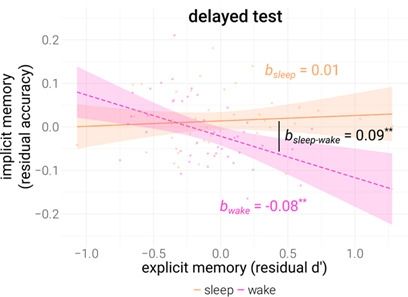
However, this initially competitive relationship was selectively resolved after a 12 h-consolidation interval including sleep but not after a day of wakefulness.
February 26, 2025 at 9:43 AM
However, this initially competitive relationship was selectively resolved after a 12 h-consolidation interval including sleep but not after a day of wakefulness.
Our main goal was to test how sleep modulates the relationship between explicit and implicit memory representations. Immediately after learning, the relationship between explicit and implicit aspects of participants' memory was competitive, as indicated by a significant negative relationship.

February 26, 2025 at 9:42 AM
Our main goal was to test how sleep modulates the relationship between explicit and implicit memory representations. Immediately after learning, the relationship between explicit and implicit aspects of participants' memory was competitive, as indicated by a significant negative relationship.
Memory tests that were designed to encourage the use of different explicit (exemplar-based) and implicit (information-integration learning) memory systems engaged different brain networks associated with (A) explicit recognition memory and (B) implicit information-integration learning, respectively.

February 26, 2025 at 9:37 AM
Memory tests that were designed to encourage the use of different explicit (exemplar-based) and implicit (information-integration learning) memory systems engaged different brain networks associated with (A) explicit recognition memory and (B) implicit information-integration learning, respectively.
(A) During task training, participants successfully learned about winning and losing exemplars. Moreover, validity of a (B) reinforcement learning (RL) model designed to predict participants’ behavior during later memory tests was confirmed by (C) good prediction of participants’ learning behavior.

February 26, 2025 at 9:36 AM
(A) During task training, participants successfully learned about winning and losing exemplars. Moreover, validity of a (B) reinforcement learning (RL) model designed to predict participants’ behavior during later memory tests was confirmed by (C) good prediction of participants’ learning behavior.