



@joshuapaleorojas.bsky.social
Paleontologist, naturalist, lover of life; science fiction, fantasy, Dragonball, and Godzilla fan. 🤓🦣🦕🦖🐉
United States. The third image shows Heterodontosaurus tucki, specimen labeled SAM-PK-K1332. Main matrix block: A: left side of block showing vertebral column, left pectoral girdle and forelimb with sternal plate, medial aspect of right femur (distal third) and

December 9, 2025 at 11:09 PM
United States. The third image shows Heterodontosaurus tucki, specimen labeled SAM-PK-K1332. Main matrix block: A: left side of block showing vertebral column, left pectoral girdle and forelimb with sternal plate, medial aspect of right femur (distal third) and
dryness - but with enough water for vegetation - digging burrows would be a good survival strategy. The second image shows a cast of specimen SAM-PK-K1332, displayed at the University of California Museum of Paleontology, located in Berkeley, California,

December 9, 2025 at 11:09 PM
dryness - but with enough water for vegetation - digging burrows would be a good survival strategy. The second image shows a cast of specimen SAM-PK-K1332, displayed at the University of California Museum of Paleontology, located in Berkeley, California,
The first image is a spectacular reconstruction of Heterodontosaurus tucki; by the talented artist @mariolanzas.bsky.social. Heterodontosaurus' holotype specimen - labeled SAM-PK-K337 - was unearthed during a British-South African expedition to South Africa and Lesotho in 1961 - 1962.

December 9, 2025 at 11:01 PM
The first image is a spectacular reconstruction of Heterodontosaurus tucki; by the talented artist @mariolanzas.bsky.social. Heterodontosaurus' holotype specimen - labeled SAM-PK-K337 - was unearthed during a British-South African expedition to South Africa and Lesotho in 1961 - 1962.
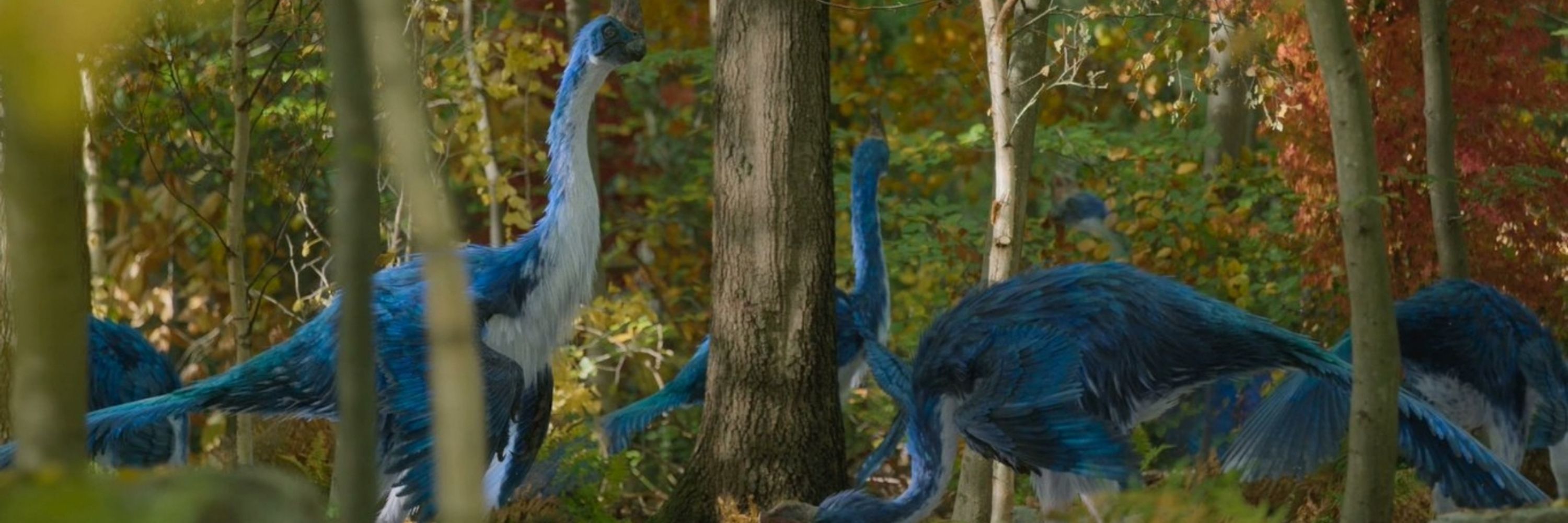
Possibly the most relatable scene in Prehistoric Planet: Ice Age. I can't help but imagine this being narrated with Kevin Hart's voice, “I'm a grown little man, watch these moves now baby, you can't handle this!" 🤓 🦕🦖
December 2, 2025 at 2:44 PM
Possibly the most relatable scene in Prehistoric Planet: Ice Age. I can't help but imagine this being narrated with Kevin Hart's voice, “I'm a grown little man, watch these moves now baby, you can't handle this!" 🤓 🦕🦖
To know that these scenes were happening just as Augustus of Prima Porta became the first Roman emperor. Or when China was in the late Eastern Han dynasty. Not in the last ice age, not so long ago at all... 😔


November 28, 2025 at 10:20 AM
To know that these scenes were happening just as Augustus of Prima Porta became the first Roman emperor. Or when China was in the late Eastern Han dynasty. Not in the last ice age, not so long ago at all... 😔
I can't get over how fantastic these giant moas look and how sad it is to think that they're just one of the few animals portrayed in this show who just existed in their habitat 600 - 500 years ago. 😍😢 🦤


November 8, 2025 at 3:44 AM
I can't get over how fantastic these giant moas look and how sad it is to think that they're just one of the few animals portrayed in this show who just existed in their habitat 600 - 500 years ago. 😍😢 🦤
It's finally here! The newest trailer for Prehistoric Planet: Ice Age! 🤓🦬🦣
November 6, 2025 at 7:13 PM
It's finally here! The newest trailer for Prehistoric Planet: Ice Age! 🤓🦬🦣
Belief in a flat Earth is one of the ultimate mind traps - a blind faith you've swallowed hook, line, and sinker from your echo-chamber indoctrination, starting with those shady YouTube rabbit holes you dove into during your late-night paranoia sessions in your mom's basement, amplified by fake "

November 4, 2025 at 3:25 PM
Belief in a flat Earth is one of the ultimate mind traps - a blind faith you've swallowed hook, line, and sinker from your echo-chamber indoctrination, starting with those shady YouTube rabbit holes you dove into during your late-night paranoia sessions in your mom's basement, amplified by fake "
A beautiful model of the newly named tyrannosaurid dinosaur, Nanotyrannus lethaeus (nicknamed, "Jane"), by Meta Natural Art. 🤓🦕🦖


November 1, 2025 at 2:27 PM
A beautiful model of the newly named tyrannosaurid dinosaur, Nanotyrannus lethaeus (nicknamed, "Jane"), by Meta Natural Art. 🤓🦕🦖
Happy Halloween to everyone!! 🎃 👻 🧙♂️🧛♂️🧛♀️🧝♂️🧝♀️🧞♀️🧟♂️🧟♀️🧌🦸♀️🦹♀️🦹♂️👽👹🧙♀️🧙

October 31, 2025 at 9:53 PM
Happy Halloween to everyone!! 🎃 👻 🧙♂️🧛♂️🧛♀️🧝♂️🧝♀️🧞♀️🧟♂️🧟♀️🧌🦸♀️🦹♀️🦹♂️👽👹🧙♀️🧙
For those who impose and continuously say that their fantasy book is 100% true. MAGA volunteers would be greatly appreciated. 🤣

October 31, 2025 at 3:53 PM
For those who impose and continuously say that their fantasy book is 100% true. MAGA volunteers would be greatly appreciated. 🤣
This is why I love paleontology. For over 20 years, I and most of my colleagues were skeptical about the validity of the genus Nanotyrannus. Now, say hello to Nanotyrannus lethaeus. The image below features a pack of these N. lethaeus attacking a juvenile T. rex. Art by Anthony Hutchings.

October 31, 2025 at 3:07 PM
This is why I love paleontology. For over 20 years, I and most of my colleagues were skeptical about the validity of the genus Nanotyrannus. Now, say hello to Nanotyrannus lethaeus. The image below features a pack of these N. lethaeus attacking a juvenile T. rex. Art by Anthony Hutchings.

Christian "science." For they hate true science and how it reveals that their book is a work of pure fiction.

October 26, 2025 at 2:45 PM
Christian "science." For they hate true science and how it reveals that their book is a work of pure fiction.
arch; ns, neural spine; prz, prezygapophysis; tp transverse process. Scale bar: 10 centimeters (only for image A). Photo credit: Mattia A. Baiano, Ignacio A. Cerda, Filippo Bertozzo, and Diego Pol, 2024. The fourth image shows a mounted skeleton reconstruction on display. Photo credit: Kabacchi,

October 22, 2025 at 9:48 PM
arch; ns, neural spine; prz, prezygapophysis; tp transverse process. Scale bar: 10 centimeters (only for image A). Photo credit: Mattia A. Baiano, Ignacio A. Cerda, Filippo Bertozzo, and Diego Pol, 2024. The fourth image shows a mounted skeleton reconstruction on display. Photo credit: Kabacchi,
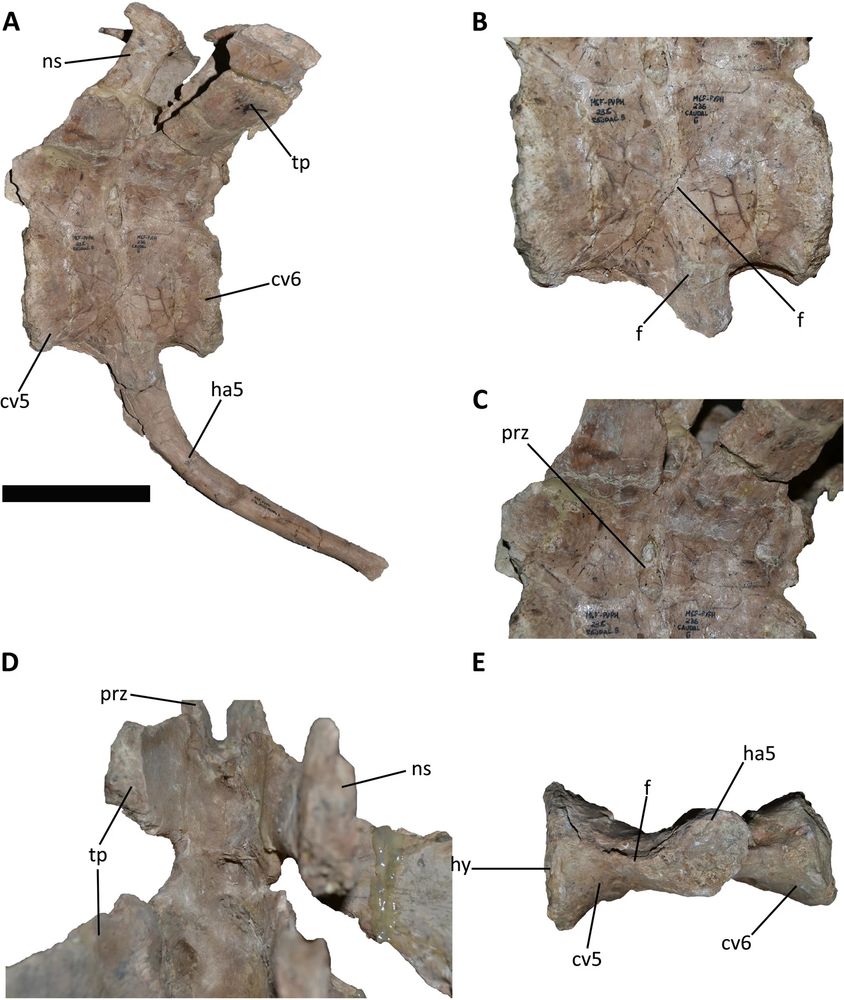
MCF-PVPH-236, in left lateral view; C and D, middle and posterior caudal vertebrae of Elemgasem nubilus MCF-PVPH-380, in left lateral view. Artwork by: (silhouette and skeleton) Alessio Ciaffi, 2024. The third image shows the fifth and sixth caudal vertebra and
October 22, 2025 at 9:47 PM
MCF-PVPH-236, in left lateral view; C and D, middle and posterior caudal vertebrae of Elemgasem nubilus MCF-PVPH-380, in left lateral view. Artwork by: (silhouette and skeleton) Alessio Ciaffi, 2024. The third image shows the fifth and sixth caudal vertebra and
was discovered. The second image shows the elements of Patagonian abelisaurids affected by pathology. A, right tibia of Quilmesaurus curriei MPCA-PV-100 in medial view; B, 5th and 6th caudal vertebrae and 5th haemal arch of Aucasaurus garridoi

October 22, 2025 at 9:46 PM
was discovered. The second image shows the elements of Patagonian abelisaurids affected by pathology. A, right tibia of Quilmesaurus curriei MPCA-PV-100 in medial view; B, 5th and 6th caudal vertebrae and 5th haemal arch of Aucasaurus garridoi
The first image is a wonderful reconstruction of the abelisaurid dinosaur, Aucasaurus garridoi; by the talented artist @serpenillus.bsky.social. The first (and only) fossils for Aucasaurus garridoi to be unearthed were discovered in the Rio Colorado Subgroup, in the Neuquen Basin of Argentina (

October 22, 2025 at 9:40 PM
The first image is a wonderful reconstruction of the abelisaurid dinosaur, Aucasaurus garridoi; by the talented artist @serpenillus.bsky.social. The first (and only) fossils for Aucasaurus garridoi to be unearthed were discovered in the Rio Colorado Subgroup, in the Neuquen Basin of Argentina (
The eighth image shows Riojavenatrix lacustris, left pedal elements. Metatarsal III (CPI 1640), I-2 phalanx (CPI 1647), phalanx III-1 (CPI 1645), phalanx III-3 (CPI 1646), and phalanx V-2 (or IV-3) (CPI 1648) in distal (A, L, R), dorsal (B, G, M, S, X), lateral (C, H, N, T, Y), ventral (D, I, P, V,

October 17, 2025 at 10:12 PM
The eighth image shows Riojavenatrix lacustris, left pedal elements. Metatarsal III (CPI 1640), I-2 phalanx (CPI 1647), phalanx III-1 (CPI 1645), phalanx III-3 (CPI 1646), and phalanx V-2 (or IV-3) (CPI 1648) in distal (A, L, R), dorsal (B, G, M, S, X), lateral (C, H, N, T, Y), ventral (D, I, P, V,
Ignacio Diaz-Martinez, Julio Company, Patxi Saez-Benito, Luis I Viera, Angelica Torices, and Xabier Pereda-Suberbiola, 2024. The seventh image shows Riojavenatrix lacustris, A-G, left astragalus and distal tibia (CPI 1638), and H-K, left calcaneum (CPI 1676) in anterior (A, H), lateral (B, I),

October 17, 2025 at 10:10 PM
Ignacio Diaz-Martinez, Julio Company, Patxi Saez-Benito, Luis I Viera, Angelica Torices, and Xabier Pereda-Suberbiola, 2024. The seventh image shows Riojavenatrix lacustris, A-G, left astragalus and distal tibia (CPI 1638), and H-K, left calcaneum (CPI 1676) in anterior (A, H), lateral (B, I),
Pereda-Suberbiola, 2024. The sixth image shows Riojavenatrix lacustris, right tibia (CPI 1642), left tibia and astragalus (CPI 1638), and left fibula (CPI 1639A-B) in anterior (A, E, K, P), lateral (B, F, L, Q), posterior (C, G, M, R), medial (D, H, N, S), proximal (I, J, O), and

October 17, 2025 at 10:08 PM
Pereda-Suberbiola, 2024. The sixth image shows Riojavenatrix lacustris, right tibia (CPI 1642), left tibia and astragalus (CPI 1638), and left fibula (CPI 1639A-B) in anterior (A, E, K, P), lateral (B, F, L, Q), posterior (C, G, M, R), medial (D, H, N, S), proximal (I, J, O), and
Patxi Saez-Benito, Luis I Viera, Angelica Torices, and Xabier Pereda-Suberbiola, 2024. The fifth image shows Riojavenatrix lacustris, left (CPI 1637) and right (CPI 1643) femora in anterior (A, E), lateral (B, F), posterior (C, G), medial (D, H), distal (I),

October 17, 2025 at 10:06 PM
Patxi Saez-Benito, Luis I Viera, Angelica Torices, and Xabier Pereda-Suberbiola, 2024. The fifth image shows Riojavenatrix lacustris, left (CPI 1637) and right (CPI 1643) femora in anterior (A, E), lateral (B, F), posterior (C, G), medial (D, H), distal (I),
Luis I Viera, Angelica Torices, and Xabier Pereda-Suberbiola, 2024. The fourth image shows Riojavenatrix lacustris, left pubis (CPI 1675A-B) and right ischium (CPI 1641A-B) in anterior (A, F, K, O), medial (B, G, L, P), lateral

October 17, 2025 at 10:04 PM
Luis I Viera, Angelica Torices, and Xabier Pereda-Suberbiola, 2024. The fourth image shows Riojavenatrix lacustris, left pubis (CPI 1675A-B) and right ischium (CPI 1641A-B) in anterior (A, F, K, O), medial (B, G, L, P), lateral
The third image shows Riojavenatrix lacustris, mid - to posterior dorsal vertebra (CPI 1677). A, anterior view. B, left lateral view. C, posterior view. Abbreviations: hy, hyposphene; ils, interspinous ligament scar; nc, neural canal; ns,

October 17, 2025 at 10:02 PM
The third image shows Riojavenatrix lacustris, mid - to posterior dorsal vertebra (CPI 1677). A, anterior view. B, left lateral view. C, posterior view. Abbreviations: hy, hyposphene; ils, interspinous ligament scar; nc, neural canal; ns,
second image shows the skeletal reconstruction of Riojavenatrix lacustris holotype (CPI 1637–1648 and CPI 1675–1677). The preserved material is coloured in fuchsia. Courtesy of Scott Hartman, 2024.

October 17, 2025 at 10:01 PM
second image shows the skeletal reconstruction of Riojavenatrix lacustris holotype (CPI 1637–1648 and CPI 1675–1677). The preserved material is coloured in fuchsia. Courtesy of Scott Hartman, 2024.