



Anders Jørgensen
@jorgenstein.bsky.social
Middle Breton, innit?
It would really be helpful if <y> was consistently used for /j/ and <i> for /i/, not just in initial position.
November 17, 2025 at 6:20 PM
It would really be helpful if <y> was consistently used for /j/ and <i> for /i/, not just in initial position.
It is unusual to find Breton words that are directly borrowed from Germanic. There is no trace of the word in French? Anyway, it does look like it requires *b (not *β) in the source language, but maybe one could get around that.
September 23, 2025 at 12:13 AM
It is unusual to find Breton words that are directly borrowed from Germanic. There is no trace of the word in French? Anyway, it does look like it requires *b (not *β) in the source language, but maybe one could get around that.
The noun *laμas was then used as the base for the verbal derivative seen in W llafasu and MCorn. lauasos.
September 22, 2025 at 10:08 PM
The noun *laμas was then used as the base for the verbal derivative seen in W llafasu and MCorn. lauasos.
Probably an old nominal derivative *lamassV- < *lema-stV- < PIE *(H)lemH-. The noun is still around in Middle Breton laffas /laμas/ 'raison, bon droit' (G 833, rhyme in /aμ/ and /as/). MBret. lafuaes (Ca.), laues (Cathech.) semingly end in /-ɛs/ for some reason (attraction to the suffix /-ɛθ/?)
September 22, 2025 at 10:08 PM
Probably an old nominal derivative *lamassV- < *lema-stV- < PIE *(H)lemH-. The noun is still around in Middle Breton laffas /laμas/ 'raison, bon droit' (G 833, rhyme in /aμ/ and /as/). MBret. lafuaes (Ca.), laues (Cathech.) semingly end in /-ɛs/ for some reason (attraction to the suffix /-ɛθ/?)
A personal favorite is the Breton verb laosk- (verbal noun leuskel) borrowed from laxicare. It shows syncope to *laxsk- and then the typical South-West Brittonic change of *xs to *u̯s, giving us Proto-Breton *lau̯sk-.
May 26, 2025 at 7:51 PM
A personal favorite is the Breton verb laosk- (verbal noun leuskel) borrowed from laxicare. It shows syncope to *laxsk- and then the typical South-West Brittonic change of *xs to *u̯s, giving us Proto-Breton *lau̯sk-.
Oh, so the actual cognate in Danish would be grøntøj (which doesn't exist)?
January 30, 2025 at 5:11 PM
Oh, so the actual cognate in Danish would be grøntøj (which doesn't exist)?
Cognate with Danish grøn(t)sag, Swedish grönsak 'vegetable'? (and I guess then that these are calqued on some German word)
January 30, 2025 at 5:02 PM
Cognate with Danish grøn(t)sag, Swedish grönsak 'vegetable'? (and I guess then that these are calqued on some German word)
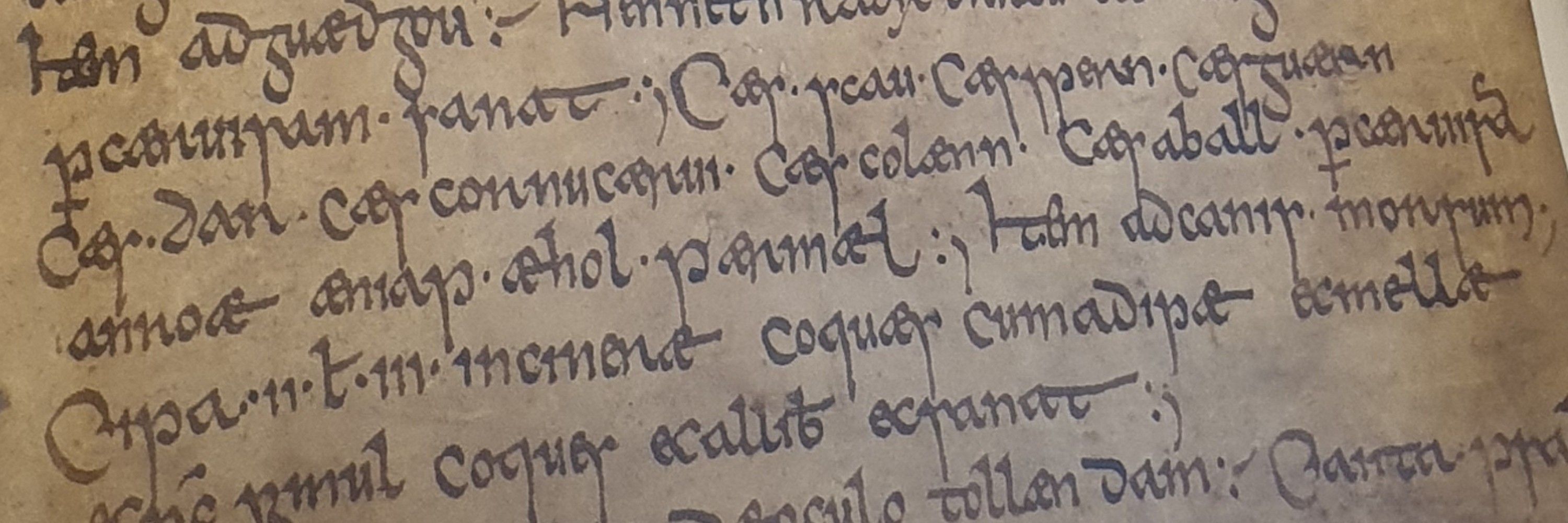
Given the translation tonsa, we would expect *guelcheñ < *wölt-i̯-enn (cf. Ca. guilchat 'to cut, to shear'), but that's not what we have.
January 16, 2025 at 2:17 PM
Given the translation tonsa, we would expect *guelcheñ < *wölt-i̯-enn (cf. Ca. guilchat 'to cut, to shear'), but that's not what we have.
It is difficult to see why this should be the case for hej-, however. So even if I don't have a good alternative etymology, I remain quite skeptical about the connection with Fr. hoch-.
December 20, 2024 at 12:12 AM
It is difficult to see why this should be the case for hej-, however. So even if I don't have a good alternative etymology, I remain quite skeptical about the connection with Fr. hoch-.
The reason for the generalization of i-affection in this particular verb may be that it is an old stative verb, with an aor. in *-ī-ss-, as opposed to the denom./caus./iter. type with aor. in *-e-ss-. So there were more forms around in the paradigm of teñv- to cause it to generalize i-affection.
December 20, 2024 at 12:12 AM
The reason for the generalization of i-affection in this particular verb may be that it is an old stative verb, with an aor. in *-ī-ss-, as opposed to the denom./caus./iter. type with aor. in *-e-ss-. So there were more forms around in the paradigm of teñv- to cause it to generalize i-affection.
The closest thing to a parallel might be tiñvañ, teñvañ 'to scar (of a wound)' < *tüμ-/tuμ-. This probably comes from a PCelt. stative verb *tum-ī- 'to grow'.
December 20, 2024 at 12:12 AM
The closest thing to a parallel might be tiñvañ, teñvañ 'to scar (of a wound)' < *tüμ-/tuμ-. This probably comes from a PCelt. stative verb *tum-ī- 'to grow'.
However, this is not otherwise how this type of verb develops. I MBret. and much of ModBret. the alternation in such verbs is preserved and when we see generalization of one of the allomorphs, it is the one without i-affection, as seen in K(T) digoriñ. alongside the usual digeriñ, digor-.

December 20, 2024 at 12:12 AM
However, this is not otherwise how this type of verb develops. I MBret. and much of ModBret. the alternation in such verbs is preserved and when we see generalization of one of the allomorphs, it is the one without i-affection, as seen in K(T) digoriñ. alongside the usual digeriñ, digor-.
If we anyway assume that we once had *hejiñ, hoj-, we would have to assume that the form hej- with i-affection had been generalized everywhere (with the exception of hoj- very locally in L).
December 20, 2024 at 12:12 AM
If we anyway assume that we once had *hejiñ, hoj-, we would have to assume that the form hej- with i-affection had been generalized everywhere (with the exception of hoj- very locally in L).
Then there is the (I suppose analogical) internal i-affection. That might be explained if the verbal noun was in -iff/-iñ, but the only place where we find the reflex of that vn ending is in Vannetais, where it has been generalized in most verbs anyway. Strange that there is no trace of it elsewhere
December 20, 2024 at 12:12 AM
Then there is the (I suppose analogical) internal i-affection. That might be explained if the verbal noun was in -iff/-iñ, but the only place where we find the reflex of that vn ending is in Vannetais, where it has been generalized in most verbs anyway. Strange that there is no trace of it elsewhere
Taking hej- as a borrowing from Fr. hoch- leaves us with a number of complications. First of all Fr. -ch- > Br. -j-, but let's set that aside.
December 20, 2024 at 12:12 AM
Taking hej- as a borrowing from Fr. hoch- leaves us with a number of complications. First of all Fr. -ch- > Br. -j-, but let's set that aside.
Yeah, genel just has internal i-aff., plenty of other forms of the verb are in gan- in Breton.
Sometimes OBret. glosses are abbreviated. I don't know if that is the case for this particular ms., but if so, it could just be for <gen[itic]> /genidig/ < *gẹn-ẹtig, cf. MBret. guinydic 'natale, natif de'
Sometimes OBret. glosses are abbreviated. I don't know if that is the case for this particular ms., but if so, it could just be for <gen[itic]> /genidig/ < *gẹn-ẹtig, cf. MBret. guinydic 'natale, natif de'
December 18, 2024 at 10:56 PM
Yeah, genel just has internal i-aff., plenty of other forms of the verb are in gan- in Breton.
Sometimes OBret. glosses are abbreviated. I don't know if that is the case for this particular ms., but if so, it could just be for <gen[itic]> /genidig/ < *gẹn-ẹtig, cf. MBret. guinydic 'natale, natif de'
Sometimes OBret. glosses are abbreviated. I don't know if that is the case for this particular ms., but if so, it could just be for <gen[itic]> /genidig/ < *gẹn-ẹtig, cf. MBret. guinydic 'natale, natif de'
Maybe, but I doubt that there was ever new lenition of medial /ʃ/. Are we sure about the etymology of hej-? As for orjal, might there have been a (south-western?) French variant around with lenition preceding syncope? I don't think one such is attested, but it should be possible, shouldn't it?
December 18, 2024 at 10:20 PM
Maybe, but I doubt that there was ever new lenition of medial /ʃ/. Are we sure about the etymology of hej-? As for orjal, might there have been a (south-western?) French variant around with lenition preceding syncope? I don't think one such is attested, but it should be possible, shouldn't it?
As for *ong-, it was meant as a last resort, if the etymology is to be maintained, hence the question mark. I guess it is otherwise after labials that we find oC' > aC'?
December 17, 2024 at 7:43 PM
As for *ong-, it was meant as a last resort, if the etymology is to be maintained, hence the question mark. I guess it is otherwise after labials that we find oC' > aC'?
But a scenario where the pal. was completely secondary (on analogy with e.g. carpat, cairptiu), one could reconstruct an original back-vowel in the second syllable, which might allow for *ango/al-. But even that might be fronted to *e/ing-, depending on what we believe about the dev. of *ang-.
December 17, 2024 at 7:43 PM
But a scenario where the pal. was completely secondary (on analogy with e.g. carpat, cairptiu), one could reconstruct an original back-vowel in the second syllable, which might allow for *ango/al-. But even that might be fronted to *e/ing-, depending on what we believe about the dev. of *ang-.
No, that's why I hedged a bit and mentioned the difficulties associated with the various reconstructions. The pal. would have to be secondarily generated when syncopating (in ADpl.) and then generalized, but I realize that this kind of spread of palatalization is not necessarily commonly accepted.
December 17, 2024 at 7:43 PM
No, that's why I hedged a bit and mentioned the difficulties associated with the various reconstructions. The pal. would have to be secondarily generated when syncopating (in ADpl.) and then generalized, but I realize that this kind of spread of palatalization is not necessarily commonly accepted.
But is there actual evidence for a *gʷ in 'fire' or is it also reconstructed in order to avoid positing a plain velar? I would tend to agree that *gʷ is most likely, but can *g be excluded?
BTW, I take it that the glossary word ong gl. teallach te may be disregarded?
BTW, I take it that the glossary word ong gl. teallach te may be disregarded?
December 16, 2024 at 9:07 PM
But is there actual evidence for a *gʷ in 'fire' or is it also reconstructed in order to avoid positing a plain velar? I would tend to agree that *gʷ is most likely, but can *g be excluded?
BTW, I take it that the glossary word ong gl. teallach te may be disregarded?
BTW, I take it that the glossary word ong gl. teallach te may be disregarded?
But isn't this reconstruction just to avoid positing a plain velar? Or is there a root connection supporting *gʷ? Sure plain velars are not that common, but we have to reconstruct them (or formulate some kind of depalatalization in spec. environments, e.g. before liquids)
December 16, 2024 at 8:46 PM
But isn't this reconstruction just to avoid positing a plain velar? Or is there a root connection supporting *gʷ? Sure plain velars are not that common, but we have to reconstruct them (or formulate some kind of depalatalization in spec. environments, e.g. before liquids)
😀 But yeah, it does feel a bit like folk etymology.
December 16, 2024 at 8:26 PM
😀 But yeah, it does feel a bit like folk etymology.