



Jordan Moffatt
@jordanmoffatt.bsky.social
Writer (municipal issues and cycling in Ottawa), author (fiction)
Website: https://jordanmoffatt.website/
Newsletter: https://jordobicycles.substack.com/
Website: https://jordanmoffatt.website/
Newsletter: https://jordobicycles.substack.com/
I think you're right that it's different than contemporary angular planes, but the language of the section is quite... complex.
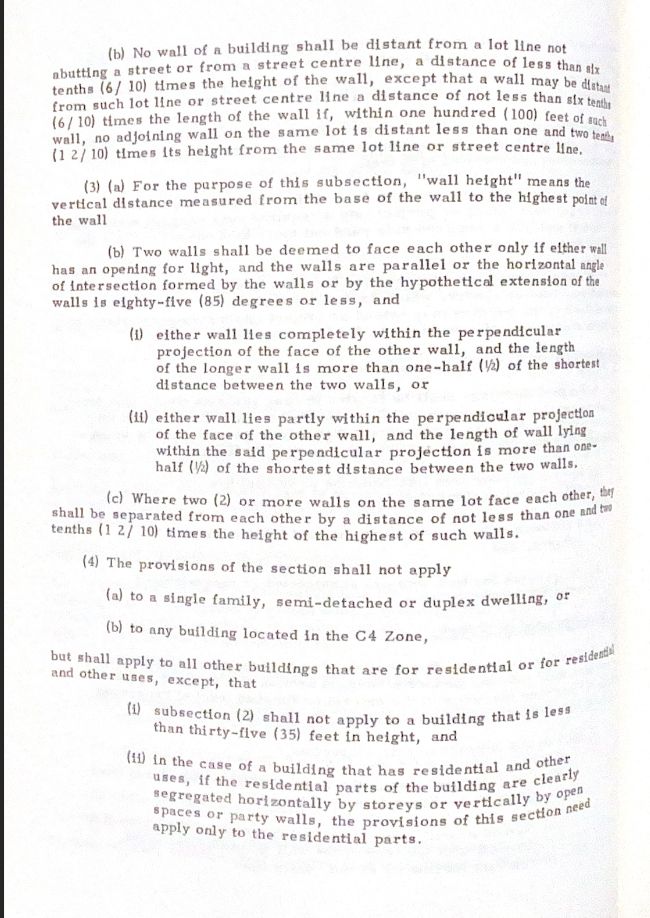
December 10, 2025 at 2:51 AM
I think you're right that it's different than contemporary angular planes, but the language of the section is quite... complex.
Bylaw 68-63, Ottawa's draft first comprehensive zoning bylaw that Bacon reviewed, contained its own angular plane control. (The first comprehensive zoning bylaw proposed in the 1920s, written by Noulan Cauchon, also had an angular plane control—which he said stemmed from the "ancient laws of light")
December 10, 2025 at 2:20 AM
Bylaw 68-63, Ottawa's draft first comprehensive zoning bylaw that Bacon reviewed, contained its own angular plane control. (The first comprehensive zoning bylaw proposed in the 1920s, written by Noulan Cauchon, also had an angular plane control—which he said stemmed from the "ancient laws of light")
And lastly, not related to Ottawa, here’s a video of Edmund Bacon 40 years after his Ottawa trip, at age 92, skateboarding in Philadelphia’s Love Park to protest a bylaw banning it. "My whole damn life has been worth it just for this moment! www.youtube.com/watch?v=GQsF...

Edmund Bacon skateboards in Love Park
YouTube video by Skate Bylines
www.youtube.com
December 9, 2025 at 10:29 PM
And lastly, not related to Ottawa, here’s a video of Edmund Bacon 40 years after his Ottawa trip, at age 92, skateboarding in Philadelphia’s Love Park to protest a bylaw banning it. "My whole damn life has been worth it just for this moment! www.youtube.com/watch?v=GQsF...
Altogether, the work by Bacon and Matthew cost taxpayers $4,124.73 ($40,000 today). Their report may not have made a big impact on Ottawa's first zoning bylaw, but the saga showed that the voices of external experts carried less weight than the perceived wants and desires of suburban homeowners.

December 9, 2025 at 10:29 PM
Altogether, the work by Bacon and Matthew cost taxpayers $4,124.73 ($40,000 today). Their report may not have made a big impact on Ottawa's first zoning bylaw, but the saga showed that the voices of external experts carried less weight than the perceived wants and desires of suburban homeowners.
Bacon was a admirer of Parliament Hill’s gothic architecture, calling it “one of the finest expressions of Victorian exuberance in the world.” During his early December stay at the Chateau Laurier, he took many snowy pictures of the buildings. You can view them here: www.flickr.com/photos/ed_ba...

December 9, 2025 at 10:29 PM
Bacon was a admirer of Parliament Hill’s gothic architecture, calling it “one of the finest expressions of Victorian exuberance in the world.” During his early December stay at the Chateau Laurier, he took many snowy pictures of the buildings. You can view them here: www.flickr.com/photos/ed_ba...
One of Bacon’s ideas was adopted, however: pegging the maximum building heights downtown to top of the Peace Tower. He’d already used that idea back home in Philadelphia, where building heights were capped to the tip of William Penn’s hat on city hall (over 200 feet higher than the Peace Tower).

December 9, 2025 at 10:29 PM
One of Bacon’s ideas was adopted, however: pegging the maximum building heights downtown to top of the Peace Tower. He’d already used that idea back home in Philadelphia, where building heights were capped to the tip of William Penn’s hat on city hall (over 200 feet higher than the Peace Tower).
The report also cautioned against Ottawa's foray into comprehensive zoning becoming a "straight-jacket inhibiting new and better forms of development." You be the judge on the city's success on that front.
December 9, 2025 at 10:29 PM
The report also cautioned against Ottawa's foray into comprehensive zoning becoming a "straight-jacket inhibiting new and better forms of development." You be the judge on the city's success on that front.
Bacon and Matthew also recommended the zoning bylaw allow narrow sideyard setbacks, ditch the angular plane, and permit rowhouses city wide. Ottawa’s planners dismissed these ideas, as they “would not be acceptable in suburban Ottawa.”
December 9, 2025 at 10:29 PM
Bacon and Matthew also recommended the zoning bylaw allow narrow sideyard setbacks, ditch the angular plane, and permit rowhouses city wide. Ottawa’s planners dismissed these ideas, as they “would not be acceptable in suburban Ottawa.”
The report suggested Ottawa limit parking downtown and encourage pedestrian movement. This didn’t pan out. Ten years after the bylaw was adopted, the core was littered with surface parking—producing the “dead areas” Bacon warned about.

December 9, 2025 at 10:29 PM
The report suggested Ottawa limit parking downtown and encourage pedestrian movement. This didn’t pan out. Ten years after the bylaw was adopted, the core was littered with surface parking—producing the “dead areas” Bacon warned about.
Bacon, in Ottawa for six days, was joined by Sir Robert Matthew, a renowned Scottish architect. Together they produced a 6 page report whose recommendations were largely rejected by Ottawa’s planners, who said the consultants didn’t appreciate local history or understand "the Ottawa experience".
December 9, 2025 at 10:29 PM
Bacon, in Ottawa for six days, was joined by Sir Robert Matthew, a renowned Scottish architect. Together they produced a 6 page report whose recommendations were largely rejected by Ottawa’s planners, who said the consultants didn’t appreciate local history or understand "the Ottawa experience".
Jane Jacobs, obviously a critic of planning at the time, gave Bacon some faint praise in The Death and Life of Great American Cities, saying his planning department "is widely admired as one of the best in the country, and it probably is, considering."
December 9, 2025 at 10:29 PM
Jane Jacobs, obviously a critic of planning at the time, gave Bacon some faint praise in The Death and Life of Great American Cities, saying his planning department "is widely admired as one of the best in the country, and it probably is, considering."
52 years ago this month, Edmund N. Bacon—father of Kevin Bacon—came to Ottawa to provide the city with advice as it prepared its first comprehensive zoning bylaw in 1963. Bacon was the Planning Commissioner in Philadelphia, and landed on the cover of Time Magazine a year later.

December 9, 2025 at 10:29 PM
52 years ago this month, Edmund N. Bacon—father of Kevin Bacon—came to Ottawa to provide the city with advice as it prepared its first comprehensive zoning bylaw in 1963. Bacon was the Planning Commissioner in Philadelphia, and landed on the cover of Time Magazine a year later.
Similar process occured in Ottawa during its first comprehensive zoning in '64. City planners pushed to bar neighbourhood retail in places like Little Italy, considering stores and light industrial "undesirable intrusions into what would otherwise be a relatively good and homogenous area."
November 5, 2025 at 8:11 PM
Similar process occured in Ottawa during its first comprehensive zoning in '64. City planners pushed to bar neighbourhood retail in places like Little Italy, considering stores and light industrial "undesirable intrusions into what would otherwise be a relatively good and homogenous area."
(Of course, as @jm-mcgrath.bsky.social has said, planning reform is cautious because “[municipalities] want the obstruction the current system creates.” The provincial government may feel the same. And so do many residents.)
October 27, 2025 at 12:41 PM
(Of course, as @jm-mcgrath.bsky.social has said, planning reform is cautious because “[municipalities] want the obstruction the current system creates.” The provincial government may feel the same. And so do many residents.)
In this way, Ontario municipalities can actually get the housing it needs built—by simplifying and standardizing rules, putting overall decision making at the right level, clearing roadblocks—while also giving communities autonomy and making citizens feel their voice matters where they live.
October 24, 2025 at 6:41 PM
In this way, Ontario municipalities can actually get the housing it needs built—by simplifying and standardizing rules, putting overall decision making at the right level, clearing roadblocks—while also giving communities autonomy and making citizens feel their voice matters where they live.
…But the implementation of these policies should come at the local level through a CPPS. Communities would work to create a land use plan that applies to their neighbourhoods in a way that reaches upper-level gov’t goals; development that meets the plans should proceed without further interference.
October 24, 2025 at 6:41 PM
…But the implementation of these policies should come at the local level through a CPPS. Communities would work to create a land use plan that applies to their neighbourhoods in a way that reaches upper-level gov’t goals; development that meets the plans should proceed without further interference.
To that end, the overall growth policies and goals should come from the province (as is currently the case with the PPS, but could also be expanded, as @jm-mcgrath suggests, with new standards for official plans and building regulations)…
October 24, 2025 at 6:41 PM
To that end, the overall growth policies and goals should come from the province (as is currently the case with the PPS, but could also be expanded, as @jm-mcgrath suggests, with new standards for official plans and building regulations)…
But going to far in this direction ignores geography: local planning drives passion because people feel a connection to where they live. That’s good. Debates over land use issues shouldn’t be removed from the local, but widened to involve more people and be redirected to where it’s most useful.
October 24, 2025 at 6:41 PM
But going to far in this direction ignores geography: local planning drives passion because people feel a connection to where they live. That’s good. Debates over land use issues shouldn’t be removed from the local, but widened to involve more people and be redirected to where it’s most useful.
I agree that giving the province more power here would blunt much of the incumbent homeowner hostility to proximate growth (aka NIMBYism). Locally unpopular policies are most successful when they are implemented by governments removed from local decision-makers.
October 24, 2025 at 6:41 PM
I agree that giving the province more power here would blunt much of the incumbent homeowner hostility to proximate growth (aka NIMBYism). Locally unpopular policies are most successful when they are implemented by governments removed from local decision-makers.
Another way to slow development is to put it in the hands of local interests. To fix this, you would upload responsibility for local planning to upper-tier governments, making decisions more impartial and regulations more standardized. This is @jm-mcgrath’s argument.
October 24, 2025 at 6:41 PM
Another way to slow development is to put it in the hands of local interests. To fix this, you would upload responsibility for local planning to upper-tier governments, making decisions more impartial and regulations more standardized. This is @jm-mcgrath’s argument.
If you want to slow housing construction, you’d add regulations, increase checkpoints for consultation, and provide opportunities for appeal. The approach I advocated in the Globe was to simplify the rules, put all consultation up front, and limit appeals on projects that reasonably meet standards.
October 24, 2025 at 6:41 PM
If you want to slow housing construction, you’d add regulations, increase checkpoints for consultation, and provide opportunities for appeal. The approach I advocated in the Globe was to simplify the rules, put all consultation up front, and limit appeals on projects that reasonably meet standards.
The problem both pieces look to address is the same: It’s very hard to actually build the type of housing that cities say they ostensibly want, i.e., “gentle density” or missing middle housing within existing low-density neighbourhoods. The planning status quo does not work to achieve this aim.
October 24, 2025 at 6:41 PM
The problem both pieces look to address is the same: It’s very hard to actually build the type of housing that cities say they ostensibly want, i.e., “gentle density” or missing middle housing within existing low-density neighbourhoods. The planning status quo does not work to achieve this aim.