



Joanna Masel
@joannamasel.bsky.social
Theoretical biologist and advisor to data scientists at the University of Arizona. Mostly theoretical population genetics and molecular evolution, but I've also published in biochemistry, infectious disease, aging, economics, education. Opinions are my own
For the sequence whose gene tree you are inferring, strict filters hurt, and our new gentle filter CLOAK performs best. Propagating uncertainty from our 16 variant alignments into a consensus among 16 variant trees was worse, showing the presence of systematic not just random alignment error. 9/10

December 4, 2025 at 11:51 PM
For the sequence whose gene tree you are inferring, strict filters hurt, and our new gentle filter CLOAK performs best. Propagating uncertainty from our 16 variant alignments into a consensus among 16 variant trees was worse, showing the presence of systematic not just random alignment error. 9/10
Using a substitution model trained on strictly filtered alignment data leads to better inference on gene trees, bringing them closer to the known species tree according to Lin-Rajan-Moret distance (an improved extension of Robinson-Foulds distance). 8/10

December 4, 2025 at 11:50 PM
Using a substitution model trained on strictly filtered alignment data leads to better inference on gene trees, bringing them closer to the known species tree according to Lin-Rajan-Moret distance (an improved extension of Robinson-Foulds distance). 8/10
Stricter filters have stronger effects in reducing exchangeabilities associated with less plausible amino acid substitutions, i.e. those that require more than one mutation, according to the genetic code. 7/10

December 4, 2025 at 11:49 PM
Stricter filters have stronger effects in reducing exchangeabilities associated with less plausible amino acid substitutions, i.e. those that require more than one mutation, according to the genetic code. 7/10
Phylogenetics relies on substitution models (rates of evolution between amino acids or nucleotides), which are normally decomposed into a symmetric exchangeability matrix and equilibrium frequencies. Filtering reduces exchangeabilities between amino acids not linked by single mutations 6/10

December 4, 2025 at 11:48 PM
Phylogenetics relies on substitution models (rates of evolution between amino acids or nucleotides), which are normally decomposed into a symmetric exchangeability matrix and equilibrium frequencies. Filtering reduces exchangeabilities between amino acids not linked by single mutations 6/10
In a trade-off between precision and recall, CLOAK is the best gentle filter, the “partial filtering” option within Divvier doi.org/10.1093/molb... is the best strict filter, and TAPER and the Divvier’s divvying option are in between. GUIDANCE2 and HmmCleaner perform less well. 5/10

December 4, 2025 at 11:47 PM
In a trade-off between precision and recall, CLOAK is the best gentle filter, the “partial filtering” option within Divvier doi.org/10.1093/molb... is the best strict filter, and TAPER and the Divvier’s divvying option are in between. GUIDANCE2 and HmmCleaner perform less well. 5/10
Trigger warning: the attached images of real multiple sequence alignments may cause feelings of distress among biologists: 2/10


December 4, 2025 at 11:44 PM
Trigger warning: the attached images of real multiple sequence alignments may cause feelings of distress among biologists: 2/10
The same difference in exploitative ability yields more coexistence when created by search speed differences than via handling times. 7/9

September 16, 2025 at 5:36 PM
The same difference in exploitative ability yields more coexistence when created by search speed differences than via handling times. 7/9
Other parameters yield the “dominance-discovery” trade-off described in ants, where the Dove loses at contests but is better at finding new resources. We also find a new “Dove-discovery” trade-off, where Hawks search better, but the opportunity costs from contests is too high. 5/9

September 16, 2025 at 5:35 PM
Other parameters yield the “dominance-discovery” trade-off described in ants, where the Dove loses at contests but is better at finding new resources. We also find a new “Dove-discovery” trade-off, where Hawks search better, but the opportunity costs from contests is too high. 5/9
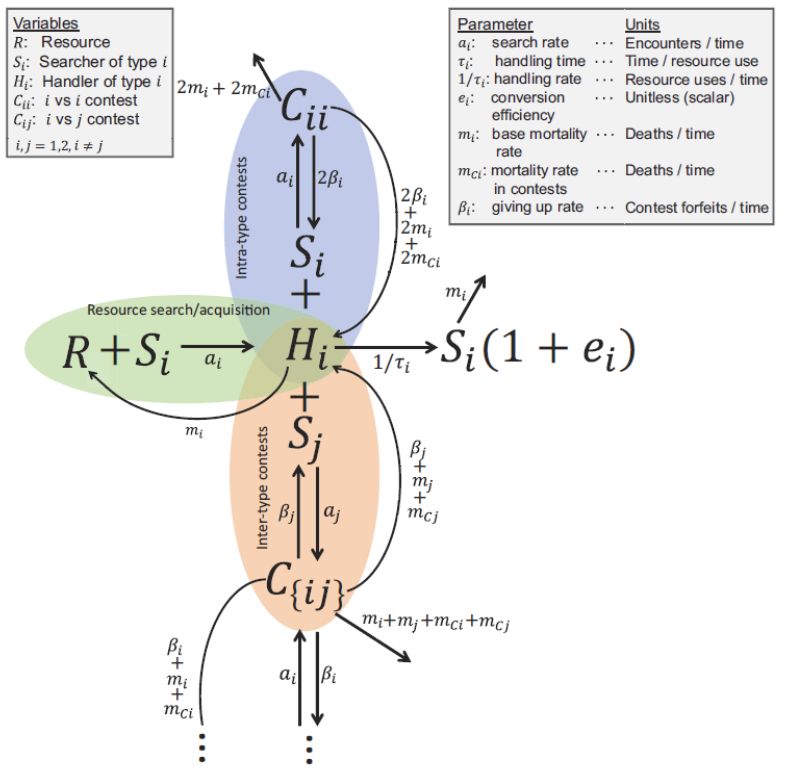
We develop a mechanistic model in which consuming a resource takes time, and Handlers can be interrupted by Searchers who find them rather than free Resource. This initiates a Contest, distracting the consumers, thus allowing the resource to grow to higher levels. 3/9
September 16, 2025 at 5:34 PM
We develop a mechanistic model in which consuming a resource takes time, and Handlers can be interrupted by Searchers who find them rather than free Resource. This initiates a Contest, distracting the consumers, thus allowing the resource to grow to higher levels. 3/9
We applied these concepts to experimental data on 517 Arabidopsis genotypes. The proportion of deaths that were selective is higher than anyone anticipated. Despite artificial conditions, this demonstrates that these concepts can be applied to data – immediately producing a surprise. 13/14

March 19, 2025 at 11:04 PM
We applied these concepts to experimental data on 517 Arabidopsis genotypes. The proportion of deaths that were selective is higher than anyone anticipated. Despite artificial conditions, this demonstrates that these concepts can be applied to data – immediately producing a surprise. 13/14
In a relative fitness model with selection on just one life history stage, selective deaths maps to the lead, illustrated here for the asexual case of Desai & Fisher with the lead q mutations better than the mean, each of them with selection coefficient s academic.oup.com/genetics/art... 9/14

March 19, 2025 at 11:03 PM
In a relative fitness model with selection on just one life history stage, selective deaths maps to the lead, illustrated here for the asexual case of Desai & Fisher with the lead q mutations better than the mean, each of them with selection coefficient s academic.oup.com/genetics/art... 9/14
Lag load arguments are flawed, but in 1971 Nei pmc.ncbi.nlm.nih.gov/articles/PMC... and Felsenstein www.journals.uchicago.edu/doi/10.1086/... derived selective deaths without them. Reproductive excess is a budget out of which selective deaths must be paid. Little work after that 7/14

March 19, 2025 at 11:01 PM
Lag load arguments are flawed, but in 1971 Nei pmc.ncbi.nlm.nih.gov/articles/PMC... and Felsenstein www.journals.uchicago.edu/doi/10.1086/... derived selective deaths without them. Reproductive excess is a budget out of which selective deaths must be paid. Little work after that 7/14
Relative load has since been rediscovered as the "lead" q in traveling wave models. Load/lead is a difference in fitness – this leads to different mathematical insights than approaches based on variances. 5/14

March 19, 2025 at 11:01 PM
Relative load has since been rediscovered as the "lead" q in traveling wave models. Load/lead is a difference in fitness – this leads to different mathematical insights than approaches based on variances. 5/14
Haldane defined "selective deaths" (incl. missing births) as those causally responsible for allele frequency change. The "cost of selection" is the proportion of deaths that need to be selective for a given rate of sweeps.
link.springer.com/article/10.1... 2/14
link.springer.com/article/10.1... 2/14

March 19, 2025 at 10:59 PM
Haldane defined "selective deaths" (incl. missing births) as those causally responsible for allele frequency change. The "cost of selection" is the proportion of deaths that need to be selective for a given rate of sweeps.
link.springer.com/article/10.1... 2/14
link.springer.com/article/10.1... 2/14
How? I have tried several times but the red "deactivate" box can't be clicked on.

March 5, 2025 at 7:07 PM
How? I have tried several times but the red "deactivate" box can't be clicked on.
So I'm still stuck, my 2021 password either doesn't work or I can't find it, and no option to reset.

February 19, 2025 at 1:10 AM
So I'm still stuck, my 2021 password either doesn't work or I can't find it, and no option to reset.
Anyone else unable to log in to NSF via research.gov to access assigned reviews? After completing login.gov 2-factor authentication, I get this screen. I tried to add a yubikey and it doesn't work. I'm just a reviewer, not a government employee!

February 19, 2025 at 12:54 AM
Anyone else unable to log in to NSF via research.gov to access assigned reviews? After completing login.gov 2-factor authentication, I get this screen. I tried to add a yubikey and it doesn't work. I'm just a reviewer, not a government employee!
I'm going to a demonstration today - my first ever. Neighbors helped me make a sign, given my lack of artistic talent or supplies. 2/3

February 17, 2025 at 4:27 PM
I'm going to a demonstration today - my first ever. Neighbors helped me make a sign, given my lack of artistic talent or supplies. 2/3
Whoops! Here is the text, both as snapshot and as alt-text.

February 15, 2025 at 3:38 PM
Whoops! Here is the text, both as snapshot and as alt-text.
Mass testing could beat a range of pathogens if population adherence were high. Frequent testing with rapid test turnaround is more important for diseases that reach peak viral load quickly, eg influenza. 5/9

February 7, 2025 at 10:45 PM
Mass testing could beat a range of pathogens if population adherence were high. Frequent testing with rapid test turnaround is more important for diseases that reach peak viral load quickly, eg influenza. 5/9
Shown here for ancestral SARS-CoV-2, mass testing effectiveness compares well to far more disruptive closures. Effectiveness is proportional to adherence & saturates with frequent testing. 4/9

February 7, 2025 at 10:44 PM
Shown here for ancestral SARS-CoV-2, mass testing effectiveness compares well to far more disruptive closures. Effectiveness is proportional to adherence & saturates with frequent testing. 4/9
Rapid antigen tests take time to develop, so early response needs to do rapid PCR testing at scale. Testing frequently enough, with faster enough test turnaround, makes the limiting factor adherence. 3/9

February 7, 2025 at 10:43 PM
Rapid antigen tests take time to develop, so early response needs to do rapid PCR testing at scale. Testing frequently enough, with faster enough test turnaround, makes the limiting factor adherence. 3/9
We had previously found an exceptionally long-term trend: older animal domains have their hydrophobic amino acids more interspersed along the primary sequence elifesciences.org/articles/57347, driven by differential loss rates. We confirmed that this trend goes all the way back to LUCA. 14/15

December 12, 2024 at 3:53 PM
We had previously found an exceptionally long-term trend: older animal domains have their hydrophobic amino acids more interspersed along the primary sequence elifesciences.org/articles/57347, driven by differential loss rates. We confirmed that this trend goes all the way back to LUCA. 14/15
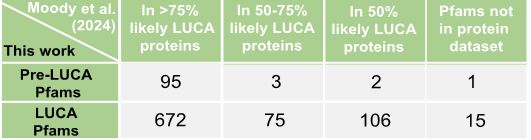
Our annotations of LUCA’s domains agree well with recent annotation of LUCA’s full-length genes by @emoody.bsky.social @phil-donoghue.bsky.social. doi.org/10.1038/s415... Recent gene-tree species-tree reconciliation methods are what made inferring LUCA possible for both groups. 13/15
December 12, 2024 at 3:52 PM
Our annotations of LUCA’s domains agree well with recent annotation of LUCA’s full-length genes by @emoody.bsky.social @phil-donoghue.bsky.social. doi.org/10.1038/s415... Recent gene-tree species-tree reconciliation methods are what made inferring LUCA possible for both groups. 13/15
Even more ancient “pre-LUCA” protein clans that had diversified pre-LUCA are more enriched for all four aromatic (ring-containing) amino acids than single-copy LUCA-clans. Abiotically produced aromatic amino acids have been found in hydrothermal vents doi.org/10.1038/s415... 11/15

December 12, 2024 at 3:50 PM
Even more ancient “pre-LUCA” protein clans that had diversified pre-LUCA are more enriched for all four aromatic (ring-containing) amino acids than single-copy LUCA-clans. Abiotically produced aromatic amino acids have been found in hydrothermal vents doi.org/10.1038/s415... 11/15