


JJ Merelo
@jjmerelo.bsky.social
Student of a BA in Art History by day, professor by another day.
Venetophile
Posts in English, Italian and Spanish.
Venetophile
Posts in English, Italian and Spanish.
Of course, passed through the lens of solid engineering and wise use of light for the representation, public presentation areas, which are right in the middle. As a bonus, you can see the Sagrada Familia through those trifora windows.

December 18, 2025 at 10:31 PM
Of course, passed through the lens of solid engineering and wise use of light for the representation, public presentation areas, which are right in the middle. As a bonus, you can see the Sagrada Familia through those trifora windows.
This is the administrative building of the Sant Pau hospital by Domenech i Muntaner; this is the part that’s actually open to the public. It’s got a certain fairytale air to it, but in fact it’s not so much Neogothic as Neo-Catalan gothic, using colors and stones that can be seen elsewhere.

December 18, 2025 at 10:31 PM
This is the administrative building of the Sant Pau hospital by Domenech i Muntaner; this is the part that’s actually open to the public. It’s got a certain fairytale air to it, but in fact it’s not so much Neogothic as Neo-Catalan gothic, using colors and stones that can be seen elsewhere.
But the serenity in the face is probably the most telltale sign. He’s not mentally adding up how much it needs to meet wages this month, but counting the days left until he can afford a third chain. It’s a rosy, healthy faced; only the eyes reveal an extraordinary acumen. Hosted at the Gulbenkian

December 17, 2025 at 8:45 PM
But the serenity in the face is probably the most telltale sign. He’s not mentally adding up how much it needs to meet wages this month, but counting the days left until he can afford a third chain. It’s a rosy, healthy faced; only the eyes reveal an extraordinary acumen. Hosted at the Gulbenkian
The painting is entitled “Self-portrait wearing beret and two chains”, we should assume that by Rembrandt with the help of the workshop, and it’s probably a good example of what Svetlana was trying to transmit. It represents a pretty successful business person who can afford not one, but two chains

December 17, 2025 at 8:45 PM
The painting is entitled “Self-portrait wearing beret and two chains”, we should assume that by Rembrandt with the help of the workshop, and it’s probably a good example of what Svetlana was trying to transmit. It represents a pretty successful business person who can afford not one, but two chains
Today we took the last lessons of the semester, and this included learning a bit about the social history of art, including historians such as Svetlana Alpers. She singled out Rembrandt’s workshop as a showcase of artistic talent meets entrepreneurship, and how one can’t understand one w/o the other

December 17, 2025 at 8:45 PM
Today we took the last lessons of the semester, and this included learning a bit about the social history of art, including historians such as Svetlana Alpers. She singled out Rembrandt’s workshop as a showcase of artistic talent meets entrepreneurship, and how one can’t understand one w/o the other
The peacocks framing the lower-floor windows are specially beautiful, and the way how they are integrated with the brick wall.
The architect was Leon de Keyser, who probably should be better known; he built also other houses in the same street and in the city. I love the way they maximize light.
The architect was Leon de Keyser, who probably should be better known; he built also other houses in the same street and in the city. I love the way they maximize light.

December 16, 2025 at 8:57 PM
The peacocks framing the lower-floor windows are specially beautiful, and the way how they are integrated with the brick wall.
The architect was Leon de Keyser, who probably should be better known; he built also other houses in the same street and in the city. I love the way they maximize light.
The architect was Leon de Keyser, who probably should be better known; he built also other houses in the same street and in the city. I love the way they maximize light.
Built at the turn of the 20th century, it’s full of art deco houses designed mainly by local architects; no Hankar or Horta there, since he was busy in Brussels and elsewhere. But they are beautifully crafted with rounded windows and ceramic tiles

December 16, 2025 at 8:57 PM
Built at the turn of the 20th century, it’s full of art deco houses designed mainly by local architects; no Hankar or Horta there, since he was busy in Brussels and elsewhere. But they are beautifully crafted with rounded windows and ceramic tiles
Before Italy, my go-to country was Belgium, ever since 1981, when I spent a month there in a Boy Scout Jamboree. The camp was close to Ghent, so it’s one of the first places I visited; I’ve been there dozens of times over the years. But I only visited Prinse Clementinalaan in 2018

December 16, 2025 at 8:57 PM
Before Italy, my go-to country was Belgium, ever since 1981, when I spent a month there in a Boy Scout Jamboree. The camp was close to Ghent, so it’s one of the first places I visited; I’ve been there dozens of times over the years. But I only visited Prinse Clementinalaan in 2018
The panel #7 also includes the Victorious Sun, that looks East to the rising sun, sun beating darkness all over again, in a victory without any kind of shades: good vs evil, Constantine-with-God-as-sidekick vs. Magentius. His “basilica” was one of the first Christian namesakes, a symbolic victory

December 15, 2025 at 10:02 PM
The panel #7 also includes the Victorious Sun, that looks East to the rising sun, sun beating darkness all over again, in a victory without any kind of shades: good vs evil, Constantine-with-God-as-sidekick vs. Magentius. His “basilica” was one of the first Christian namesakes, a symbolic victory
And it features in three panels Constantine’s arch, the triumphal arch just by the side of the Colosseum. It celebrates the victory of Constantine over Magentius in the Battle of the bridge Milvius, which is also famous in Christian history because it’s where cross-as-victory talisman made its intro

December 15, 2025 at 10:02 PM
And it features in three panels Constantine’s arch, the triumphal arch just by the side of the Colosseum. It celebrates the victory of Constantine over Magentius in the Battle of the bridge Milvius, which is also famous in Christian history because it’s where cross-as-victory talisman made its intro
I’ve started reading Atlas Mnemosyne, the life’s work of Aby Warburg, one of the greatest art historians of all time. Although at times cryptic, he makes sense in a way. The work is organized in panels that set in a grid different images with a common rough topic. Panel 7 is about victory

December 15, 2025 at 10:02 PM
I’ve started reading Atlas Mnemosyne, the life’s work of Aby Warburg, one of the greatest art historians of all time. Although at times cryptic, he makes sense in a way. The work is organized in panels that set in a grid different images with a common rough topic. Panel 7 is about victory
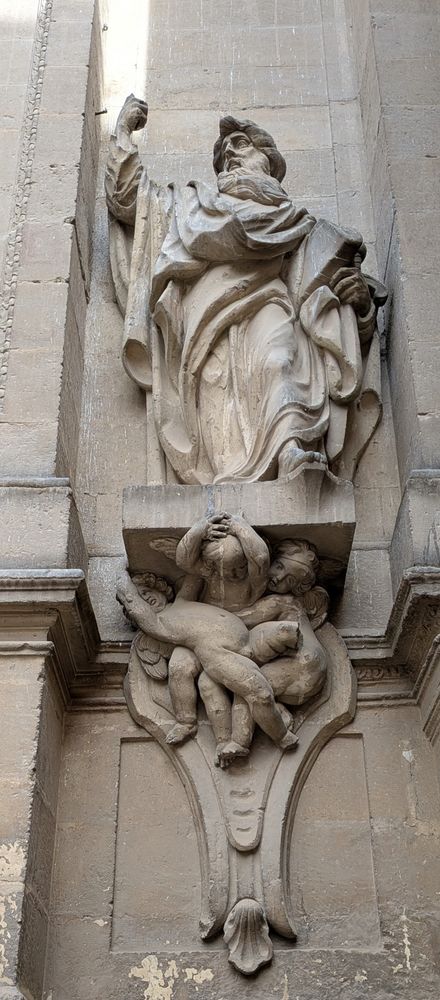
The issue with Saint Paul is that he died by the sword, so it’s not a thing you would brandish. So I thought it would be Elijah. But then Elijah comes with a crow.
No problem: the lore also says that, in the hands of Paul, the word of God was wielded like a sword.
No problem: the lore also says that, in the hands of Paul, the word of God was wielded like a sword.
December 14, 2025 at 8:59 PM
The issue with Saint Paul is that he died by the sword, so it’s not a thing you would brandish. So I thought it would be Elijah. But then Elijah comes with a crow.
No problem: the lore also says that, in the hands of Paul, the word of God was wielded like a sword.
No problem: the lore also says that, in the hands of Paul, the word of God was wielded like a sword.
What do we have here? A (missing) sword, a long beard, robes, humongous book. Who could that be? Well, a prophet or a gospel writer, and then someone who uses a sword or died by the sword. That would be either the prophet Elijah, who used a flaming sword, and… Saint Paul

December 14, 2025 at 8:59 PM
What do we have here? A (missing) sword, a long beard, robes, humongous book. Who could that be? Well, a prophet or a gospel writer, and then someone who uses a sword or died by the sword. That would be either the prophet Elijah, who used a flaming sword, and… Saint Paul
How do we know what’s the topic of a painting or an sculpture? That’s what’s called iconography. Through pattern books or “manuals” such as the “Golden Legend” or the apocryphal gospels, saints, archangels, prophets, get associated to “attributes”, the combination of which identifies the topic.

December 14, 2025 at 8:59 PM
How do we know what’s the topic of a painting or an sculpture? That’s what’s called iconography. Through pattern books or “manuals” such as the “Golden Legend” or the apocryphal gospels, saints, archangels, prophets, get associated to “attributes”, the combination of which identifies the topic.
By the side of the altar, a traditional representation of the saint, with the palm of martyrdom as well as the eyes in a plate, the usual attributes. This very fine Baroque sculpture pales by the side of Caravaggio, but then everything does.

December 13, 2025 at 9:25 PM
By the side of the altar, a traditional representation of the saint, with the palm of martyrdom as well as the eyes in a plate, the usual attributes. This very fine Baroque sculpture pales by the side of Caravaggio, but then everything does.
It’s a wonderful painting, created by Caravaggion during his stay in Sicily, while fleeing away from murder accusations in Rome; she was beheaded, but Caravaggio barely suggests this with a cloth around the neck, that actually hides a “pentimento” where the head was actually severed.

December 13, 2025 at 9:25 PM
It’s a wonderful painting, created by Caravaggion during his stay in Sicily, while fleeing away from murder accusations in Rome; she was beheaded, but Caravaggio barely suggests this with a cloth around the neck, that actually hides a “pentimento” where the head was actually severed.
This painting is about the burial of Saint Lucy; she’s dead, lying on the floor of the “Latonia”, caves that were used by the Christians back then, in the late 4th century. The golden light of the Mediterranean sun shines on the cave walls, and it illuminates the face of the saint.

December 13, 2025 at 9:25 PM
This painting is about the burial of Saint Lucy; she’s dead, lying on the floor of the “Latonia”, caves that were used by the Christians back then, in the late 4th century. The golden light of the Mediterranean sun shines on the cave walls, and it illuminates the face of the saint.
Today is Saint Lucy, a saint born (most probably in the figurative sense) in Syracuse, Sicily, where she’s the patron saint. Here’s the sanctuary devoted to her… and a painting by Caravaggio

December 13, 2025 at 9:25 PM
Today is Saint Lucy, a saint born (most probably in the figurative sense) in Syracuse, Sicily, where she’s the patron saint. Here’s the sanctuary devoted to her… and a painting by Caravaggio
The rooms in the upper floor are decorated with grotteschi in the most fashionable style, trompe l’oeil grisalla paintings and colorful manierist stories. Although execution is irregular, you really have to admire the craftmanship.
It’s really worth the while a detour to pay a visit.
It’s really worth the while a detour to pay a visit.

December 12, 2025 at 8:54 PM
The rooms in the upper floor are decorated with grotteschi in the most fashionable style, trompe l’oeil grisalla paintings and colorful manierist stories. Although execution is irregular, you really have to admire the craftmanship.
It’s really worth the while a detour to pay a visit.
It’s really worth the while a detour to pay a visit.
… “Because he could and he wanted”. He brought an architect, the Bergamasco, and painters , the Peroli brothers, from Italy, in the second half of the 16th century.
These painters are not excellent, but at least they had a good understanding of mythology and allegory, put to good use in ceilings
These painters are not excellent, but at least they had a good understanding of mythology and allegory, put to good use in ceilings

December 12, 2025 at 8:54 PM
… “Because he could and he wanted”. He brought an architect, the Bergamasco, and painters , the Peroli brothers, from Italy, in the second half of the 16th century.
These painters are not excellent, but at least they had a good understanding of mythology and allegory, put to good use in ceilings
These painters are not excellent, but at least they had a good understanding of mythology and allegory, put to good use in ceilings
But we talk about art here, and he commissioned one of the best pieces of civil Renaissance architecture in Spain: the palace “del marqués” in, well, El Viso del Marqués; in the middle of Castille, 400 kms away from the see, “lo hizo el marqués del Viso porque pudo y porque quiso”…

December 12, 2025 at 8:54 PM
But we talk about art here, and he commissioned one of the best pieces of civil Renaissance architecture in Spain: the palace “del marqués” in, well, El Viso del Marqués; in the middle of Castille, 400 kms away from the see, “lo hizo el marqués del Viso porque pudo y porque quiso”…
The part shown above is not open to the general public; the part you can visit is this one, a neogothic fantasy as opposed to the other part, which looks more neo-Byzantine. This would be the administration building, including auditorium and chapel. Right in front of the Sagrada Familia, too.

December 11, 2025 at 8:56 PM
The part shown above is not open to the general public; the part you can visit is this one, a neogothic fantasy as opposed to the other part, which looks more neo-Byzantine. This would be the administration building, including auditorium and chapel. Right in front of the Sagrada Familia, too.
They are also used as a resting room for patients that can get out of bed, who can get sun and air when needed. This “cut” corner also follows the same layout as the “Eixample”, the grid-like urban structure that was created in the 19th century by Ildefons Cerdà.

December 11, 2025 at 8:56 PM
They are also used as a resting room for patients that can get out of bed, who can get sun and air when needed. This “cut” corner also follows the same layout as the “Eixample”, the grid-like urban structure that was created in the 19th century by Ildefons Cerdà.
But I digress… modernism is about gesamtkunstwerk, a “total work of art”, and Domenech i Montaner designed everything, from the layout of the buildings in the campus to the specific trees that were planted. All in the service of health. Round buildings, for instance, avoid accumulation of dirt.

December 11, 2025 at 8:56 PM
But I digress… modernism is about gesamtkunstwerk, a “total work of art”, and Domenech i Montaner designed everything, from the layout of the buildings in the campus to the specific trees that were planted. All in the service of health. Round buildings, for instance, avoid accumulation of dirt.
As promised, here’s one of the corner buildings of the Sant Pau hospital, by the architect Domenech i Montaner. Together with the Palau by the same it’s a world heritage site. But this is a whole campus occupying a whole block. Parts of these building are still used as a hospital.

December 11, 2025 at 8:56 PM
As promised, here’s one of the corner buildings of the Sant Pau hospital, by the architect Domenech i Montaner. Together with the Palau by the same it’s a world heritage site. But this is a whole campus occupying a whole block. Parts of these building are still used as a hospital.