



Josh Corrie
@jcorrie.bsky.social
Ph.D. in paleontology with a focus on the evolution, anatomy, and feeding ecology of cetaceans.
Reposted by Josh Corrie
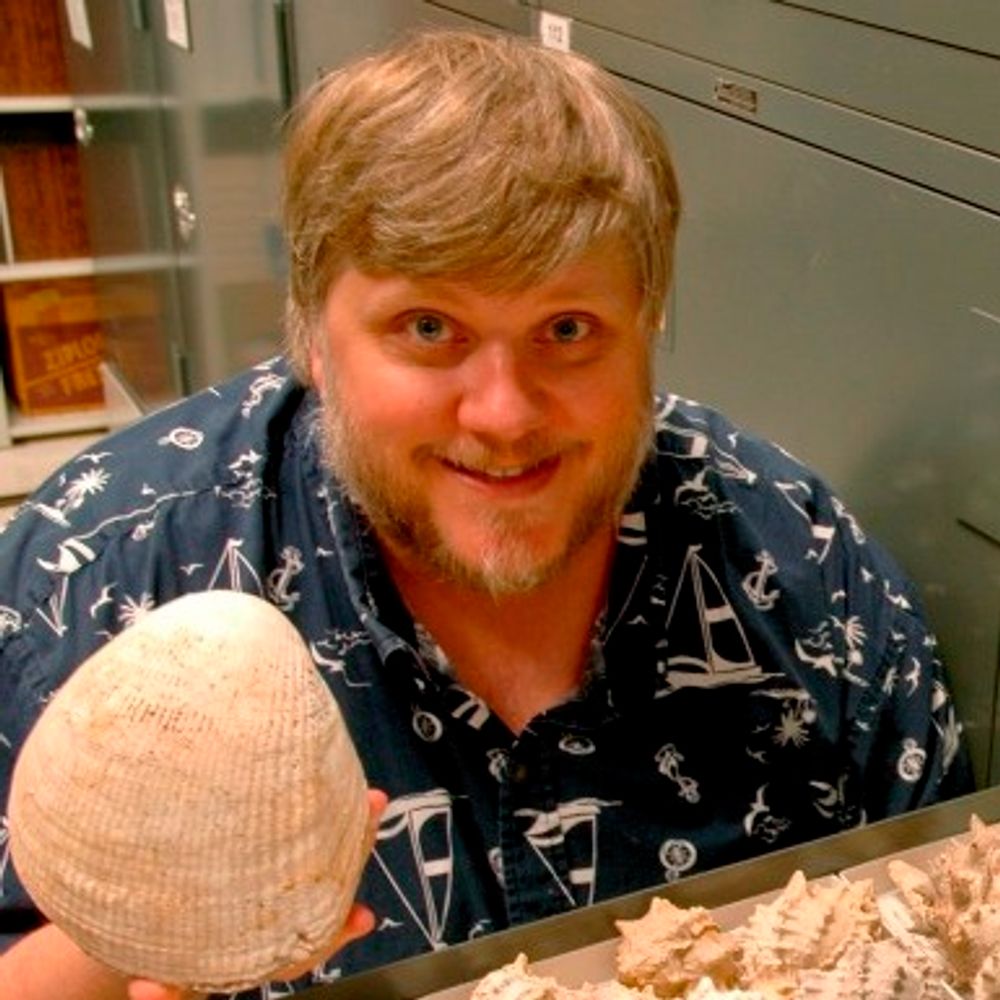
I’m one of two vertebrate paleontologists on the faculty at SDSU (shout out to the other, @jcorrie.bsky.social). We're both temporary. SDSU had a rich history in paleo w/ two tenured paleo profs in my department not too long ago, but they were never replaced. It’s sad watching that history dwindle.

Our report on employment is out in Paleobiology
(They did let us append that the paper was accepted before the election/changes to NSF and other granting agencies)
Employment in paleontology: status and trends in the United States | Paleobiology | Cambridge Core - www.cambridge.org/core/journal...
(They did let us append that the paper was accepted before the election/changes to NSF and other granting agencies)
Employment in paleontology: status and trends in the United States | Paleobiology | Cambridge Core - www.cambridge.org/core/journal...
Employment in paleontology: status and trends in the United States | Paleobiology | Cambridge Core
Employment in paleontology: status and trends in the United States
www.cambridge.org
May 14, 2025 at 4:04 PM
I’m one of two vertebrate paleontologists on the faculty at SDSU (shout out to the other, @jcorrie.bsky.social). We're both temporary. SDSU had a rich history in paleo w/ two tenured paleo profs in my department not too long ago, but they were never replaced. It’s sad watching that history dwindle.
Reposted by Josh Corrie
I have a new paper out on the evolution of hearing in toothed whales! It looks like a narrow range of high-frequency auditory sensitivity in some living dolphins and porpoises may be an ancestral physiology rather than novel specializations in select groups.
onlinelibrary.wiley.com/doi/10.1111/...
onlinelibrary.wiley.com/doi/10.1111/...
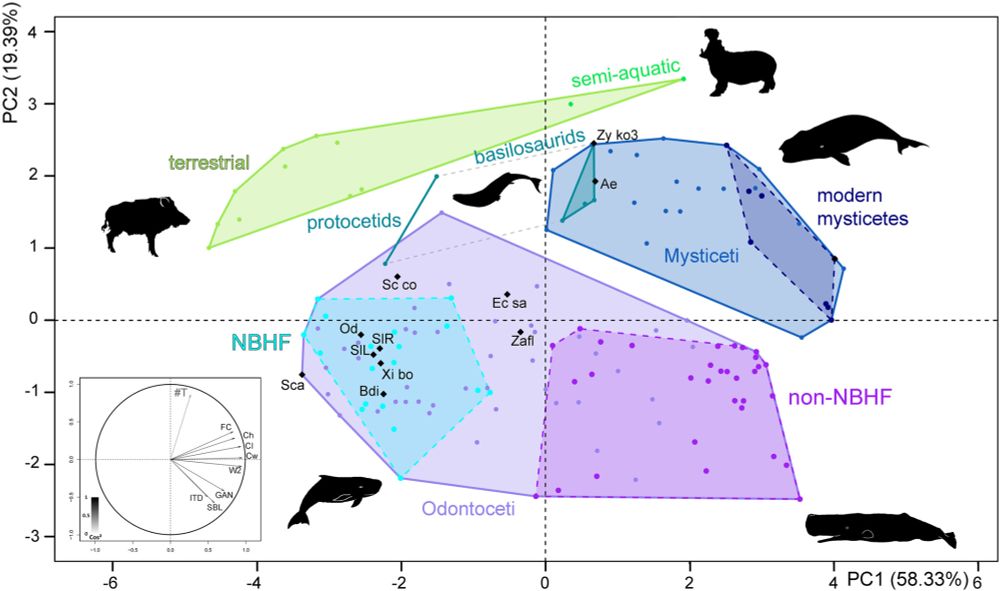
Variation in whale (Cetacea) inner ear anatomy reveals the early evolution of “specialized” high‐frequency hearing sensitivity
Our findings support sensitivity to low-frequency sound in the archaeocete Zygorhiza kochii and an early toothed mysticete cf. Aetiocetus. Narrow-band high-frequency hearing was present in Oligocene ...
onlinelibrary.wiley.com
December 4, 2024 at 2:15 AM
I have a new paper out on the evolution of hearing in toothed whales! It looks like a narrow range of high-frequency auditory sensitivity in some living dolphins and porpoises may be an ancestral physiology rather than novel specializations in select groups.
onlinelibrary.wiley.com/doi/10.1111/...
onlinelibrary.wiley.com/doi/10.1111/...
Reposted by Josh Corrie

Cochlear analysis of Kekenodon onamata, a late Oligocene stem whale, suggests they specialised in low-frequency hearing, a trait of raptorial feeding in fossil whales. Low-frequency hearing may be characteristic of raptorial macrophagous fossil cetaceans @joshcorrie @Blogozoic

February 19, 2025 at 9:38 AM
Cochlear analysis of Kekenodon onamata, a late Oligocene stem whale, suggests they specialised in low-frequency hearing, a trait of raptorial feeding in fossil whales. Low-frequency hearing may be characteristic of raptorial macrophagous fossil cetaceans @joshcorrie @Blogozoic