



Kate (Kathryn) Lawrence
@itskatelawrence.bsky.social
Stanford Genetics PhD Candidate
MIT Physics 2020
I also ride bikes
MIT Physics 2020
I also ride bikes
That's great! Thank you!
June 27, 2025 at 9:47 PM
That's great! Thank you!
Yes you're right - I think I need to look into our data a bit more and see how this is playing out. Even for the larger clusters, the PC is just a linear combination of the expression values so it would just be a QTL on a weighted sum/difference over more variables
June 10, 2025 at 4:28 PM
Yes you're right - I think I need to look into our data a bit more and see how this is playing out. Even for the larger clusters, the PC is just a linear combination of the expression values so it would just be a QTL on a weighted sum/difference over more variables
so if something is a PC2 QTL, then it would be pulling expression away from that main axis of correlated variation, and then to a larger difference in expression levels for any given individual.
June 9, 2025 at 10:11 PM
so if something is a PC2 QTL, then it would be pulling expression away from that main axis of correlated variation, and then to a larger difference in expression levels for any given individual.
Thank you, I think you are right - I've been conceptualizing (at least for a correlated 2 gene cluster) PC1 capturing the shared main axis of variation, and PC2 capturing the spread away from that main axis (so for positively correlated variables I think you're right that would be the difference)

June 9, 2025 at 10:11 PM
Thank you, I think you are right - I've been conceptualizing (at least for a correlated 2 gene cluster) PC1 capturing the shared main axis of variation, and PC2 capturing the spread away from that main axis (so for positively correlated variables I think you're right that would be the difference)
Just brainstorming, but do you think multi-ancestry GWAS/QTLs or comparing between ancestries could help to at least give us different LD confounders and tease apart those relationships? I'm not as familiar with the literature in that space though
June 9, 2025 at 9:58 PM
Just brainstorming, but do you think multi-ancestry GWAS/QTLs or comparing between ancestries could help to at least give us different LD confounders and tease apart those relationships? I'm not as familiar with the literature in that space though
I think establishing a gold-standard set of single-gene effect variants would be difficult - there are just so many strange mechanisms in biology! For instance, NMD of mutated mRNAs can cause up-regulation of paralogs. So even a PTVs can have multi-gene effects www.nature.com/articles/s41...

Genetic compensation triggered by mutant mRNA degradation - Nature
Transcriptional adaptation, a genetic compensation process by which organisms respond to mutations by upregulating related genes, is triggered by mRNA decay and involves a sequence-dependent mechanism...
www.nature.com
June 9, 2025 at 9:55 PM
I think establishing a gold-standard set of single-gene effect variants would be difficult - there are just so many strange mechanisms in biology! For instance, NMD of mutated mRNAs can cause up-regulation of paralogs. So even a PTVs can have multi-gene effects www.nature.com/articles/s41...
I think also the omnigenic model has influenced how I think about this. If one of the regulated genes is a "core gene" then maybe that one is the most important but the other regulated genes still have some impact pmc.ncbi.nlm.nih.gov/articles/PMC...

An expanded view of complex traits: from polygenic to omnigenic
A central goal of genetics is to understand the links between genetic variation and disease. Intuitively, one might expect disease-causing variants to cluster into key pathways that drive disease etio...
pmc.ncbi.nlm.nih.gov
June 9, 2025 at 9:44 PM
I think also the omnigenic model has influenced how I think about this. If one of the regulated genes is a "core gene" then maybe that one is the most important but the other regulated genes still have some impact pmc.ncbi.nlm.nih.gov/articles/PMC...
How to get at this in an unbiased way is further complicated by the fact that its fairly common for paralogs or functionally related genes to be near each other, like those IFNa/b and OAS1/OAS2/OASL loci
June 9, 2025 at 9:39 PM
How to get at this in an unbiased way is further complicated by the fact that its fairly common for paralogs or functionally related genes to be near each other, like those IFNa/b and OAS1/OAS2/OASL loci
I don't, I think it would be really interesting to think of a way to systematically access how often it is one or the other. I like @kauralasoo.bsky.social 's point about comparing putative proxitropic regulatory QTLs with missense or splicing QTLs which are more likely to be single-gene effects.
June 9, 2025 at 9:39 PM
I don't, I think it would be really interesting to think of a way to systematically access how often it is one or the other. I like @kauralasoo.bsky.social 's point about comparing putative proxitropic regulatory QTLs with missense or splicing QTLs which are more likely to be single-gene effects.
Awesome! I will DM you
June 9, 2025 at 9:29 PM
Awesome! I will DM you
It was a delight to work with you on this Tami! 🫶 hope for more collaboration in the future :)
June 9, 2025 at 5:54 PM
It was a delight to work with you on this Tami! 🫶 hope for more collaboration in the future :)
This MPRA work from our lab suggests that this multiple-causal variant senario is fairly likely (17% of eQTLs tested) www.science.org/doi/10.1126/...

Multiple causal variants underlie genetic associations in humans
Some human quantitative traits are determined by multiple linked genetic variants.
www.science.org
June 9, 2025 at 5:49 PM
This MPRA work from our lab suggests that this multiple-causal variant senario is fairly likely (17% of eQTLs tested) www.science.org/doi/10.1126/...
That's an interesting point and definitely worth thinking about. I think a case with multiple causal variants in LD with different marginal effects on each of the genes near them would require orthogonal approaches (perhaps MPRAs?) to disentangle.
Multiple causal variants underlie genetic associations in humans
Some human quantitative traits are determined by multiple linked genetic variants.
www.science.org
June 9, 2025 at 5:49 PM
That's an interesting point and definitely worth thinking about. I think a case with multiple causal variants in LD with different marginal effects on each of the genes near them would require orthogonal approaches (perhaps MPRAs?) to disentangle.
www.medrxiv.org/content/10.1... this paper @mykmal.xyz recommended elsewhere in this thread may be of interest to you as a framework to think about co-expression effects

Co-expression-wide association studies link genetically regulated interactions with complex traits
Transcriptome- and proteome-wide association studies (TWAS/PWAS) have proven successful in prioritizing genes and proteins whose genetically regulated expression modulates disease risk, but they ignor...
www.medrxiv.org
June 9, 2025 at 5:42 PM
www.medrxiv.org/content/10.1... this paper @mykmal.xyz recommended elsewhere in this thread may be of interest to you as a framework to think about co-expression effects
I hadn't seen your paper, thank you for sharing! I was wondering, in your analysis, did you see if cis-eQTLs did worse in the prioritization task when the pQTL gene they attempted to pick shared regulation with nearby genes or overlapped nearby genes?
June 9, 2025 at 5:40 PM
I hadn't seen your paper, thank you for sharing! I was wondering, in your analysis, did you see if cis-eQTLs did worse in the prioritization task when the pQTL gene they attempted to pick shared regulation with nearby genes or overlapped nearby genes?
Ribeiro et. al. has a nice analysis showing eSNPs shared between multiple eGenes are more indeed pleiotropic. We also see this in our data www.nature.com/articles/s41...

June 9, 2025 at 5:23 PM
Ribeiro et. al. has a nice analysis showing eSNPs shared between multiple eGenes are more indeed pleiotropic. We also see this in our data www.nature.com/articles/s41...
I think that both of these occur. Sometimes maybe a pcQTL effects multiple genes and we need the power boost from looking at all the genes to detect it, but only one gene actually impacts the trait, but I believe sometimes it is a multi-gene or even second order gene co-expression effect
June 9, 2025 at 5:14 PM
I think that both of these occur. Sometimes maybe a pcQTL effects multiple genes and we need the power boost from looking at all the genes to detect it, but only one gene actually impacts the trait, but I believe sometimes it is a multi-gene or even second order gene co-expression effect
Yes I think you are exactly right! They tend to be weaker effects. We also have some preliminary results not in this preprint indicating that as you increase sample size, you end up discovering many of the loci as eQTLs that were only pcQTLs at the smaller sample size
June 9, 2025 at 5:10 PM
Yes I think you are exactly right! They tend to be weaker effects. We also have some preliminary results not in this preprint indicating that as you increase sample size, you end up discovering many of the loci as eQTLs that were only pcQTLs at the smaller sample size
Very exciting you'll be coming to Stanford, I would love to chat when you're here! Do you think extending COWAS to larger groups of proteins with PCs would be feasible?
June 9, 2025 at 4:09 AM
Very exciting you'll be coming to Stanford, I would love to chat when you're here! Do you think extending COWAS to larger groups of proteins with PCs would be feasible?
Thank you! No worries, I only just made the account so it would have been impossible to find!
June 8, 2025 at 6:30 PM
Thank you! No worries, I only just made the account so it would have been impossible to find!
If you're interested in a bit more detail about what we did, check out our tweetorial here! bsky.app/profile/itsk...
June 8, 2025 at 6:20 PM
If you're interested in a bit more detail about what we did, check out our tweetorial here! bsky.app/profile/itsk...
If you're interested in a bit more detail about what we did, check out our tweetorial here! bsky.app/profile/itsk...
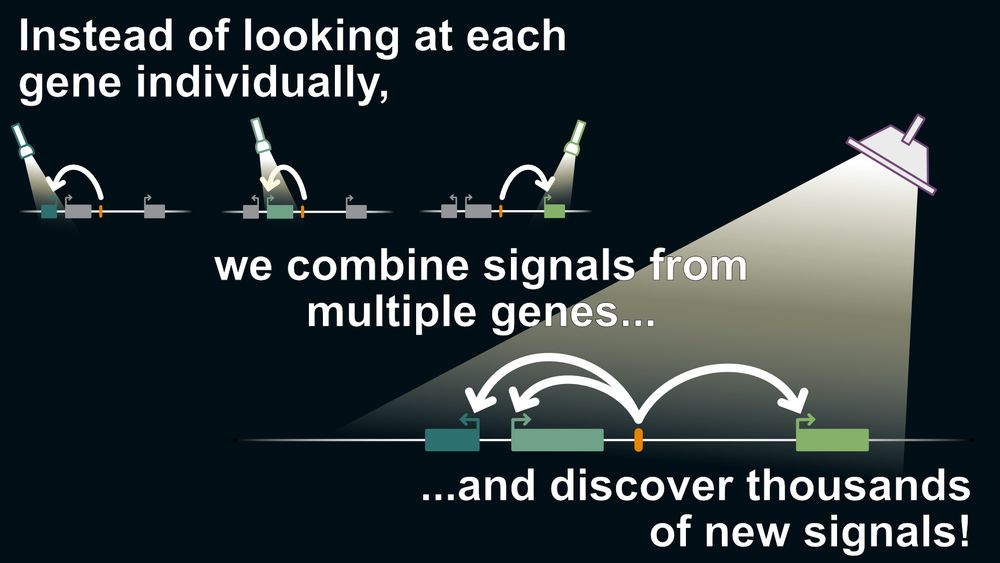
Excited to share my first PhD paper in the @sbmontgom.bsky.social lab with @tamigj.bsky.social (www.biorxiv.org/content/10.1...)! Standard QTL methods treat each gene independently. But what if a single variant regulates multiple nearby genes at once - what we call “allelic proxitropy”? 🧵 ⬇️
June 8, 2025 at 6:18 PM
If you're interested in a bit more detail about what we did, check out our tweetorial here! bsky.app/profile/itsk...
Thank you for the shoutout! I just posted a tweetorial (bsky.app/profile/itsk...) if anyone is interested in a bit more about what we did!
Excited to share my first PhD paper in the @sbmontgom.bsky.social lab with @tamigj.bsky.social (www.biorxiv.org/content/10.1...)! Standard QTL methods treat each gene independently. But what if a single variant regulates multiple nearby genes at once - what we call “allelic proxitropy”? 🧵 ⬇️
June 8, 2025 at 6:16 PM
Thank you for the shoutout! I just posted a tweetorial (bsky.app/profile/itsk...) if anyone is interested in a bit more about what we did!
🧵5/5 Make allelic proxitropy work for you! Even this simple approach substantially increased colocalizations. We’re excited to see future refinements as we move beyond the “one variant, one gene” paradigm to get a more complete picture of the complexities of local gene regulation 🔬🧬✨

June 8, 2025 at 5:39 PM
🧵5/5 Make allelic proxitropy work for you! Even this simple approach substantially increased colocalizations. We’re excited to see future refinements as we move beyond the “one variant, one gene” paradigm to get a more complete picture of the complexities of local gene regulation 🔬🧬✨
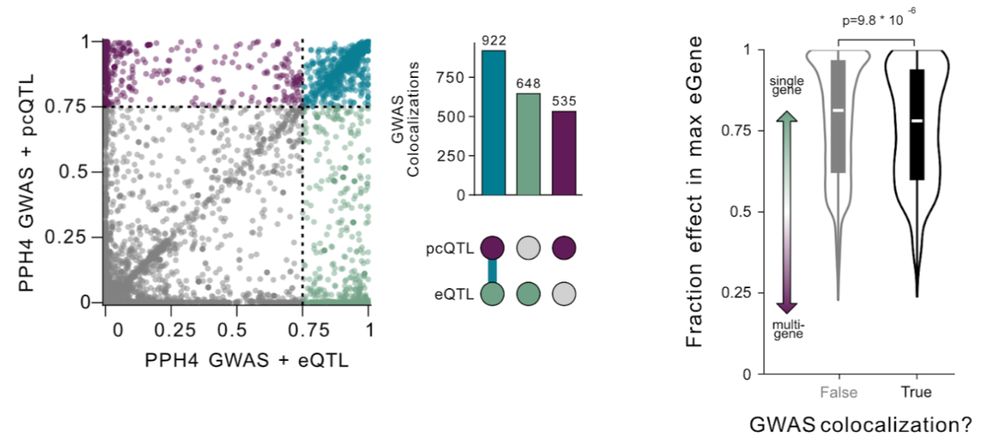
🧵4/5 But are new pcQTLs relevant? We examined associations with GWAS for complex traits and diseases and found over 500 new colocalizations – a 34% increase over single-gene-based analyses! In fact, variants with distributed effects are more likely to be GWAS hits than those affecting just one gene
June 8, 2025 at 5:39 PM
🧵4/5 But are new pcQTLs relevant? We examined associations with GWAS for complex traits and diseases and found over 500 new colocalizations – a 34% increase over single-gene-based analyses! In fact, variants with distributed effects are more likely to be GWAS hits than those affecting just one gene