




Giuseppe Tarantino, PhD
@giuseppetara.bsky.social
Instructor in Medicine at @DanaFarber @harvardmed @broadinstitute | PhD in Oncology at University of Bologna | visiting scientist @wharton
10/10 What’s next?
- Applying these findings to liquid biopsy & target panel sequencing data.
- Testing in larger, independent cohorts.
Check out the full study here:
www.science.org/doi/10.1126/...
- Applying these findings to liquid biopsy & target panel sequencing data.
- Testing in larger, independent cohorts.
Check out the full study here:
www.science.org/doi/10.1126/...
Genomic heterogeneity and ploidy identify patients with intrinsic resistance to PD-1 blockade in metastatic melanoma
Genomic features and models predict patients with aPD-1 intrinsic resistance who may benefit from combination ICB therapy.
www.science.org
November 29, 2024 at 9:44 PM
10/10 What’s next?
- Applying these findings to liquid biopsy & target panel sequencing data.
- Testing in larger, independent cohorts.
Check out the full study here:
www.science.org/doi/10.1126/...
- Applying these findings to liquid biopsy & target panel sequencing data.
- Testing in larger, independent cohorts.
Check out the full study here:
www.science.org/doi/10.1126/...
9/10 Clinical implications:
Our model provides additional predictive power beyond existing biomarkers like TMB and IFN-γ signatures.
It complements clinical features to better stratify patients for personalized immunotherapy
Our model provides additional predictive power beyond existing biomarkers like TMB and IFN-γ signatures.
It complements clinical features to better stratify patients for personalized immunotherapy
November 29, 2024 at 9:43 PM
9/10 Clinical implications:
Our model provides additional predictive power beyond existing biomarkers like TMB and IFN-γ signatures.
It complements clinical features to better stratify patients for personalized immunotherapy
Our model provides additional predictive power beyond existing biomarkers like TMB and IFN-γ signatures.
It complements clinical features to better stratify patients for personalized immunotherapy
8/10 Independent validation:
Using paired targeted NGS panels (MSK-IMPACT):
- Ploidy estimates were consistent with WES.
- TNGS shows promise for broader clinical adoption.
Using paired targeted NGS panels (MSK-IMPACT):
- Ploidy estimates were consistent with WES.
- TNGS shows promise for broader clinical adoption.
November 29, 2024 at 9:43 PM
8/10 Independent validation:
Using paired targeted NGS panels (MSK-IMPACT):
- Ploidy estimates were consistent with WES.
- TNGS shows promise for broader clinical adoption.
Using paired targeted NGS panels (MSK-IMPACT):
- Ploidy estimates were consistent with WES.
- TNGS shows promise for broader clinical adoption.
7/10 Subtype insights:
Non-cutaneous melanoma subtypes (e.g., Acral, Mucosal) showed:
⬆️ Higher heterogeneity
⬆️ WGD incidence
Cutaneous melanomas exhibited heterogeneity driven by non-UV mutational processes.
Non-cutaneous melanoma subtypes (e.g., Acral, Mucosal) showed:
⬆️ Higher heterogeneity
⬆️ WGD incidence
Cutaneous melanomas exhibited heterogeneity driven by non-UV mutational processes.
November 29, 2024 at 9:43 PM
7/10 Subtype insights:
Non-cutaneous melanoma subtypes (e.g., Acral, Mucosal) showed:
⬆️ Higher heterogeneity
⬆️ WGD incidence
Cutaneous melanomas exhibited heterogeneity driven by non-UV mutational processes.
Non-cutaneous melanoma subtypes (e.g., Acral, Mucosal) showed:
⬆️ Higher heterogeneity
⬆️ WGD incidence
Cutaneous melanomas exhibited heterogeneity driven by non-UV mutational processes.
6/10 Beyond response prediction:
- Timing of whole genome doubling (WGD) affects resistance: Tumors with recent WGD (high proportion of SNV with multiplicity of 2) showed high resistance despite low heterogeneity.
- Timing of whole genome doubling (WGD) affects resistance: Tumors with recent WGD (high proportion of SNV with multiplicity of 2) showed high resistance despite low heterogeneity.
November 29, 2024 at 9:43 PM
6/10 Beyond response prediction:
- Timing of whole genome doubling (WGD) affects resistance: Tumors with recent WGD (high proportion of SNV with multiplicity of 2) showed high resistance despite low heterogeneity.
- Timing of whole genome doubling (WGD) affects resistance: Tumors with recent WGD (high proportion of SNV with multiplicity of 2) showed high resistance despite low heterogeneity.
5/10 Model performance:
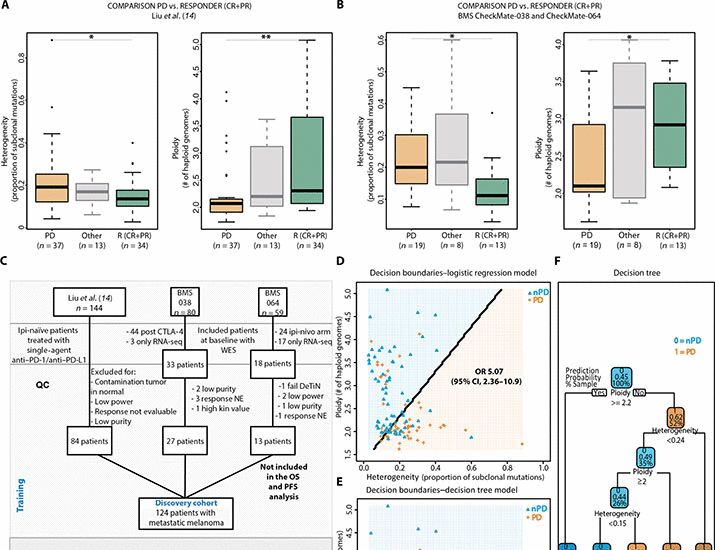
Our decision tree model using heterogeneity & ploidy achieved:
✅ High specificity (97%)
✅ Strong PPV (90%)
This helps identify patients unlikely to benefit from single-agent aPD-1 ICB, who might need combo therapies.
Our decision tree model using heterogeneity & ploidy achieved:
✅ High specificity (97%)
✅ Strong PPV (90%)
This helps identify patients unlikely to benefit from single-agent aPD-1 ICB, who might need combo therapies.
November 29, 2024 at 9:43 PM
5/10 Model performance:
Our decision tree model using heterogeneity & ploidy achieved:
✅ High specificity (97%)
✅ Strong PPV (90%)
This helps identify patients unlikely to benefit from single-agent aPD-1 ICB, who might need combo therapies.
Our decision tree model using heterogeneity & ploidy achieved:
✅ High specificity (97%)
✅ Strong PPV (90%)
This helps identify patients unlikely to benefit from single-agent aPD-1 ICB, who might need combo therapies.
4/10 Why does this matter? integrating TCGA data we show that:
- Genomic heterogeneity predicts therapy resistance.
- Ploidy offers prognostic value.
Together, they provide a precise and independent biomarker system to improve clinical decision-making. 🔬
- Genomic heterogeneity predicts therapy resistance.
- Ploidy offers prognostic value.
Together, they provide a precise and independent biomarker system to improve clinical decision-making. 🔬
November 29, 2024 at 9:43 PM
4/10 Why does this matter? integrating TCGA data we show that:
- Genomic heterogeneity predicts therapy resistance.
- Ploidy offers prognostic value.
Together, they provide a precise and independent biomarker system to improve clinical decision-making. 🔬
- Genomic heterogeneity predicts therapy resistance.
- Ploidy offers prognostic value.
Together, they provide a precise and independent biomarker system to improve clinical decision-making. 🔬
3/10 Main findings:
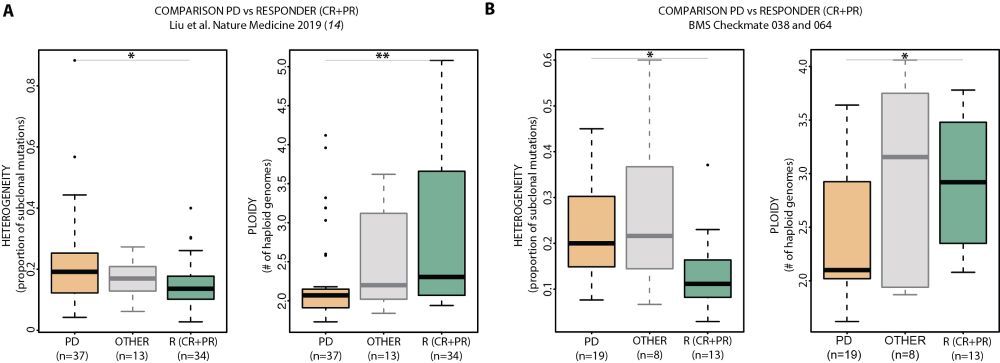
Across different cohorts, low ploidy 📉 and high heterogeneity 📈 robustly identify patients with intrinsic resistance to aPD-1 therapy
Across different cohorts, low ploidy 📉 and high heterogeneity 📈 robustly identify patients with intrinsic resistance to aPD-1 therapy
November 29, 2024 at 9:43 PM
3/10 Main findings:
Across different cohorts, low ploidy 📉 and high heterogeneity 📈 robustly identify patients with intrinsic resistance to aPD-1 therapy
Across different cohorts, low ploidy 📉 and high heterogeneity 📈 robustly identify patients with intrinsic resistance to aPD-1 therapy
2/10 What we did:
- Harmonized data across independent metastatic melanoma cohorts.
- Focused on ICB-naïve patients treated with aPD-1 therapy.
- Used whole-exome sequencing (WES), bulkRNAseq and clinical annotations.
- Harmonized data across independent metastatic melanoma cohorts.
- Focused on ICB-naïve patients treated with aPD-1 therapy.
- Used whole-exome sequencing (WES), bulkRNAseq and clinical annotations.
November 29, 2024 at 9:43 PM
2/10 What we did:
- Harmonized data across independent metastatic melanoma cohorts.
- Focused on ICB-naïve patients treated with aPD-1 therapy.
- Used whole-exome sequencing (WES), bulkRNAseq and clinical annotations.
- Harmonized data across independent metastatic melanoma cohorts.
- Focused on ICB-naïve patients treated with aPD-1 therapy.
- Used whole-exome sequencing (WES), bulkRNAseq and clinical annotations.