




GES4SEAS MOOCs
@ges4seas-mooc.fediscience.org.ap.brid.gy
GES4SEAS is an EU project to develop an innovative toolbox to assess the seas in the context of adaptive Ecosystem-based management. – This account is […]
[bridged from https://fediscience.org/@ges4seas_mooc on the fediverse by https://fed.brid.gy/ ]
[bridged from https://fediscience.org/@ges4seas_mooc on the fediverse by https://fed.brid.gy/ ]
We can see:
🌊Areas that are most vulnerable
🌊Combined pressures
🌊Our gaps in knowledge
Coupled with Marine Spatial Planning (#msp), which minimizes conflicts over space and clarifies who uses what, these assessments form the foundation for decision-making under #EBM. ✍️
🌊Areas that are most vulnerable
🌊Combined pressures
🌊Our gaps in knowledge
Coupled with Marine Spatial Planning (#msp), which minimizes conflicts over space and clarifies who uses what, these assessments form the foundation for decision-making under #EBM. ✍️

December 10, 2025 at 10:00 AM
We can see:
🌊Areas that are most vulnerable
🌊Combined pressures
🌊Our gaps in knowledge
Coupled with Marine Spatial Planning (#msp), which minimizes conflicts over space and clarifies who uses what, these assessments form the foundation for decision-making under #EBM. ✍️
🌊Areas that are most vulnerable
🌊Combined pressures
🌊Our gaps in knowledge
Coupled with Marine Spatial Planning (#msp), which minimizes conflicts over space and clarifies who uses what, these assessments form the foundation for decision-making under #EBM. ✍️
So far in this #mooc we’ have explored some core principles of #ebm (Ecosystem-Based Management) 🌊but here’s something we haven’t yet talked about:
👉 EBM isn’t a one-off process. It’s cyclical and constantly evolving.
How does this make the ends meet? Stay tuned to find out…
👉 EBM isn’t a one-off process. It’s cyclical and constantly evolving.
How does this make the ends meet? Stay tuned to find out…

December 8, 2025 at 10:01 AM

...with the urgent need for #offshorerenewableenergy to transform Europe into a climate-neutral continent by 2050. Siting wind farms needs careful planning to minimise conflict with fishing grounds and avoid sensitive habitats... all while managing risks from […]
[Original post on fediscience.org]
[Original post on fediscience.org]

December 3, 2025 at 10:01 AM
...with the urgent need for #offshorerenewableenergy to transform Europe into a climate-neutral continent by 2050. Siting wind farms needs careful planning to minimise conflict with fishing grounds and avoid sensitive habitats... all while managing risks from […]
[Original post on fediscience.org]
[Original post on fediscience.org]

This week in the #ges4seas #mooc, we're exploring the many dimensions of #EBM. These are the competing sectors we must manage in order to protect our marine environment.
In the #atlantic (for example, the #bayofbiscay), there is the challenge to balance various sectors demands?
In the #atlantic (for example, the #bayofbiscay), there is the challenge to balance various sectors demands?

December 1, 2025 at 10:01 AM
This week in the #ges4seas #mooc, we're exploring the many dimensions of #EBM. These are the competing sectors we must manage in order to protect our marine environment.
In the #atlantic (for example, the #bayofbiscay), there is the challenge to balance various sectors demands?
In the #atlantic (for example, the #bayofbiscay), there is the challenge to balance various sectors demands?
So, is #ebm just a concept on paper? Not at all. 📜
It is already shaping how we manage European seas, through global conventions, directives, regional policies, and local implementation.
Stay tuned for next week’s #mooc on how EBM spans marine sectors & the related challenges🚧
It is already shaping how we manage European seas, through global conventions, directives, regional policies, and local implementation.
Stay tuned for next week’s #mooc on how EBM spans marine sectors & the related challenges🚧

November 28, 2025 at 10:00 AM
👉 The #marinestrategyframeworkdirective is one of the #EU’s main tools to protect the marine environment. Its goal? Achieving "Good Environmental Status" of EU seas. 🌍 And the approach? You guessed it ➡️ Ecosystem-based.
🌊 Internationally, #ebm pops up too! […]
[Original post on fediscience.org]
🌊 Internationally, #ebm pops up too! […]
[Original post on fediscience.org]

November 26, 2025 at 10:01 AM
👉 The #marinestrategyframeworkdirective is one of the #EU’s main tools to protect the marine environment. Its goal? Achieving "Good Environmental Status" of EU seas. 🌍 And the approach? You guessed it ➡️ Ecosystem-based.
🌊 Internationally, #ebm pops up too! […]
[Original post on fediscience.org]
🌊 Internationally, #ebm pops up too! […]
[Original post on fediscience.org]

What have we learnt this week❓❓
To summarise #ebm means understanding how much the ecosystem can endure, how much we can pull on different strings, where we need to be careful, and where we need to strengthen the web. 🕸️🕸️
Ecosystem knowledge is […]
[Original post on fediscience.org]
To summarise #ebm means understanding how much the ecosystem can endure, how much we can pull on different strings, where we need to be careful, and where we need to strengthen the web. 🕸️🕸️
Ecosystem knowledge is […]
[Original post on fediscience.org]

November 21, 2025 at 10:00 AM
What have we learnt this week❓❓
To summarise #ebm means understanding how much the ecosystem can endure, how much we can pull on different strings, where we need to be careful, and where we need to strengthen the web. 🕸️🕸️
Ecosystem knowledge is […]
[Original post on fediscience.org]
To summarise #ebm means understanding how much the ecosystem can endure, how much we can pull on different strings, where we need to be careful, and where we need to strengthen the web. 🕸️🕸️
Ecosystem knowledge is […]
[Original post on fediscience.org]
If the #ocean is like a spider web🕸️, then our human activities are like pulling on the different strings which puts pressure on the structure as a whole. Therefore we need to understand the bigger picture to ensure ecosystems can recover and function […]
[Original post on fediscience.org]
[Original post on fediscience.org]

November 19, 2025 at 10:00 AM
If the #ocean is like a spider web🕸️, then our human activities are like pulling on the different strings which puts pressure on the structure as a whole. Therefore we need to understand the bigger picture to ensure ecosystems can recover and function […]
[Original post on fediscience.org]
[Original post on fediscience.org]
The #ocean provides for all of us, but that is not the end of the story. We are part of the ecosystem and we need to respect that. The fish 🐟 we eat, the corals 🪸 that protect our coast, with our actions we influence them, harm them and in doing so can harm ourselves.

November 17, 2025 at 7:00 AM
The #ocean provides for all of us, but that is not the end of the story. We are part of the ecosystem and we need to respect that. The fish 🐟 we eat, the corals 🪸 that protect our coast, with our actions we influence them, harm them and in doing so can harm ourselves.
By managing all human activities together, we can find smarter, more effective ways to protect and restore our oceans. 🌊 This ensures the sea can keep providing all the things we rely on: the food we eat, the air we breathe, and places for recreation, for […]
[Original post on fediscience.org]
[Original post on fediscience.org]
November 14, 2025 at 10:06 AM
By managing all human activities together, we can find smarter, more effective ways to protect and restore our oceans. 🌊 This ensures the sea can keep providing all the things we rely on: the food we eat, the air we breathe, and places for recreation, for […]
[Original post on fediscience.org]
[Original post on fediscience.org]
How can we effectively manage human pressures on our marine ecosystems? 🌊 Sector-by-sector approaches often miss the bigger picture! Following our previous #moocs, next moth we start to explore Ecosystem-based Management (#ebm), an integrated approach that considers the whole system. #ges4seas

October 16, 2025 at 1:57 PM
When human activities put too much pressure on ecosystems, they can reach a #tippingpoint. Once this tipping point is passed. It is extremely difficult to return the ecosystem to its previous state. This means that we need to manage ecosystems to avoid #tippingpoints.

June 30, 2025 at 9:05 AM
When human activities put too much pressure on ecosystems, they can reach a #tippingpoint. Once this tipping point is passed. It is extremely difficult to return the ecosystem to its previous state. This means that we need to manage ecosystems to avoid #tippingpoints.
Europe launched the NATURA 2000 to protect ecosystems. A great initiative😃 But it remains difficult to highly protect ecosystem.
https://www.eea.europa.eu/themes/biodiversity/natura-2000/the-natura-2000-protected-areas-network
Can you spot the HIGHLY or FULLY protected areas across European seas?
https://www.eea.europa.eu/themes/biodiversity/natura-2000/the-natura-2000-protected-areas-network
Can you spot the HIGHLY or FULLY protected areas across European seas?

June 25, 2025 at 6:23 AM
Europe launched the NATURA 2000 to protect ecosystems. A great initiative😃 But it remains difficult to highly protect ecosystem.
https://www.eea.europa.eu/themes/biodiversity/natura-2000/the-natura-2000-protected-areas-network
Can you spot the HIGHLY or FULLY protected areas across European seas?
https://www.eea.europa.eu/themes/biodiversity/natura-2000/the-natura-2000-protected-areas-network
Can you spot the HIGHLY or FULLY protected areas across European seas?
Time to show what you’ve got—quiz mode: activated!😁 #tipp
Follow the link below to the quiz and feel free to refer back to previous posts.
Have fun! The answers will come at the end of the #mooc
Choose to answer anonymously
https://app.wooclap.com/KZANBE/questionnaires/683db0b7ac164e53f6b4ffe3
Follow the link below to the quiz and feel free to refer back to previous posts.
Have fun! The answers will come at the end of the #mooc
Choose to answer anonymously
https://app.wooclap.com/KZANBE/questionnaires/683db0b7ac164e53f6b4ffe3

June 23, 2025 at 5:50 AM
Time to show what you’ve got—quiz mode: activated!😁 #tipp
Follow the link below to the quiz and feel free to refer back to previous posts.
Have fun! The answers will come at the end of the #mooc
Choose to answer anonymously
https://app.wooclap.com/KZANBE/questionnaires/683db0b7ac164e53f6b4ffe3
Follow the link below to the quiz and feel free to refer back to previous posts.
Have fun! The answers will come at the end of the #mooc
Choose to answer anonymously
https://app.wooclap.com/KZANBE/questionnaires/683db0b7ac164e53f6b4ffe3
If the hypoxia persists, suddenly the biological and chemical processes, and the plant/animal populations changes so much that the whole system goes in a different environmental state. That is, the system tumbles past the tipping point.

June 20, 2025 at 7:14 AM
If the hypoxia persists, suddenly the biological and chemical processes, and the plant/animal populations changes so much that the whole system goes in a different environmental state. That is, the system tumbles past the tipping point.
Collapse of Cod fisheries in the Western #BalticSea
This example shows how the Cod biomass reached a tipping point around 1985. Intensive fishing pressure pushed the system too far and recovery was not possible.
Sounds familiar? #NorthSea
Full study […]
[Original post on fediscience.org]
This example shows how the Cod biomass reached a tipping point around 1985. Intensive fishing pressure pushed the system too far and recovery was not possible.
Sounds familiar? #NorthSea
Full study […]
[Original post on fediscience.org]

June 18, 2025 at 8:38 AM
Collapse of Cod fisheries in the Western #BalticSea
This example shows how the Cod biomass reached a tipping point around 1985. Intensive fishing pressure pushed the system too far and recovery was not possible.
Sounds familiar? #NorthSea
Full study […]
[Original post on fediscience.org]
This example shows how the Cod biomass reached a tipping point around 1985. Intensive fishing pressure pushed the system too far and recovery was not possible.
Sounds familiar? #NorthSea
Full study […]
[Original post on fediscience.org]
But things can get complicated!
When we have many species changing along the timeline or the pressure.
Then we use more complex community-based statistics to identify when the community shifted.
When we have many species changing along the timeline or the pressure.
Then we use more complex community-based statistics to identify when the community shifted.

June 16, 2025 at 8:14 AM
But things can get complicated!
When we have many species changing along the timeline or the pressure.
Then we use more complex community-based statistics to identify when the community shifted.
When we have many species changing along the timeline or the pressure.
Then we use more complex community-based statistics to identify when the community shifted.
How can we detect Tipping Points? #tipp
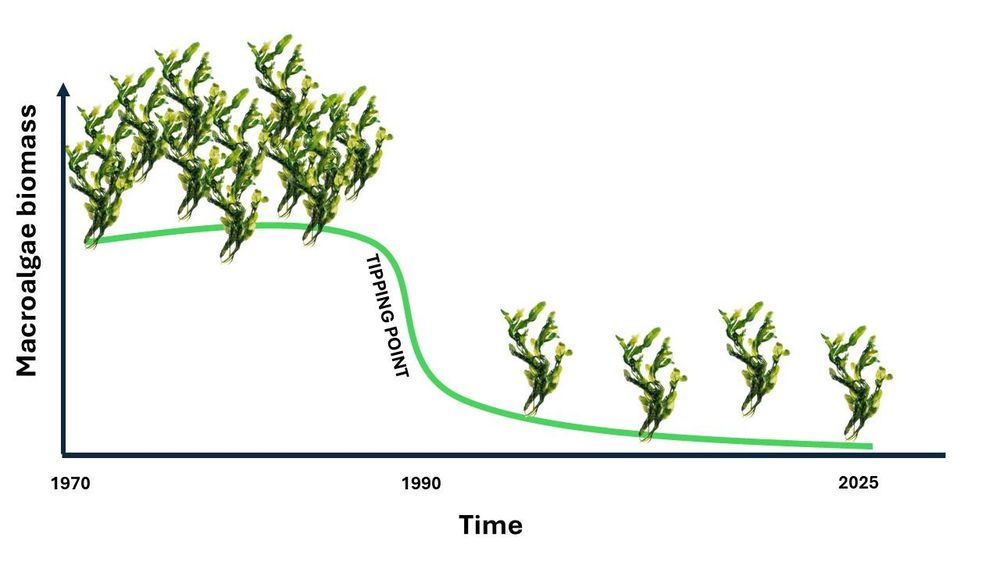
1. Detection along timelines. E.g., when the high biomass of a macroalgae suddenly decreases from one year to another and stays low.
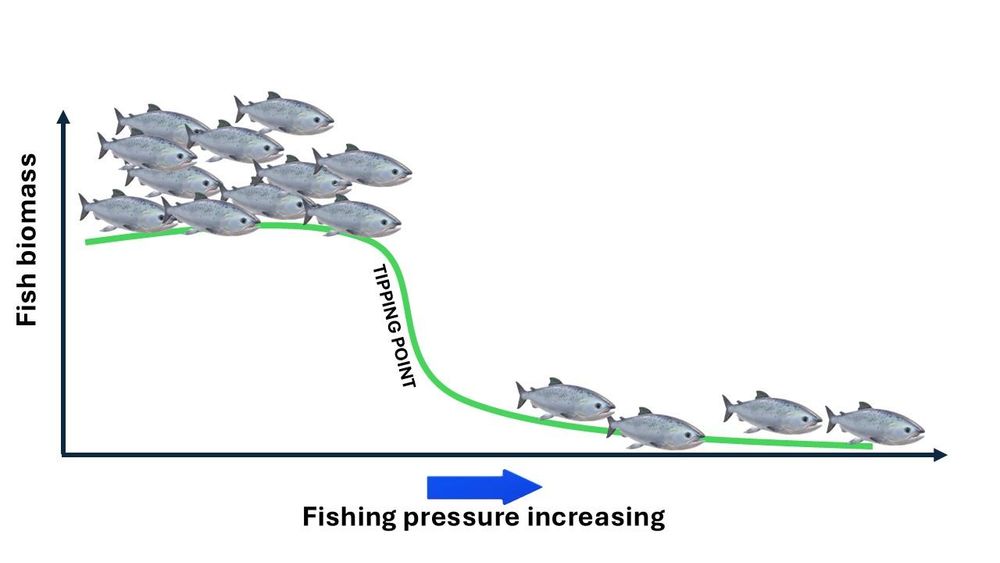
2. Detection with increasing pressure. E.g., increasing fishing pressure suddenly reduce fish biomass.
1. Detection along timelines. E.g., when the high biomass of a macroalgae suddenly decreases from one year to another and stays low.
2. Detection with increasing pressure. E.g., increasing fishing pressure suddenly reduce fish biomass.
June 16, 2025 at 8:12 AM
How can we detect Tipping Points? #tipp
1. Detection along timelines. E.g., when the high biomass of a macroalgae suddenly decreases from one year to another and stays low.
2. Detection with increasing pressure. E.g., increasing fishing pressure suddenly reduce fish biomass.
1. Detection along timelines. E.g., when the high biomass of a macroalgae suddenly decreases from one year to another and stays low.
2. Detection with increasing pressure. E.g., increasing fishing pressure suddenly reduce fish biomass.
Algal blooms during upwellings (nutrient rich water from deep move up) are an example of transcritical bifurcation. The system transits into a bloom state but after the nutrient is depleted, it returns back to its original state.

June 13, 2025 at 5:45 AM
Algal blooms during upwellings (nutrient rich water from deep move up) are an example of transcritical bifurcation. The system transits into a bloom state but after the nutrient is depleted, it returns back to its original state.
🤟The third one is TRANSCRITICAL bifurcation. This is when the system smoothly transits towards a new stable state. In such cases, it may be easier for the system to come back to its original state (it is non-catastrophic).

June 13, 2025 at 5:45 AM
🤟The third one is TRANSCRITICAL bifurcation. This is when the system smoothly transits towards a new stable state. In such cases, it may be easier for the system to come back to its original state (it is non-catastrophic).
An example of PITCHFORK bifurcation is when a system can be an urchin barren or kelp dominated. Depending on subtle changes in stressors on urchins or algae, the system can either shift to an urchin barren (urchins clear up algae) or kelp dominated (predation on urchins is high).

June 13, 2025 at 5:44 AM
An example of PITCHFORK bifurcation is when a system can be an urchin barren or kelp dominated. Depending on subtle changes in stressors on urchins or algae, the system can either shift to an urchin barren (urchins clear up algae) or kelp dominated (predation on urchins is high).
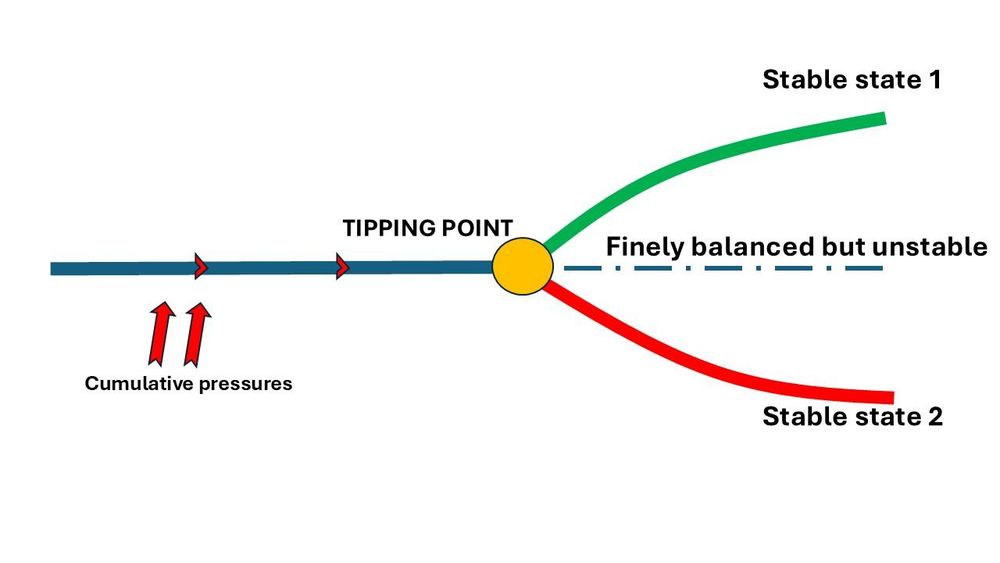
✌️The second is a PITCHFORK bifurcation. This is where the cumulation of pressure takes the ecosystem to an unstable state where it could tip one way or another depending on small perturbations in the ecosystem.
June 13, 2025 at 5:43 AM
✌️The second is a PITCHFORK bifurcation. This is where the cumulation of pressure takes the ecosystem to an unstable state where it could tip one way or another depending on small perturbations in the ecosystem.