



Fabian Schneider
@fabianschneider.bsky.social
Doctoral researcher at the University Medical Centre Hamburg-Eppendorf (UKE). Interested in memory, audition, semantics, neural coding, spiking networks.
http://mvpy.tools
http://mvpy.tools
Pinned

Sensory sharpening and semantic prediction errors unify competing models of predictive processing in human speech comprehension
Speech comprehension relies on predictive mechanisms, but models disagree on whether the brain prioritizes expected or unexpected information. This study shows that sharpening of sensory representatio...
dx.plos.org
Same sound, different perception: Do expectations change what you hear?👂🧠
We paired faces w topics and played the same ambiguous speech w different faces. The brain sharpened sensory signals toward predictions and showed gated prediction errors at higher levels.
Read @plosbiology.org. Blueprint👇
We paired faces w topics and played the same ambiguous speech w different faces. The brain sharpened sensory signals toward predictions and showed gated prediction errors at higher levels.
Read @plosbiology.org. Blueprint👇
Reposted by Fabian Schneider

Our work with @georgkeller.bsky.social on testing predictive processing (PP) models in cortex is out on biorvix now! www.biorxiv.org/content/10.6... A short thread on our findings and thoughts on where we should move on from PP below.
A functional influence based circuit motif that constrains the set of plausible algorithms of cortical function
There are several plausible algorithms for cortical function that are specific enough to make testable predictions of the interactions between functionally identified cell types. Many of these algorithms are based on some variant of predictive processing. Here we set out to experimentally distinguish between two such predictive processing variants. A central point of variability between them lies in the proposed vertical communication between layer 2/3 and layer 5, which stems from the diverging assumptions about the computational role of layer 5. One assumes a hierarchically organized architecture and proposes that, within a given node of the network, layer 5 conveys unexplained bottom-up input to prediction error neurons of layer 2/3. The other proposes a non-hierarchical architecture in which internal representation neurons of layer 5 provide predictions for the local prediction error neurons of layer 2/3. We show that the functional influence of layer 2/3 cell types on layer 5 is incompatible with the hierarchical variant, while the functional influence of layer 5 cell types on prediction error neurons of layer 2/3 is incompatible with the non-hierarchical variant. Given these data, we can constrain the space of plausible algorithms of cortical function. We propose a model for cortical function based on a combination of a joint embedding predictive architecture (JEPA) and predictive processing that makes experimentally testable predictions. ### Competing Interest Statement The authors have declared no competing interest. Swiss National Science Foundation, https://ror.org/00yjd3n13 Novartis Foundation, https://ror.org/04f9t1x17 European Research Council, https://ror.org/0472cxd90, 865617
www.biorxiv.org
January 30, 2026 at 2:37 PM
Our work with @georgkeller.bsky.social on testing predictive processing (PP) models in cortex is out on biorvix now! www.biorxiv.org/content/10.6... A short thread on our findings and thoughts on where we should move on from PP below.
Reposted by Fabian Schneider
Same sound, different perception: Do expectations change what you hear?👂🧠
We paired faces w topics and played the same ambiguous speech w different faces. The brain sharpened sensory signals toward predictions and showed gated prediction errors at higher levels.
Read @plosbiology.org. Blueprint👇
We paired faces w topics and played the same ambiguous speech w different faces. The brain sharpened sensory signals toward predictions and showed gated prediction errors at higher levels.
Read @plosbiology.org. Blueprint👇
Sensory sharpening and semantic prediction errors unify competing models of predictive processing in human speech comprehension
Speech comprehension relies on predictive mechanisms, but models disagree on whether the brain prioritizes expected or unexpected information. This study shows that sharpening of sensory representatio...
dx.plos.org
January 12, 2026 at 10:34 AM
Same sound, different perception: Do expectations change what you hear?👂🧠
We paired faces w topics and played the same ambiguous speech w different faces. The brain sharpened sensory signals toward predictions and showed gated prediction errors at higher levels.
Read @plosbiology.org. Blueprint👇
We paired faces w topics and played the same ambiguous speech w different faces. The brain sharpened sensory signals toward predictions and showed gated prediction errors at higher levels.
Read @plosbiology.org. Blueprint👇
Same sound, different perception: Do expectations change what you hear?👂🧠
We paired faces w topics and played the same ambiguous speech w different faces. The brain sharpened sensory signals toward predictions and showed gated prediction errors at higher levels.
Read @plosbiology.org. Blueprint👇
We paired faces w topics and played the same ambiguous speech w different faces. The brain sharpened sensory signals toward predictions and showed gated prediction errors at higher levels.
Read @plosbiology.org. Blueprint👇
Sensory sharpening and semantic prediction errors unify competing models of predictive processing in human speech comprehension
Speech comprehension relies on predictive mechanisms, but models disagree on whether the brain prioritizes expected or unexpected information. This study shows that sharpening of sensory representatio...
dx.plos.org
January 12, 2026 at 10:34 AM
Same sound, different perception: Do expectations change what you hear?👂🧠
We paired faces w topics and played the same ambiguous speech w different faces. The brain sharpened sensory signals toward predictions and showed gated prediction errors at higher levels.
Read @plosbiology.org. Blueprint👇
We paired faces w topics and played the same ambiguous speech w different faces. The brain sharpened sensory signals toward predictions and showed gated prediction errors at higher levels.
Read @plosbiology.org. Blueprint👇
Reposted by Fabian Schneider

After 5 years of data collection, our WARN-D machine learning competition to forecast depression onset is now LIVE! We hope many of you will participate—we have incredibly rich data.
If you share a single thing of my lab this year, please make it this competition.
eiko-fried.com/warn-d-machi...
If you share a single thing of my lab this year, please make it this competition.
eiko-fried.com/warn-d-machi...

WARN-D machine learning competition is live » Eiko Fried
If you share one single thing of our team in 2026—on social media or per email with your colleagues—please let it be this machine learning competition. It was half a decade of work to get here, especi...
eiko-fried.com
January 7, 2026 at 7:39 PM
After 5 years of data collection, our WARN-D machine learning competition to forecast depression onset is now LIVE! We hope many of you will participate—we have incredibly rich data.
If you share a single thing of my lab this year, please make it this competition.
eiko-fried.com/warn-d-machi...
If you share a single thing of my lab this year, please make it this competition.
eiko-fried.com/warn-d-machi...
Reposted by Fabian Schneider

Introducing CorText: a framework that fuses brain data directly into a large language model, allowing for interactive neural readout using natural language.
tl;dr: you can now chat with a brain scan 🧠💬
1/n
tl;dr: you can now chat with a brain scan 🧠💬
1/n

November 3, 2025 at 3:17 PM
Introducing CorText: a framework that fuses brain data directly into a large language model, allowing for interactive neural readout using natural language.
tl;dr: you can now chat with a brain scan 🧠💬
1/n
tl;dr: you can now chat with a brain scan 🧠💬
1/n
Reposted by Fabian Schneider

How well do classifiers trained on visual activity actually transfer to non-visual reactivation?
#Decoding studies often rely on training in one (visual) condition and applying it to another (e.g. rest-reactivation). However: How well does this work? Show us what makes it work and win up to 1000$!
#Decoding studies often rely on training in one (visual) condition and applying it to another (e.g. rest-reactivation). However: How well does this work? Show us what makes it work and win up to 1000$!
IMAGINE-decoding-challenge
Predict which words participants were hearing, based upon brain activity recordings of visually seeing these items?
www.kaggle.com
October 24, 2025 at 6:55 AM
How well do classifiers trained on visual activity actually transfer to non-visual reactivation?
#Decoding studies often rely on training in one (visual) condition and applying it to another (e.g. rest-reactivation). However: How well does this work? Show us what makes it work and win up to 1000$!
#Decoding studies often rely on training in one (visual) condition and applying it to another (e.g. rest-reactivation). However: How well does this work? Show us what makes it work and win up to 1000$!
Reposted by Fabian Schneider

🧠 Regularization, Action, and Attractors in the Dynamical “Bayesian” Brain
direct.mit.edu/jocn/article...
(still uncorrected proofs, but they should post the corrected one soon--also OA is forthcoming, for now PDF at brainandexperience.org/pdf/10.1162-...)
direct.mit.edu/jocn/article...
(still uncorrected proofs, but they should post the corrected one soon--also OA is forthcoming, for now PDF at brainandexperience.org/pdf/10.1162-...)

Regularization, Action, and Attractors in the Dynamical “Bayesian” Brain
Abstract. The idea that the brain is a probabilistic (Bayesian) inference machine, continuously trying to figure out the hidden causes of its inputs, has become very influential in cognitive (neuro)sc...
direct.mit.edu
October 22, 2025 at 8:59 AM
🧠 Regularization, Action, and Attractors in the Dynamical “Bayesian” Brain
direct.mit.edu/jocn/article...
(still uncorrected proofs, but they should post the corrected one soon--also OA is forthcoming, for now PDF at brainandexperience.org/pdf/10.1162-...)
direct.mit.edu/jocn/article...
(still uncorrected proofs, but they should post the corrected one soon--also OA is forthcoming, for now PDF at brainandexperience.org/pdf/10.1162-...)
Reposted by Fabian Schneider

In neuroscience, we often try to understand systems by analyzing their representations — using tools like regression or RSA. But are these analyses biased towards discovering a subset of what a system represents? If you're interested in this question, check out our new commentary! Thread:
![What do representations tell us about a system? Image of a mouse with a scope showing a vector of activity patterns, and a neural network with a vector of unit activity patterns
Common analyses of neural representations: Encoding models (relating activity to task features) drawing of an arrow from a trace saying [on_____on____] to a neuron and spike train. Comparing models via neural predictivity: comparing two neural networks by their R^2 to mouse brain activity. RSA: assessing brain-brain or model-brain correspondence using representational dissimilarity matrices](https://cdn.bsky.app/img/feed_thumbnail/plain/did:plc:e6ewzleebkdi2y2bxhjxoknt/bafkreiav2io2ska33o4kizf57co5bboqyyfdpnozo2gxsicrfr5l7qzjcq@jpeg)
August 5, 2025 at 2:36 PM
In neuroscience, we often try to understand systems by analyzing their representations — using tools like regression or RSA. But are these analyses biased towards discovering a subset of what a system represents? If you're interested in this question, check out our new commentary! Thread:
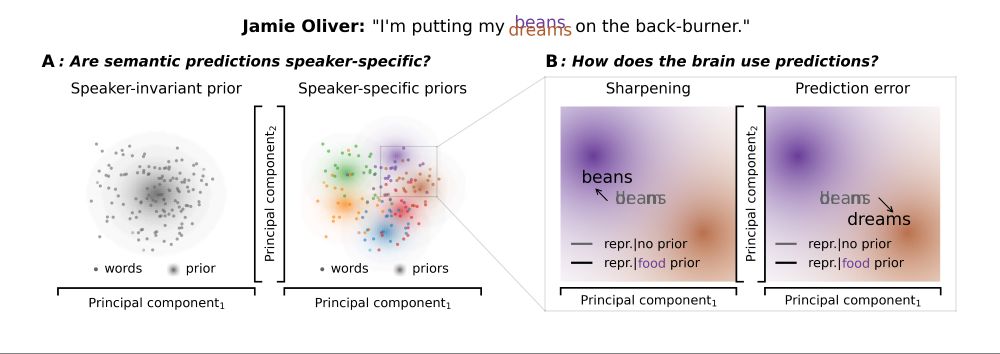
🚨 Fresh preprint w/ @helenblank.bsky.social!
How does the brain acquire expectations about a conversational partner, and how are priors integrated w/ sensory inputs?
Current evidence diverges. Is it prediction error? Sharpening?
Spoiler: It's both.👀
🧵1/16
www.biorxiv.org/content/10.1...
How does the brain acquire expectations about a conversational partner, and how are priors integrated w/ sensory inputs?
Current evidence diverges. Is it prediction error? Sharpening?
Spoiler: It's both.👀
🧵1/16
www.biorxiv.org/content/10.1...
August 1, 2025 at 11:24 AM
🚨 Fresh preprint w/ @helenblank.bsky.social!
How does the brain acquire expectations about a conversational partner, and how are priors integrated w/ sensory inputs?
Current evidence diverges. Is it prediction error? Sharpening?
Spoiler: It's both.👀
🧵1/16
www.biorxiv.org/content/10.1...
How does the brain acquire expectations about a conversational partner, and how are priors integrated w/ sensory inputs?
Current evidence diverges. Is it prediction error? Sharpening?
Spoiler: It's both.👀
🧵1/16
www.biorxiv.org/content/10.1...
Reposted by Fabian Schneider
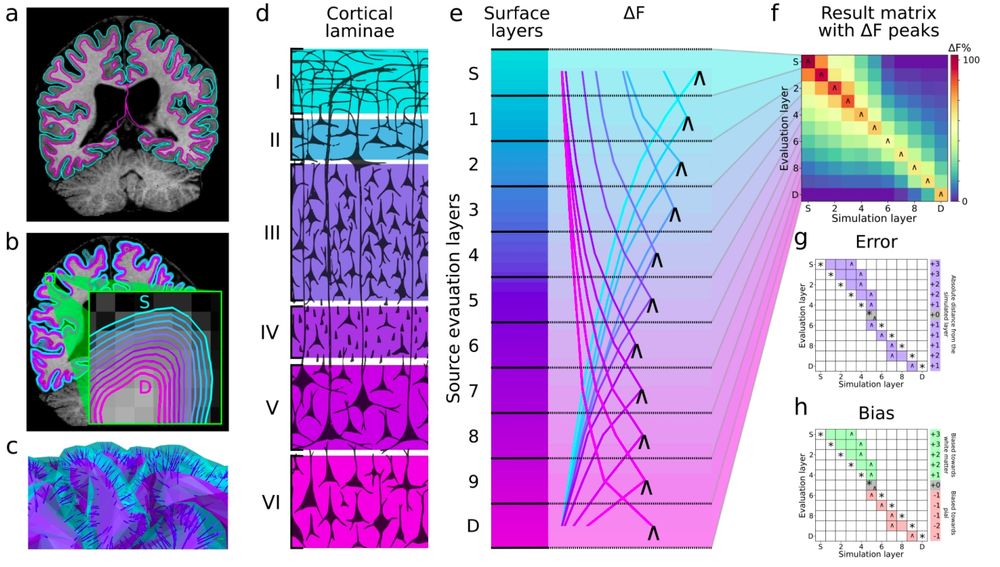
It's been a while since our last laminar MEG paper, but we're back! This time we push beyond deep versus superficial distinctions and go whole hog. Check it out- lots more exciting stuff to come! 🧠📈

🚨🚨🚨PREPRINT ALERT🚨🚨🚨
Neural dynamics across cortical layers are key to brain computations - but non-invasively, we’ve been limited to rough "deep vs. superficial" distinctions. What if we told you that it is possible to achieve full (TRUE!) laminar (I, II, III, IV, V, VI) precision with MEG!
Neural dynamics across cortical layers are key to brain computations - but non-invasively, we’ve been limited to rough "deep vs. superficial" distinctions. What if we told you that it is possible to achieve full (TRUE!) laminar (I, II, III, IV, V, VI) precision with MEG!
June 2, 2025 at 12:31 PM
It's been a while since our last laminar MEG paper, but we're back! This time we push beyond deep versus superficial distinctions and go whole hog. Check it out- lots more exciting stuff to come! 🧠📈