




EZ Lab
@ezlab.bsky.social
Arachnology / Evolutionary Zoology / Systematic Zoology / Behavioral Ecology / Biodiversity and Conservation / E-mail: eazylab@gmail
8/8
The discovery of Osmooka aphana highlights Madagascar’s tremendous, still-undescribed biodiversity—and the power of combining museum science, fieldwork, and genomics.
Open-access paper in Insect Systematics & Diversity: academic.oup.com/isd/article/...
The discovery of Osmooka aphana highlights Madagascar’s tremendous, still-undescribed biodiversity—and the power of combining museum science, fieldwork, and genomics.
Open-access paper in Insect Systematics & Diversity: academic.oup.com/isd/article/...

December 6, 2025 at 9:17 AM
8/8
The discovery of Osmooka aphana highlights Madagascar’s tremendous, still-undescribed biodiversity—and the power of combining museum science, fieldwork, and genomics.
Open-access paper in Insect Systematics & Diversity: academic.oup.com/isd/article/...
The discovery of Osmooka aphana highlights Madagascar’s tremendous, still-undescribed biodiversity—and the power of combining museum science, fieldwork, and genomics.
Open-access paper in Insect Systematics & Diversity: academic.oup.com/isd/article/...
7/8
Was this a relic of ancient Gondwana?
Probably not. Divergence dating puts their common ancestor at ~57 million years, long after Gondwana broke apart (~130 Ma).
The most likely explanation: Cenozoic long-distance dispersal.
Was this a relic of ancient Gondwana?
Probably not. Divergence dating puts their common ancestor at ~57 million years, long after Gondwana broke apart (~130 Ma).
The most likely explanation: Cenozoic long-distance dispersal.


December 6, 2025 at 9:16 AM
7/8
Was this a relic of ancient Gondwana?
Probably not. Divergence dating puts their common ancestor at ~57 million years, long after Gondwana broke apart (~130 Ma).
The most likely explanation: Cenozoic long-distance dispersal.
Was this a relic of ancient Gondwana?
Probably not. Divergence dating puts their common ancestor at ~57 million years, long after Gondwana broke apart (~130 Ma).
The most likely explanation: Cenozoic long-distance dispersal.
6/8
Morphology and phylogenomics together place both genera in the family Paraplectanoididae, which now expands beyond a single genus—reshaping spider family-level classification.
Morphology and phylogenomics together place both genera in the family Paraplectanoididae, which now expands beyond a single genus—reshaping spider family-level classification.

December 6, 2025 at 9:15 AM
6/8
Morphology and phylogenomics together place both genera in the family Paraplectanoididae, which now expands beyond a single genus—reshaping spider family-level classification.
Morphology and phylogenomics together place both genera in the family Paraplectanoididae, which now expands beyond a single genus—reshaping spider family-level classification.
5/8
Genomic analyses delivered the biggest surprise:
Osmooka’s closest known relative is an Australian spider, Paraplectanoides.
A Madagascar–Australia link with no known intermediates.
Genomic analyses delivered the biggest surprise:
Osmooka’s closest known relative is an Australian spider, Paraplectanoides.
A Madagascar–Australia link with no known intermediates.

December 6, 2025 at 9:14 AM
5/8
Genomic analyses delivered the biggest surprise:
Osmooka’s closest known relative is an Australian spider, Paraplectanoides.
A Madagascar–Australia link with no known intermediates.
Genomic analyses delivered the biggest surprise:
Osmooka’s closest known relative is an Australian spider, Paraplectanoides.
A Madagascar–Australia link with no known intermediates.
4/8
To find more, the team conducted intensive fieldwork in northern Madagascar with Malagasy collaborators. Even with targeted searches, they found just one male in 2022 and several females in 2024.
To find more, the team conducted intensive fieldwork in northern Madagascar with Malagasy collaborators. Even with targeted searches, they found just one male in 2022 and several females in 2024.


December 6, 2025 at 9:13 AM
4/8
To find more, the team conducted intensive fieldwork in northern Madagascar with Malagasy collaborators. Even with targeted searches, they found just one male in 2022 and several females in 2024.
To find more, the team conducted intensive fieldwork in northern Madagascar with Malagasy collaborators. Even with targeted searches, they found just one male in 2022 and several females in 2024.
3/8
The male was first noticed in a San Francisco museum collection, where it didn’t fit any known spider family. A matching female later surfaced at the Smithsonian, collected back in 1993.
The male was first noticed in a San Francisco museum collection, where it didn’t fit any known spider family. A matching female later surfaced at the Smithsonian, collected back in 1993.


December 6, 2025 at 9:12 AM
3/8
The male was first noticed in a San Francisco museum collection, where it didn’t fit any known spider family. A matching female later surfaced at the Smithsonian, collected back in 1993.
The male was first noticed in a San Francisco museum collection, where it didn’t fit any known spider family. A matching female later surfaced at the Smithsonian, collected back in 1993.
2/8
This species is exceptionally rare—only eight adult specimens exist worldwide, collected across 30 years from museum archives and two recent expeditions (2022 & 2024).
This species is exceptionally rare—only eight adult specimens exist worldwide, collected across 30 years from museum archives and two recent expeditions (2022 & 2024).


December 6, 2025 at 9:10 AM
2/8
This species is exceptionally rare—only eight adult specimens exist worldwide, collected across 30 years from museum archives and two recent expeditions (2022 & 2024).
This species is exceptionally rare—only eight adult specimens exist worldwide, collected across 30 years from museum archives and two recent expeditions (2022 & 2024).
1/8
A new spider genus from Madagascar!
Researchers led by Matjaž Kuntner (National Institute of Biology, Slovenia) have described Osmooka aphana, discovered in the montane forests of Marojejy National Park.
A new spider genus from Madagascar!
Researchers led by Matjaž Kuntner (National Institute of Biology, Slovenia) have described Osmooka aphana, discovered in the montane forests of Marojejy National Park.

December 6, 2025 at 9:09 AM
1/8
A new spider genus from Madagascar!
Researchers led by Matjaž Kuntner (National Institute of Biology, Slovenia) have described Osmooka aphana, discovered in the montane forests of Marojejy National Park.
A new spider genus from Madagascar!
Researchers led by Matjaž Kuntner (National Institute of Biology, Slovenia) have described Osmooka aphana, discovered in the montane forests of Marojejy National Park.
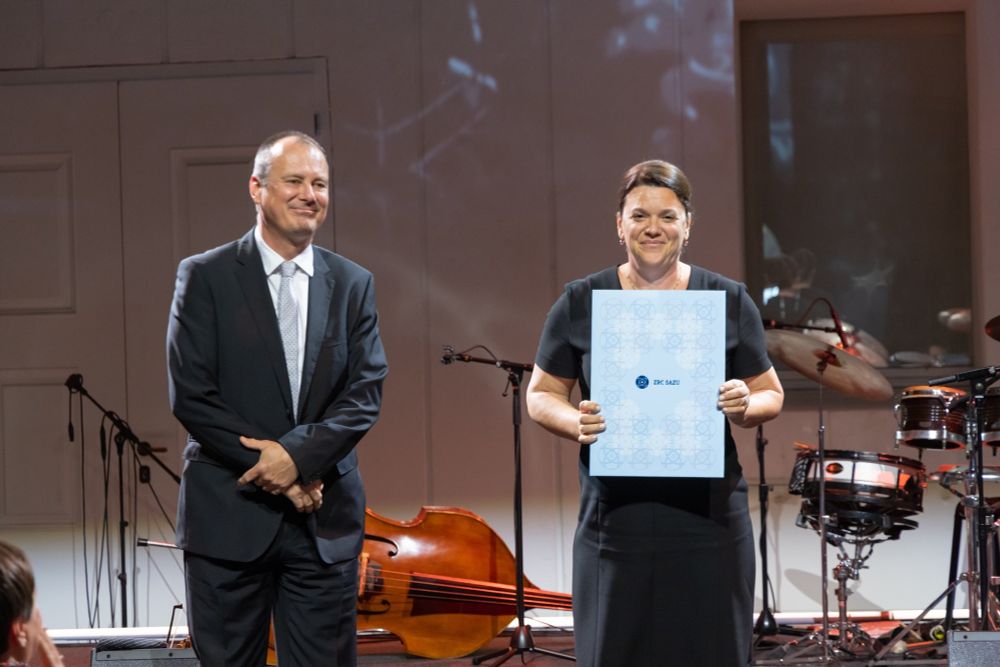
On Thursday, the XXXI. "Generations of Science" were held at ZRC SAZU. Among the awardees was our Simona Kralj-Fišer, who received the ZRC SAZU Gold Award for top scientific research results. The award was presented to her by the former awardee and colleague, our Matjaž Kuntner.
Congratulations!
Congratulations!
April 14, 2025 at 6:27 AM
On Thursday, the XXXI. "Generations of Science" were held at ZRC SAZU. Among the awardees was our Simona Kralj-Fišer, who received the ZRC SAZU Gold Award for top scientific research results. The award was presented to her by the former awardee and colleague, our Matjaž Kuntner.
Congratulations!
Congratulations!
New pub! Investigating surface/cave isopods, we test the fluctuating selection hypothesis that suggests genetic and phenotypic variation scales with fluctuations in selection over space and time. Results support the hypothesis for movement activity but not risk-taking.
www.ezlab.si/post/varianc...
www.ezlab.si/post/varianc...

February 11, 2025 at 12:12 PM
New pub! Investigating surface/cave isopods, we test the fluctuating selection hypothesis that suggests genetic and phenotypic variation scales with fluctuations in selection over space and time. Results support the hypothesis for movement activity but not risk-taking.
www.ezlab.si/post/varianc...
www.ezlab.si/post/varianc...