




Eleonora Guarnieri
@eleonoraguarnieri.bsky.social
Assistant Professor in Economics, University of Bristol || From Val di Rabbi, Trentino, Italy
https://sites.google.com/view/eleonora-guarnieri
https://sites.google.com/view/eleonora-guarnieri
Thanks to all the participants for a fantastic development economics workshop!
The 2025 Bristol Applied Economics Meetings (BÆM) are not over yet. Tomorrow we continue with the meeting on “Gender, Diversity, and Human Capital.” www.baem.info
The 2025 Bristol Applied Economics Meetings (BÆM) are not over yet. Tomorrow we continue with the meeting on “Gender, Diversity, and Human Capital.” www.baem.info

May 7, 2025 at 4:00 PM
Thanks to all the participants for a fantastic development economics workshop!
The 2025 Bristol Applied Economics Meetings (BÆM) are not over yet. Tomorrow we continue with the meeting on “Gender, Diversity, and Human Capital.” www.baem.info
The 2025 Bristol Applied Economics Meetings (BÆM) are not over yet. Tomorrow we continue with the meeting on “Gender, Diversity, and Human Capital.” www.baem.info
Last up is Devesh Rustagi @warwickecon.bsky.social showing that managing the commons may require both formal rules and civic capital. In managing forests in Ethiopia, combining civic capital with rules deters free-riding and improves cooperation.
Paper: drive.google.com/file/d/1u1lF...
Paper: drive.google.com/file/d/1u1lF...

May 7, 2025 at 11:12 AM
Last up is Devesh Rustagi @warwickecon.bsky.social showing that managing the commons may require both formal rules and civic capital. In managing forests in Ethiopia, combining civic capital with rules deters free-riding and improves cooperation.
Paper: drive.google.com/file/d/1u1lF...
Paper: drive.google.com/file/d/1u1lF...
Do training and data provision help local decision-makers target beneficiaries of social policies? Not necessarily. @violaasri.bsky.social finds that targeting in Bangladesh only improved along easily observable traits, and if committees had educated chairs.
Paper: docs.iza.org/dp17365.pdf
Paper: docs.iza.org/dp17365.pdf

May 7, 2025 at 10:37 AM
Do training and data provision help local decision-makers target beneficiaries of social policies? Not necessarily. @violaasri.bsky.social finds that targeting in Bangladesh only improved along easily observable traits, and if committees had educated chairs.
Paper: docs.iza.org/dp17365.pdf
Paper: docs.iza.org/dp17365.pdf
Can public infrastructure investments boost tax morale? @climent.bsky.social shows that randomized street paving in Mexico increased local tax compliance by 5.5% via both public goods provision and improved beliefs about government efficiency.
Paper: econ.hkust.edu.hk/sites/econom...
Paper: econ.hkust.edu.hk/sites/econom...

May 7, 2025 at 9:41 AM
Can public infrastructure investments boost tax morale? @climent.bsky.social shows that randomized street paving in Mexico increased local tax compliance by 5.5% via both public goods provision and improved beliefs about government efficiency.
Paper: econ.hkust.edu.hk/sites/econom...
Paper: econ.hkust.edu.hk/sites/econom...
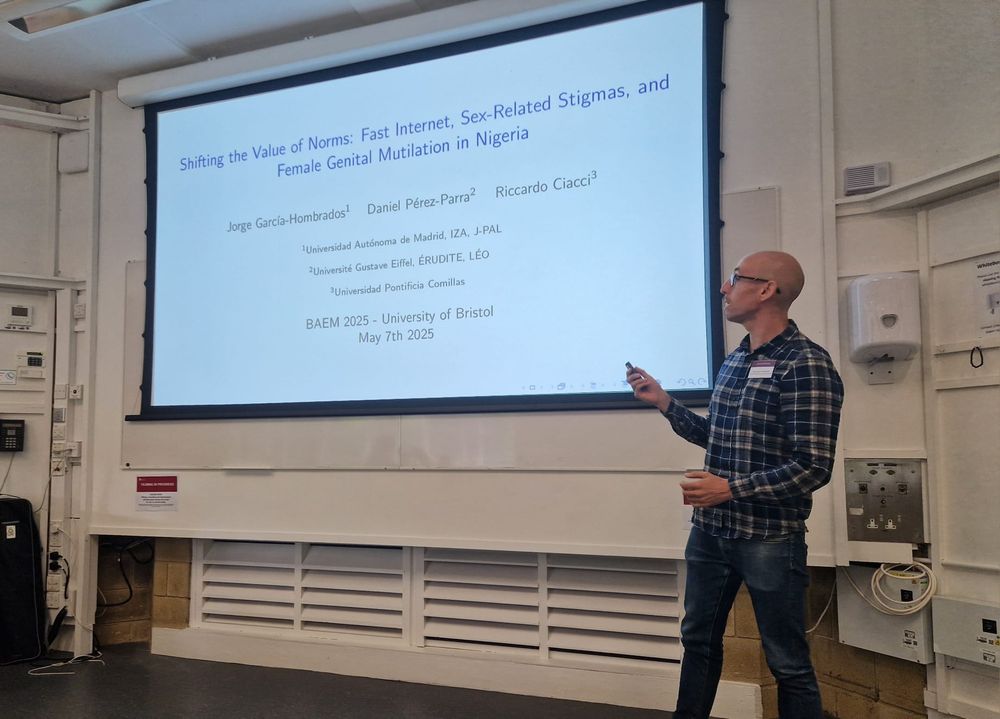
Jorge Garcia Hombrados presents evidence from Nigeria that fast internet reduces female genital mutilation. Not by spreading anti-FGM content, but by reshaping women’s broader identity with less stigma around promiscuous behaviors and premarital sex.
Paper: docs.iza.org/dp17194.pdf
Paper: docs.iza.org/dp17194.pdf
May 7, 2025 at 9:10 AM
Jorge Garcia Hombrados presents evidence from Nigeria that fast internet reduces female genital mutilation. Not by spreading anti-FGM content, but by reshaping women’s broader identity with less stigma around promiscuous behaviors and premarital sex.
Paper: docs.iza.org/dp17194.pdf
Paper: docs.iza.org/dp17194.pdf
Karmini Sharma shows that job seekers in India would trade 5-13% of their salary for safety from anti-sexual harassment. But firms misjudge both anti-harassment legislation and worker demand and underinvest in such amenities, even after being provided with more information.

May 7, 2025 at 8:35 AM
Karmini Sharma shows that job seekers in India would trade 5-13% of their salary for safety from anti-sexual harassment. But firms misjudge both anti-harassment legislation and worker demand and underinvest in such amenities, even after being provided with more information.
Does mass media shape identity? @deanyang.bsky.social presents evidence that the Ramayan TV show, a popular adaptation of the Hindu epic broadcast in India in 1987-88, led to stronger Hindu identity, more communal violence, and long-run BJP electoral gains.
Paper: www.nber.org/system/files...
Paper: www.nber.org/system/files...

May 6, 2025 at 4:13 PM
Does mass media shape identity? @deanyang.bsky.social presents evidence that the Ramayan TV show, a popular adaptation of the Hindu epic broadcast in India in 1987-88, led to stronger Hindu identity, more communal violence, and long-run BJP electoral gains.
Paper: www.nber.org/system/files...
Paper: www.nber.org/system/files...
@clementminaudier.bsky.social shows that digitizing land records in Punjab reduced agricultural tax collection. Digitization did not lower the tax base but weakened state capacity to collect taxes by disrupting the bureaucracy’s organization.
Paper: www.clementminaudier.com/ARM_Digitiza...
Paper: www.clementminaudier.com/ARM_Digitiza...

May 6, 2025 at 3:35 PM
@clementminaudier.bsky.social shows that digitizing land records in Punjab reduced agricultural tax collection. Digitization did not lower the tax base but weakened state capacity to collect taxes by disrupting the bureaucracy’s organization.
Paper: www.clementminaudier.com/ARM_Digitiza...
Paper: www.clementminaudier.com/ARM_Digitiza...
@maxposch.bsky.social shows that increased market access induced by railroad expansion and population growth in the US between 1850 and 1920 fostered a set of cultural traits associated with cooperation. Mechanism: economic interdependence.

May 6, 2025 at 2:37 PM
@maxposch.bsky.social shows that increased market access induced by railroad expansion and population growth in the US between 1850 and 1920 fostered a set of cultural traits associated with cooperation. Mechanism: economic interdependence.
Shunsuke Tsuda shows that interethnic proximity fosters long-run political and economic development in Malaysia. Communities exposed to Chinese ethnic camps set up by the colonial government display more economic prosperity and less ethnonationalism: stsuda.github.io/mypolitics_K...

May 6, 2025 at 2:07 PM
Shunsuke Tsuda shows that interethnic proximity fosters long-run political and economic development in Malaysia. Communities exposed to Chinese ethnic camps set up by the colonial government display more economic prosperity and less ethnonationalism: stsuda.github.io/mypolitics_K...
@saralowes.bsky.social delivers a keynote lecture on "Culture and Development Policy" discussing how culture shapes incentives, persists and evolves, and documenting cultural mismatches between policymakers and target populations

May 6, 2025 at 1:20 PM
@saralowes.bsky.social delivers a keynote lecture on "Culture and Development Policy" discussing how culture shapes incentives, persists and evolves, and documenting cultural mismatches between policymakers and target populations
@andregroeger.bsky.social estimates a dynamic structural model of farm production using high-quality data from Vietnam to quantify the relative importance of market frictions and technological constraints in limiting farmers’ ability to adjust production to changing conditions.

May 6, 2025 at 11:11 AM
@andregroeger.bsky.social estimates a dynamic structural model of farm production using high-quality data from Vietnam to quantify the relative importance of market frictions and technological constraints in limiting farmers’ ability to adjust production to changing conditions.
Masahiro Kubo uncovers the historical origins of Islamist insurgencies in West Africa. Jihad violence is concentrated along the trans-Saharan caravan routes, where landlocked cities played a key role before European colonization.
Paper: stsuda.github.io/draft_IslamH...
Paper: stsuda.github.io/draft_IslamH...

May 6, 2025 at 10:38 AM
Masahiro Kubo uncovers the historical origins of Islamist insurgencies in West Africa. Jihad violence is concentrated along the trans-Saharan caravan routes, where landlocked cities played a key role before European colonization.
Paper: stsuda.github.io/draft_IslamH...
Paper: stsuda.github.io/draft_IslamH...
Natalia Guerrero Trinidad shows that a non-state security arrangement in Peru—the Peasant Rounds—generated long-lasting reductions in criminality and conflict by fostering social capital. The research highlights the importance of bottom-up structures in weak state capacity settings.

May 6, 2025 at 9:38 AM
Natalia Guerrero Trinidad shows that a non-state security arrangement in Peru—the Peasant Rounds—generated long-lasting reductions in criminality and conflict by fostering social capital. The research highlights the importance of bottom-up structures in weak state capacity settings.
Héctor Paredes Castro looks at the effects of a land expropriation and redistribution process in Peru on local political competition. The reform increased the number of contesting parties, voter turnout, and the participation of more educated, older, and indigenous candidates.

May 6, 2025 at 9:07 AM
Héctor Paredes Castro looks at the effects of a land expropriation and redistribution process in Peru on local political competition. The reform increased the number of contesting parties, voter turnout, and the participation of more educated, older, and indigenous candidates.
First up is @andreaslink.bsky.social, who finds that preventing “conflict diamonds” from entering world markets reduces armed conflicts in Africa, underscoring the importance of international initiatives in fostering peace.
Paper: bit.ly/3PgdeHL
Paper: bit.ly/3PgdeHL

May 6, 2025 at 8:40 AM
First up is @andreaslink.bsky.social, who finds that preventing “conflict diamonds” from entering world markets reduces armed conflicts in Africa, underscoring the importance of international initiatives in fostering peace.
Paper: bit.ly/3PgdeHL
Paper: bit.ly/3PgdeHL