




Cody Moser
@culturologies.co
Assistant Professor, UM6P School of Collective Intelligence | PhD UCMCogSci: collective intelligence, systems collapse, complex systems, networks, etc.
You can check out the pre-print here:
Moser, C., & Smaldino, P.E. (2025). Limit Cycles in Opinion Dynamic Networks with Competing Stubborn Agents.
osf.io/preprints/so...
Moser, C., & Smaldino, P.E. (2025). Limit Cycles in Opinion Dynamic Networks with Competing Stubborn Agents.
osf.io/preprints/so...

December 1, 2025 at 10:31 AM
You can check out the pre-print here:
Moser, C., & Smaldino, P.E. (2025). Limit Cycles in Opinion Dynamic Networks with Competing Stubborn Agents.
osf.io/preprints/so...
Moser, C., & Smaldino, P.E. (2025). Limit Cycles in Opinion Dynamic Networks with Competing Stubborn Agents.
osf.io/preprints/so...
Several implications emerge regarding online information architectures: the space of analytic solutions is constrained by networks with these cycles. Second, in an increasingly connected world, more leverage points exist for nefarious actors to disrupt our online ecosystems.
December 1, 2025 at 10:31 AM
Several implications emerge regarding online information architectures: the space of analytic solutions is constrained by networks with these cycles. Second, in an increasingly connected world, more leverage points exist for nefarious actors to disrupt our online ecosystems.
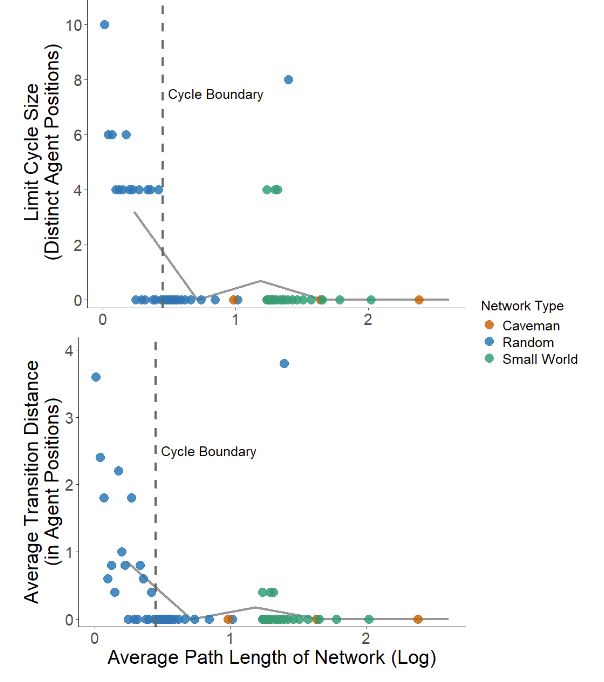
Importantly, the length and complexity of these cycles is dependent on the path length of the network: in centralized networks, centrality is devalued such that multiple optimal positions emerge and agents spend more time chasing optimal positions in these cycles.
December 1, 2025 at 10:31 AM
Importantly, the length and complexity of these cycles is dependent on the path length of the network: in centralized networks, centrality is devalued such that multiple optimal positions emerge and agents spend more time chasing optimal positions in these cycles.
Known as the counter-optimal stubborn agent placement problem, previous research has looked at the use of greedy algorithms for finding optimal positions in this NP-hard task.
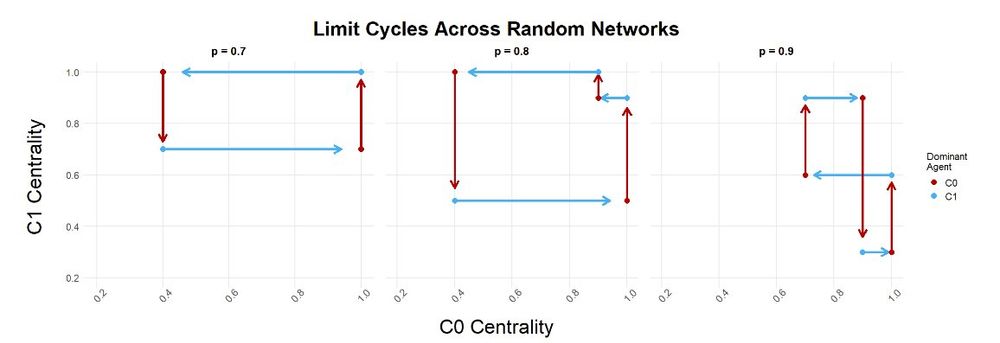
We find that as agents attempt to disrupt each other certain network configurations lead to limit cycles in agent position.
We find that as agents attempt to disrupt each other certain network configurations lead to limit cycles in agent position.
December 1, 2025 at 10:31 AM
Known as the counter-optimal stubborn agent placement problem, previous research has looked at the use of greedy algorithms for finding optimal positions in this NP-hard task.
We find that as agents attempt to disrupt each other certain network configurations lead to limit cycles in agent position.
We find that as agents attempt to disrupt each other certain network configurations lead to limit cycles in agent position.
We examine agent positioning strategies with repeated iterations: once a node has established its optimal influence over a network, we ask how counter-stubborn agents with opposite opinions can "disrupt" the influence of their counterpart.

December 1, 2025 at 10:31 AM
We examine agent positioning strategies with repeated iterations: once a node has established its optimal influence over a network, we ask how counter-stubborn agents with opposite opinions can "disrupt" the influence of their counterpart.

I appreciate these comments, by the way, this is good for tightening up the text in the paper to specify what we are doing. Thank you!
April 24, 2025 at 6:47 PM
I appreciate these comments, by the way, this is good for tightening up the text in the paper to specify what we are doing. Thank you!
I agree we can't judge accuracy, hence we don't use it as a benchmark. We're looking for convergence in the Collins dataset and merely used inter-rater reliability to see if the two came to similar classifications.
Sure, they probably used the same texts, but I don't see this as a problem.
Sure, they probably used the same texts, but I don't see this as a problem.
April 24, 2025 at 4:53 PM
I agree we can't judge accuracy, hence we don't use it as a benchmark. We're looking for convergence in the Collins dataset and merely used inter-rater reliability to see if the two came to similar classifications.
Sure, they probably used the same texts, but I don't see this as a problem.
Sure, they probably used the same texts, but I don't see this as a problem.
It probably could have helped increase the accuracy, but I am skeptical it had anything close to the edge lists from the book given we had to manually reconstruct them ourselves.
April 24, 2025 at 3:13 PM
It probably could have helped increase the accuracy, but I am skeptical it had anything close to the edge lists from the book given we had to manually reconstruct them ourselves.
This work aims to move beyond the traditional boundaries of philosophy of science and science of science, proposing here an emerging "science of philosophy".
Preprint here:
Moser, C. J., Ortega, A., & Marghetis, T. (2025). The network science of philosophy.
osf.io/ep3ub_v1
Preprint here:
Moser, C. J., Ortega, A., & Marghetis, T. (2025). The network science of philosophy.
osf.io/ep3ub_v1
OSF
osf.io
April 24, 2025 at 4:37 AM
This work aims to move beyond the traditional boundaries of philosophy of science and science of science, proposing here an emerging "science of philosophy".
Preprint here:
Moser, C. J., Ortega, A., & Marghetis, T. (2025). The network science of philosophy.
osf.io/ep3ub_v1
Preprint here:
Moser, C. J., Ortega, A., & Marghetis, T. (2025). The network science of philosophy.
osf.io/ep3ub_v1
What are the distinguishing factors of vital and static periods of philosophy? Vital communities are marked by the emergence of highly central figures who compress conversational space. These thinkers reorient the structure of debate, reinventing periods through synthesis, integration, reformation.


April 24, 2025 at 4:37 AM
What are the distinguishing factors of vital and static periods of philosophy? Vital communities are marked by the emergence of highly central figures who compress conversational space. These thinkers reorient the structure of debate, reinventing periods through synthesis, integration, reformation.
Vital and static communities do not differ in overall levels of disagreement, neither in static structure over time.
What sets vital communities apart is not amount of disagreement, but its organization. In vital periods, disagreement is restructured into productive and generative conversation.
What sets vital communities apart is not amount of disagreement, but its organization. In vital periods, disagreement is restructured into productive and generative conversation.

April 24, 2025 at 4:37 AM
Vital and static communities do not differ in overall levels of disagreement, neither in static structure over time.
What sets vital communities apart is not amount of disagreement, but its organization. In vital periods, disagreement is restructured into productive and generative conversation.
What sets vital communities apart is not amount of disagreement, but its organization. In vital periods, disagreement is restructured into productive and generative conversation.