



CelticStoic 🏴
@celticstoic.bsky.social
Chipping away at literature, history, and other interests,
whilst navigating stormy seas and a lee shore. #TodaysPoem #poetry
Locus: Massachusetts & the abyss of MECFS / FQAD
🌤️Sol Omnibus Lucet
– Petronius
whilst navigating stormy seas and a lee shore. #TodaysPoem #poetry
Locus: Massachusetts & the abyss of MECFS / FQAD
🌤️Sol Omnibus Lucet
– Petronius
I think I will do nothing for a long time but listen,
And accrue what I hear into myself . . . . and let sounds
contribute toward me.
- Walt Whitman, Leaves of Grass, c. 1855
From my wife's walk yesterday:
And accrue what I hear into myself . . . . and let sounds
contribute toward me.
- Walt Whitman, Leaves of Grass, c. 1855
From my wife's walk yesterday:

December 4, 2025 at 8:35 PM
I think I will do nothing for a long time but listen,
And accrue what I hear into myself . . . . and let sounds
contribute toward me.
- Walt Whitman, Leaves of Grass, c. 1855
From my wife's walk yesterday:
And accrue what I hear into myself . . . . and let sounds
contribute toward me.
- Walt Whitman, Leaves of Grass, c. 1855
From my wife's walk yesterday:
#HeartofDarkness
"She was savage and superb, wild-eyed and magnificent; there was something ominous and stately in her deliberate progress."
- Joseph Conrad
"She was savage and superb, wild-eyed and magnificent; there was something ominous and stately in her deliberate progress."
- Joseph Conrad

December 4, 2025 at 5:00 PM
#HeartofDarkness
"She was savage and superb, wild-eyed and magnificent; there was something ominous and stately in her deliberate progress."
- Joseph Conrad
"She was savage and superb, wild-eyed and magnificent; there was something ominous and stately in her deliberate progress."
- Joseph Conrad
#WhitmanWednesday 🌾
I play not a march for victors only . . . . I play great marches
for conquered and slain persons.
- Walt Whitman, 1855
I play not a march for victors only . . . . I play great marches
for conquered and slain persons.
- Walt Whitman, 1855

![• Frontispiece engraving of Walt Whitman [age 36] by Samuel Hollyer, based on a daguerreotype by Gabriel Harrison, for the first edition of Leaves of Grass, 1855, which was self-published.
• Source: Walt Whitman at the Lilly (curated by Christoph Irmscher), Indiana University Library, Bloomington.](https://cdn.bsky.app/img/feed_thumbnail/plain/did:plc:c7ex5lsw6ieo65txcbw7of2r/bafkreigd3a3skopsr6fyoz6afrhomv4vovetrodpszyr3yy4iw2shnovqm@jpeg)
December 3, 2025 at 8:23 PM
#WhitmanWednesday 🌾
I play not a march for victors only . . . . I play great marches
for conquered and slain persons.
- Walt Whitman, 1855
I play not a march for victors only . . . . I play great marches
for conquered and slain persons.
- Walt Whitman, 1855
December 3, 2025 at 8:16 PM
#JosephConrad
"They only showed that Mr Kurtz lacked restraint in the gratification of his various lusts, that there was something wanting in him—some small matter which, when the pressing need arose, could not be found under his magnificent eloquence."
Ch. 3
"They only showed that Mr Kurtz lacked restraint in the gratification of his various lusts, that there was something wanting in him—some small matter which, when the pressing need arose, could not be found under his magnificent eloquence."
Ch. 3
December 3, 2025 at 5:59 PM
#JosephConrad
"They only showed that Mr Kurtz lacked restraint in the gratification of his various lusts, that there was something wanting in him—some small matter which, when the pressing need arose, could not be found under his magnificent eloquence."
Ch. 3
"They only showed that Mr Kurtz lacked restraint in the gratification of his various lusts, that there was something wanting in him—some small matter which, when the pressing need arose, could not be found under his magnificent eloquence."
Ch. 3
Yesterday is History,
'Tis so far away –
Yesterday is Poetry –
'Tis Philosophy –
Yesterday is mystery –
Where it is Today
While we shrewdly speculate
Flutter both away
Emily Dickinson, c. 1873 (poem 1292)
'Tis so far away –
Yesterday is Poetry –
'Tis Philosophy –
Yesterday is mystery –
Where it is Today
While we shrewdly speculate
Flutter both away
Emily Dickinson, c. 1873 (poem 1292)


December 2, 2025 at 8:35 PM
Yesterday is History,
'Tis so far away –
Yesterday is Poetry –
'Tis Philosophy –
Yesterday is mystery –
Where it is Today
While we shrewdly speculate
Flutter both away
Emily Dickinson, c. 1873 (poem 1292)
'Tis so far away –
Yesterday is Poetry –
'Tis Philosophy –
Yesterday is mystery –
Where it is Today
While we shrewdly speculate
Flutter both away
Emily Dickinson, c. 1873 (poem 1292)
#JosephConrad
"Evidently the appetite for more ivory had got the better of the—what shall I say?—less material aspirations."
Ch. 3
"Evidently the appetite for more ivory had got the better of the—what shall I say?—less material aspirations."
Ch. 3
December 2, 2025 at 5:40 PM
#JosephConrad
"Evidently the appetite for more ivory had got the better of the—what shall I say?—less material aspirations."
Ch. 3
"Evidently the appetite for more ivory had got the better of the—what shall I say?—less material aspirations."
Ch. 3
#MelvilleMonday
"If there is poetry in my book about the sea, it is not because I deliberately put it there, but because no one could write truthfully about the sea and leave out the poetry."
- Rachel Carson, 1952
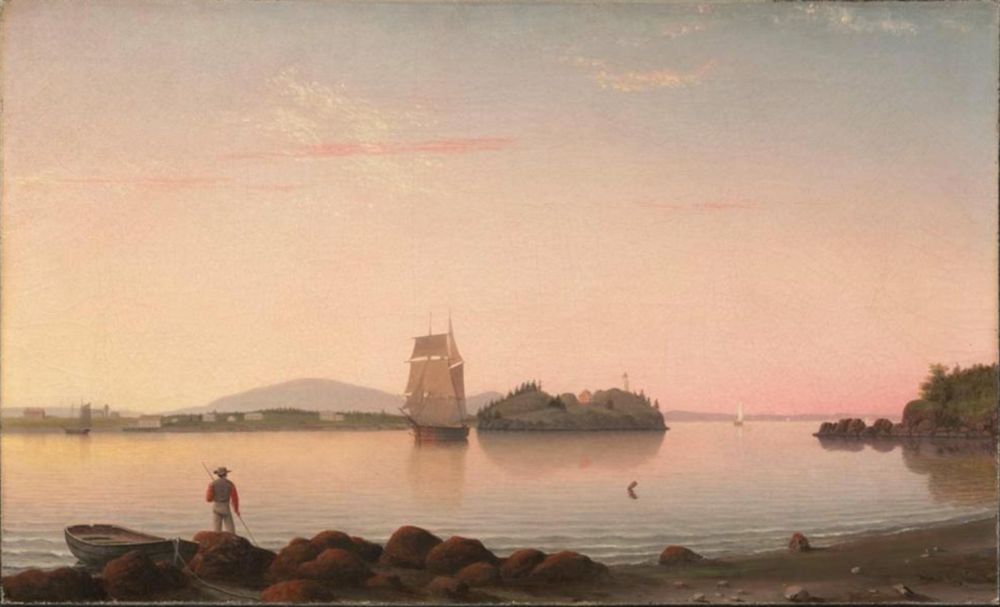
Fitz Henry Lane. Owl's Head, Penobscot Bay, Maine. 1862.
"If there is poetry in my book about the sea, it is not because I deliberately put it there, but because no one could write truthfully about the sea and leave out the poetry."
- Rachel Carson, 1952
Fitz Henry Lane. Owl's Head, Penobscot Bay, Maine. 1862.
December 1, 2025 at 9:25 PM
#MelvilleMonday
"If there is poetry in my book about the sea, it is not because I deliberately put it there, but because no one could write truthfully about the sea and leave out the poetry."
- Rachel Carson, 1952
Fitz Henry Lane. Owl's Head, Penobscot Bay, Maine. 1862.
"If there is poetry in my book about the sea, it is not because I deliberately put it there, but because no one could write truthfully about the sea and leave out the poetry."
- Rachel Carson, 1952
Fitz Henry Lane. Owl's Head, Penobscot Bay, Maine. 1862.
#JosephConrad
"If the absolutely pure, uncalculating, unpractical spirit of adventure had ever ruled a human being, it ruled this be-patched youth. I almost envied him the possession of this modest and clear flame."
Ch. 3
"If the absolutely pure, uncalculating, unpractical spirit of adventure had ever ruled a human being, it ruled this be-patched youth. I almost envied him the possession of this modest and clear flame."
Ch. 3

December 1, 2025 at 2:04 PM
#JosephConrad
"If the absolutely pure, uncalculating, unpractical spirit of adventure had ever ruled a human being, it ruled this be-patched youth. I almost envied him the possession of this modest and clear flame."
Ch. 3
"If the absolutely pure, uncalculating, unpractical spirit of adventure had ever ruled a human being, it ruled this be-patched youth. I almost envied him the possession of this modest and clear flame."
Ch. 3
On that specific Pillow
Our projects flit away -
The Night's tremendous Morrow
And whether sleep will stay
Or usher us - a stranger -
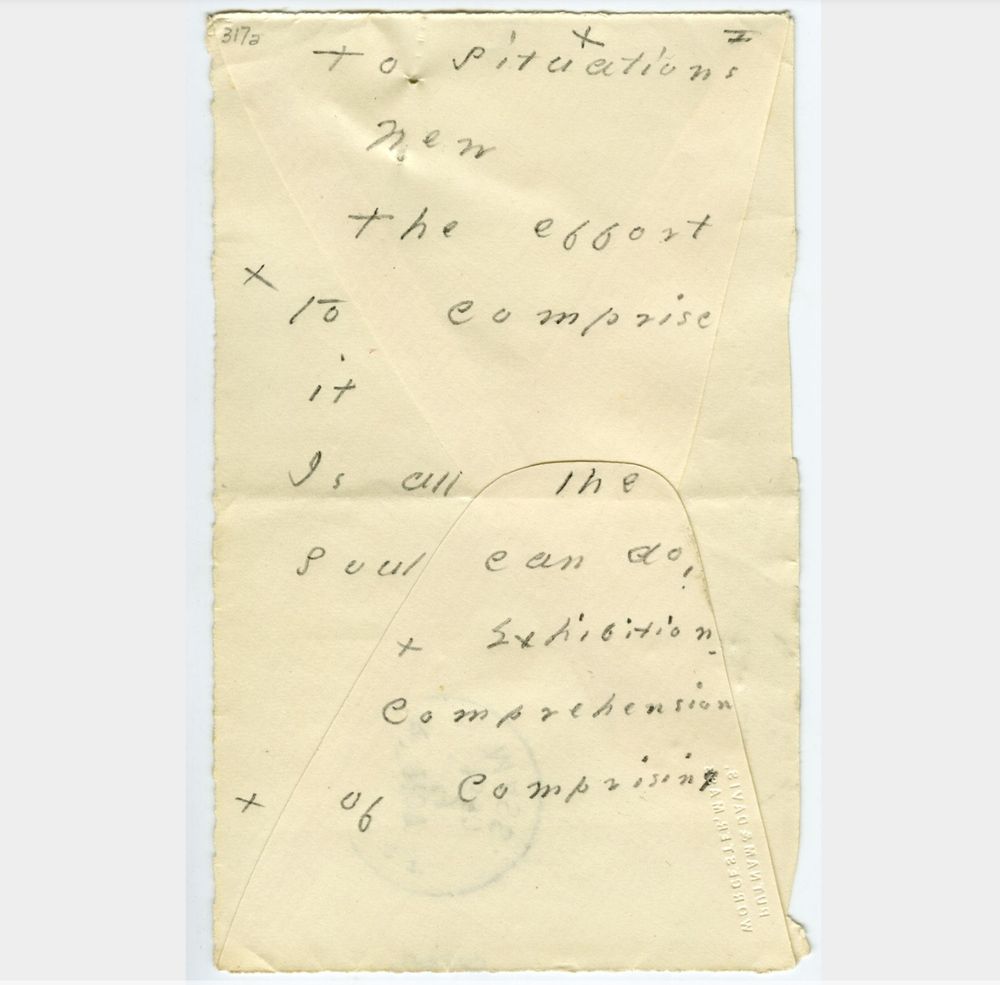
To situations new
The effort to comprise it
Is all the soul can do.
- Emily Dickinson, c. 1881
ED's draft written on the back of an envelope and a paper scrap:
Our projects flit away -
The Night's tremendous Morrow
And whether sleep will stay
Or usher us - a stranger -
To situations new
The effort to comprise it
Is all the soul can do.
- Emily Dickinson, c. 1881
ED's draft written on the back of an envelope and a paper scrap:

November 30, 2025 at 9:37 PM
On that specific Pillow
Our projects flit away -
The Night's tremendous Morrow
And whether sleep will stay
Or usher us - a stranger -
To situations new
The effort to comprise it
Is all the soul can do.
- Emily Dickinson, c. 1881
ED's draft written on the back of an envelope and a paper scrap:
Our projects flit away -
The Night's tremendous Morrow
And whether sleep will stay
Or usher us - a stranger -
To situations new
The effort to comprise it
Is all the soul can do.
- Emily Dickinson, c. 1881
ED's draft written on the back of an envelope and a paper scrap:
#SundaySentence
"We knew him in those unprotected days when we were content to hold in our hands our lives and our property."
- Joseph Conrad (Karain: A Memory)
"We knew him in those unprotected days when we were content to hold in our hands our lives and our property."
- Joseph Conrad (Karain: A Memory)
November 30, 2025 at 4:48 PM
#SundaySentence
"We knew him in those unprotected days when we were content to hold in our hands our lives and our property."
- Joseph Conrad (Karain: A Memory)
"We knew him in those unprotected days when we were content to hold in our hands our lives and our property."
- Joseph Conrad (Karain: A Memory)
#JosephConrad
"He had no restraint, no restraint— just like Kurtz—a tree swayed by the wind. […] Oh! he was heavy, heavy; heavier than any man on earth, I should imagine. Then without more ado I tipped him overboard."
Ch. 2
"He had no restraint, no restraint— just like Kurtz—a tree swayed by the wind. […] Oh! he was heavy, heavy; heavier than any man on earth, I should imagine. Then without more ado I tipped him overboard."
Ch. 2
November 29, 2025 at 6:12 PM
#JosephConrad
"He had no restraint, no restraint— just like Kurtz—a tree swayed by the wind. […] Oh! he was heavy, heavy; heavier than any man on earth, I should imagine. Then without more ado I tipped him overboard."
Ch. 2
"He had no restraint, no restraint— just like Kurtz—a tree swayed by the wind. […] Oh! he was heavy, heavy; heavier than any man on earth, I should imagine. Then without more ado I tipped him overboard."
Ch. 2
November 29, 2025 at 6:01 PM
Dedication to The Wizard of Oz (1939)🎬

November 29, 2025 at 5:02 PM
Dedication to The Wizard of Oz (1939)🎬
#JosephConrad
"The thing was to know what he belonged to, how many powers of darkness claimed him for their own. That was the reflection that made you creepy all over. […] He had taken a high seat amongst the devils of the land — I mean literally."
Ch. 2
"The thing was to know what he belonged to, how many powers of darkness claimed him for their own. That was the reflection that made you creepy all over. […] He had taken a high seat amongst the devils of the land — I mean literally."
Ch. 2
November 28, 2025 at 4:41 PM
#JosephConrad
"The thing was to know what he belonged to, how many powers of darkness claimed him for their own. That was the reflection that made you creepy all over. […] He had taken a high seat amongst the devils of the land — I mean literally."
Ch. 2
"The thing was to know what he belonged to, how many powers of darkness claimed him for their own. That was the reflection that made you creepy all over. […] He had taken a high seat amongst the devils of the land — I mean literally."
Ch. 2
~Thanksgiving~
This is the grass that grows wherever the land is and the
water is,
This is the common air that bathes the globe.
- Walt Whitman, Leaves of Grass, c. 1855
This is the grass that grows wherever the land is and the
water is,
This is the common air that bathes the globe.
- Walt Whitman, Leaves of Grass, c. 1855

November 27, 2025 at 8:33 PM
~Thanksgiving~
This is the grass that grows wherever the land is and the
water is,
This is the common air that bathes the globe.
- Walt Whitman, Leaves of Grass, c. 1855
This is the grass that grows wherever the land is and the
water is,
This is the common air that bathes the globe.
- Walt Whitman, Leaves of Grass, c. 1855
~Thanksgiving~
What nothing earthly gives or can destroy, —
The soul's calm sunshine, and the heartfelt joy.
- Alexander Pope (1688 – 1744)
From my wife's walk:
What nothing earthly gives or can destroy, —
The soul's calm sunshine, and the heartfelt joy.
- Alexander Pope (1688 – 1744)
From my wife's walk:

November 27, 2025 at 3:40 PM
~Thanksgiving~
What nothing earthly gives or can destroy, —
The soul's calm sunshine, and the heartfelt joy.
- Alexander Pope (1688 – 1744)
From my wife's walk:
What nothing earthly gives or can destroy, —
The soul's calm sunshine, and the heartfelt joy.
- Alexander Pope (1688 – 1744)
From my wife's walk:
#JosephConrad
"No fear can stand up to hunger, no patience can wear it out, disgust simply does not exist where hunger is; and as to superstition, beliefs, and what you may call principles, they are less than chaff in a breeze."
- Joseph Conrad
"No fear can stand up to hunger, no patience can wear it out, disgust simply does not exist where hunger is; and as to superstition, beliefs, and what you may call principles, they are less than chaff in a breeze."
- Joseph Conrad
November 26, 2025 at 8:52 PM
#JosephConrad
"No fear can stand up to hunger, no patience can wear it out, disgust simply does not exist where hunger is; and as to superstition, beliefs, and what you may call principles, they are less than chaff in a breeze."
- Joseph Conrad
"No fear can stand up to hunger, no patience can wear it out, disgust simply does not exist where hunger is; and as to superstition, beliefs, and what you may call principles, they are less than chaff in a breeze."
- Joseph Conrad
#WhitmanWednesday 🌾
What living and buried speech is always vibrating here
. . . . what howls restrained by decorum,
- Walt Whitman, Leaves of Grass, c. 1855
What living and buried speech is always vibrating here
. . . . what howls restrained by decorum,
- Walt Whitman, Leaves of Grass, c. 1855

November 26, 2025 at 3:39 PM
#WhitmanWednesday 🌾
What living and buried speech is always vibrating here
. . . . what howls restrained by decorum,
- Walt Whitman, Leaves of Grass, c. 1855
What living and buried speech is always vibrating here
. . . . what howls restrained by decorum,
- Walt Whitman, Leaves of Grass, c. 1855
#WhitmanWednesday 🌾
Not words, not music or rhyme I want . . . . not custom or
lecture, not even the best,
Only the lull I like, the hum of your valved voice.
- Walt Whitman, Leaves of Grass, c. 1855
Not words, not music or rhyme I want . . . . not custom or
lecture, not even the best,
Only the lull I like, the hum of your valved voice.
- Walt Whitman, Leaves of Grass, c. 1855
November 26, 2025 at 3:03 PM
#WhitmanWednesday 🌾
Not words, not music or rhyme I want . . . . not custom or
lecture, not even the best,
Only the lull I like, the hum of your valved voice.
- Walt Whitman, Leaves of Grass, c. 1855
Not words, not music or rhyme I want . . . . not custom or
lecture, not even the best,
Only the lull I like, the hum of your valved voice.
- Walt Whitman, Leaves of Grass, c. 1855
November 25, 2025 at 4:43 PM
#MelvilleMonday
"Oh, give me again the rover's life—the joy, the thrill, the whirl! Let me feel thee again, old sea! let me leap into thy saddle once more. […] Let me snuff thee up, sea-breeze! and whinny in thy spray."
- Herman Melville, White-Jacket (Ch. XIX, The Jacket Aloft)
"Oh, give me again the rover's life—the joy, the thrill, the whirl! Let me feel thee again, old sea! let me leap into thy saddle once more. […] Let me snuff thee up, sea-breeze! and whinny in thy spray."
- Herman Melville, White-Jacket (Ch. XIX, The Jacket Aloft)

November 24, 2025 at 10:42 PM
#MelvilleMonday
"Oh, give me again the rover's life—the joy, the thrill, the whirl! Let me feel thee again, old sea! let me leap into thy saddle once more. […] Let me snuff thee up, sea-breeze! and whinny in thy spray."
- Herman Melville, White-Jacket (Ch. XIX, The Jacket Aloft)
"Oh, give me again the rover's life—the joy, the thrill, the whirl! Let me feel thee again, old sea! let me leap into thy saddle once more. […] Let me snuff thee up, sea-breeze! and whinny in thy spray."
- Herman Melville, White-Jacket (Ch. XIX, The Jacket Aloft)
#JosephConrad
"The mind of man is capable of anything—because everything is in it, all the past as well as all the future."
"The mind of man is capable of anything—because everything is in it, all the past as well as all the future."
November 24, 2025 at 5:08 PM
#JosephConrad
"The mind of man is capable of anything—because everything is in it, all the past as well as all the future."
"The mind of man is capable of anything—because everything is in it, all the past as well as all the future."
#SundaySentence
A child said, What is the grass? fetching it to me with full
hands;
How could I answer the child?. . . . I do not know what it
is any more than he.
- Walt Whitman, Leaves of Grass, c. 1855
A child said, What is the grass? fetching it to me with full
hands;
How could I answer the child?. . . . I do not know what it
is any more than he.
- Walt Whitman, Leaves of Grass, c. 1855
November 23, 2025 at 5:14 PM
#SundaySentence
A child said, What is the grass? fetching it to me with full
hands;
How could I answer the child?. . . . I do not know what it
is any more than he.
- Walt Whitman, Leaves of Grass, c. 1855
A child said, What is the grass? fetching it to me with full
hands;
How could I answer the child?. . . . I do not know what it
is any more than he.
- Walt Whitman, Leaves of Grass, c. 1855
#JosephConrad
"I don't like work—no man does—but I like what is in the work,— the chance to find yourself."
- Joseph Conrad
"I don't like work—no man does—but I like what is in the work,— the chance to find yourself."
- Joseph Conrad
November 22, 2025 at 7:23 PM
#JosephConrad
"I don't like work—no man does—but I like what is in the work,— the chance to find yourself."
- Joseph Conrad
"I don't like work—no man does—but I like what is in the work,— the chance to find yourself."
- Joseph Conrad