


Ariel Greiner (she/her)
@arielgreiner.bsky.social
Quantitative ecologist using modelling to inform conservation sol'ns. Passionate about fixing EDI issues in science + beyond. Postdoc
@pennstatebio/@oxzoodept
arielgreiner.com
@pennstatebio/@oxzoodept
arielgreiner.com
Pinned

Connections help stabilise reef health, reducing the risk of collapse 🪸 New research shows that improving conditions on both land and sea may be the best way of protecting these crucial ecosystems.
Led by @arielgreiner.bsky.social with @wcs.org and @utoronto.ca 👇
bit.ly/4rMyg2Z
Led by @arielgreiner.bsky.social with @wcs.org and @utoronto.ca 👇
bit.ly/4rMyg2Z

Connection and protection boost health in coral reefs
bit.ly
So excited that this work is finally out in the world! An example of working with practitioners to develop a mathematical model that can provide insight into the usefulness of management methods for coral reef health in the region.
Reposted by Ariel Greiner (she/her)

LISTEN: Coral reefs face unprecedented pressures. But scientists are finding some are more resilient than others.
On a new #WCSWildAudio with WCS’s Dr. Emily Darling, a strategy to shape the future of coral conservation worldwide.
🌎 apple.co/45Gk8yR
On a new #WCSWildAudio with WCS’s Dr. Emily Darling, a strategy to shape the future of coral conservation worldwide.
🌎 apple.co/45Gk8yR
January 29, 2026 at 9:54 PM
LISTEN: Coral reefs face unprecedented pressures. But scientists are finding some are more resilient than others.
On a new #WCSWildAudio with WCS’s Dr. Emily Darling, a strategy to shape the future of coral conservation worldwide.
🌎 apple.co/45Gk8yR
On a new #WCSWildAudio with WCS’s Dr. Emily Darling, a strategy to shape the future of coral conservation worldwide.
🌎 apple.co/45Gk8yR
Reposted by Ariel Greiner (she/her)
How do you know whether or not your conservation monitoring program is helping you to deliver outcomes? We have made a checklist of 15 distinct reasons - some more directly connected to outcomes than others.

2025 Georgina Mace Review now out in #ProcB - How monitoring matters for nature #conservation: 15 reasons framed in a theory of change #OpenAccess royalsocietypublishing.org/rspb/article...

December 27, 2025 at 6:49 AM
How do you know whether or not your conservation monitoring program is helping you to deliver outcomes? We have made a checklist of 15 distinct reasons - some more directly connected to outcomes than others.
A study I'm proud to have contributed to, led by @katehelmstedt.bsky.social @matthholden.bsky.social @hugepossum.bsky.social! The study pushes for people to explicitly consider for what purpose they are pursuing environmental monitoring, and gives 15 example reasons.
2025 Georgina Mace Review now out in #ProcB - How monitoring matters for nature #conservation: 15 reasons framed in a theory of change #OpenAccess royalsocietypublishing.org/rspb/article...
December 25, 2025 at 3:58 PM
A study I'm proud to have contributed to, led by @katehelmstedt.bsky.social @matthholden.bsky.social @hugepossum.bsky.social! The study pushes for people to explicitly consider for what purpose they are pursuing environmental monitoring, and gives 15 example reasons.
Reposted by Ariel Greiner (she/her)

Find the #OpenAccess study here, in our journal "Ecological Applications"! doi.org/10.1002/eap....
Connections help stabilise reef health, reducing the risk of collapse 🪸 New research shows that improving conditions on both land and sea may be the best way of protecting these crucial ecosystems.
Led by @arielgreiner.bsky.social with @wcs.org and @utoronto.ca 👇
bit.ly/4rMyg2Z
Led by @arielgreiner.bsky.social with @wcs.org and @utoronto.ca 👇
bit.ly/4rMyg2Z
Connection and protection boost health in coral reefs
bit.ly
December 24, 2025 at 4:23 PM
Find the #OpenAccess study here, in our journal "Ecological Applications"! doi.org/10.1002/eap....
So excited that this work is finally out in the world! An example of working with practitioners to develop a mathematical model that can provide insight into the usefulness of management methods for coral reef health in the region.
Connections help stabilise reef health, reducing the risk of collapse 🪸 New research shows that improving conditions on both land and sea may be the best way of protecting these crucial ecosystems.
Led by @arielgreiner.bsky.social with @wcs.org and @utoronto.ca 👇
bit.ly/4rMyg2Z
Led by @arielgreiner.bsky.social with @wcs.org and @utoronto.ca 👇
bit.ly/4rMyg2Z
Connection and protection boost health in coral reefs
bit.ly
December 11, 2025 at 10:15 AM
So excited that this work is finally out in the world! An example of working with practitioners to develop a mathematical model that can provide insight into the usefulness of management methods for coral reef health in the region.
Reposted by Ariel Greiner (she/her)

Our new paper provides 𝗜𝗻𝘀𝗶𝗴𝗵𝘁𝘀 𝗼𝗻 𝘁𝗵𝗲 𝗿𝗼𝗹𝗲𝘀 𝗼𝗳 𝘄𝗼𝗺𝗲𝗻 𝗶𝗻 𝗲𝗳𝗳𝗲𝗰𝘁𝗶𝘃𝗲 𝗮𝗻𝗱 𝗽𝗿𝗼𝗰𝗲𝗱𝘂𝗿𝗮𝗹𝗹𝘆 𝗷𝘂𝘀𝘁 𝗲𝗻𝘃𝗶𝗿𝗼𝗻𝗺𝗲𝗻𝘁𝗮𝗹 𝗴𝗼𝘃𝗲𝗿𝗻𝗮𝗻𝗰𝗲 𝗳𝗿𝗼𝗺 𝗰𝗼𝗮𝘀𝘁𝗮𝗹 𝗳𝗶𝘀𝗵𝗲𝗿𝗶𝗲𝘀 𝗺𝗮𝗻𝗮𝗴𝗲𝗺𝗲𝗻𝘁 𝗶𝗻 𝗙𝗶𝗷𝗶. Inclusion is the key! @talanoaconsulting.bsky.social @morenamills.bsky.social conbio.onlinelibrary.wiley.com/doi/10.1111/...

Insights on the roles of women in effective and procedurally just environmental governance from coastal fisheries management in Fiji
Women are widely viewed as the backbone of their villages, yet their participation in fisheries management is limited by restrictive gender roles. Men and women alike agree that women have valuable k...
conbio.onlinelibrary.wiley.com
August 29, 2025 at 1:54 AM
Our new paper provides 𝗜𝗻𝘀𝗶𝗴𝗵𝘁𝘀 𝗼𝗻 𝘁𝗵𝗲 𝗿𝗼𝗹𝗲𝘀 𝗼𝗳 𝘄𝗼𝗺𝗲𝗻 𝗶𝗻 𝗲𝗳𝗳𝗲𝗰𝘁𝗶𝘃𝗲 𝗮𝗻𝗱 𝗽𝗿𝗼𝗰𝗲𝗱𝘂𝗿𝗮𝗹𝗹𝘆 𝗷𝘂𝘀𝘁 𝗲𝗻𝘃𝗶𝗿𝗼𝗻𝗺𝗲𝗻𝘁𝗮𝗹 𝗴𝗼𝘃𝗲𝗿𝗻𝗮𝗻𝗰𝗲 𝗳𝗿𝗼𝗺 𝗰𝗼𝗮𝘀𝘁𝗮𝗹 𝗳𝗶𝘀𝗵𝗲𝗿𝗶𝗲𝘀 𝗺𝗮𝗻𝗮𝗴𝗲𝗺𝗲𝗻𝘁 𝗶𝗻 𝗙𝗶𝗷𝗶. Inclusion is the key! @talanoaconsulting.bsky.social @morenamills.bsky.social conbio.onlinelibrary.wiley.com/doi/10.1111/...
Excited to share a study w José L. Herrera-Diestra, Katriona Shea, @mjtildesley.bsky.social + @theferrarilab.bsky.social assessing the effectiveness of surveillance informed by network/spatial data for detecting Foot and Mouth Disease outbreaks when FMD is endemic journals.plos.org/ploscompbiol...

Allocating limited surveillance effort for outbreak detection of endemic foot and mouth disease
Author Summary Foot and Mouth Disease (FMD) poses a significant economic burden in countries where it is endemic. Developing surveillance systems that are efficient at detecting outbreaks is essential...
journals.plos.org
July 29, 2025 at 4:30 PM
Excited to share a study w José L. Herrera-Diestra, Katriona Shea, @mjtildesley.bsky.social + @theferrarilab.bsky.social assessing the effectiveness of surveillance informed by network/spatial data for detecting Foot and Mouth Disease outbreaks when FMD is endemic journals.plos.org/ploscompbiol...
Reposted by Ariel Greiner (she/her)

CIDD folks hiked up the dune (and ran down 🏃🏻♀️)!


June 18, 2025 at 11:05 PM
CIDD folks hiked up the dune (and ran down 🏃🏻♀️)!
Thanks to everyone who came to my talk earlier today and who chatted with me after @eeid2025.bsky.social! Had many great conversations 🐄
Dr. Greiner presenting on FMD.

June 19, 2025 at 3:32 AM
Thanks to everyone who came to my talk earlier today and who chatted with me after @eeid2025.bsky.social! Had many great conversations 🐄
Reposted by Ariel Greiner (she/her)

Really pleased to be able to share this work by @deepit.bsky.social on predicting subnational measles vaccination coverage in sub-Saharan Africa. He shows that a statistical model based on country-level surveillance data can generate estimates almost as good as the DHS-survey gold standard 🧵 /1

Prediction of subnational-level vaccination coverage estimates using routine surveillance data and survey data
Measles vaccination has significantly reduced the global burden of the disease, but disparities in vaccination coverage persist. Accurate and timely e…
www.sciencedirect.com
May 27, 2025 at 5:13 PM
Really pleased to be able to share this work by @deepit.bsky.social on predicting subnational measles vaccination coverage in sub-Saharan Africa. He shows that a statistical model based on country-level surveillance data can generate estimates almost as good as the DHS-survey gold standard 🧵 /1
Was great to talk about my coral reef connectivity work with the USW Nature society today! Thanks to Isabel Black for the photo and thank you to Danny and Claire for the invite!

May 27, 2025 at 10:08 AM
Was great to talk about my coral reef connectivity work with the USW Nature society today! Thanks to Isabel Black for the photo and thank you to Danny and Claire for the invite!
Reposted by Ariel Greiner (she/her)
I gave a keynote talk to the Pennsylvania Academy of Science on Friday. Over 100 STEM undergrads from small colleges and universities from across the state, gathered in the Capital.
I talked about the economic, aesthetic, and humanitarian impact of science. And I showed this slide.
I talked about the economic, aesthetic, and humanitarian impact of science. And I showed this slide.

April 13, 2025 at 2:35 PM
I gave a keynote talk to the Pennsylvania Academy of Science on Friday. Over 100 STEM undergrads from small colleges and universities from across the state, gathered in the Capital.
I talked about the economic, aesthetic, and humanitarian impact of science. And I showed this slide.
I talked about the economic, aesthetic, and humanitarian impact of science. And I showed this slide.
Reposted by Ariel Greiner (she/her)

Reality check: coral restoration won’t save the world’s reefs
~ Without coral reefs, the world would be a much poorer place. So when corals die or become damaged, many people try to restore them. But the enormity of the task is growing as the climate keeps warming.
~ Without coral reefs, the world would be a much poorer place. So when corals die or become damaged, many people try to restore them. But the enormity of the task is growing as the climate keeps warming.

Reality check: coral restoration won’t save the world’s reefs
New research examined coral restoration projects worldwide to calculate what it would actually cost to bring back what’s already been lost.
buff.ly
April 11, 2025 at 3:27 AM
Reality check: coral restoration won’t save the world’s reefs
~ Without coral reefs, the world would be a much poorer place. So when corals die or become damaged, many people try to restore them. But the enormity of the task is growing as the climate keeps warming.
~ Without coral reefs, the world would be a much poorer place. So when corals die or become damaged, many people try to restore them. But the enormity of the task is growing as the climate keeps warming.
Reposted by Ariel Greiner (she/her)

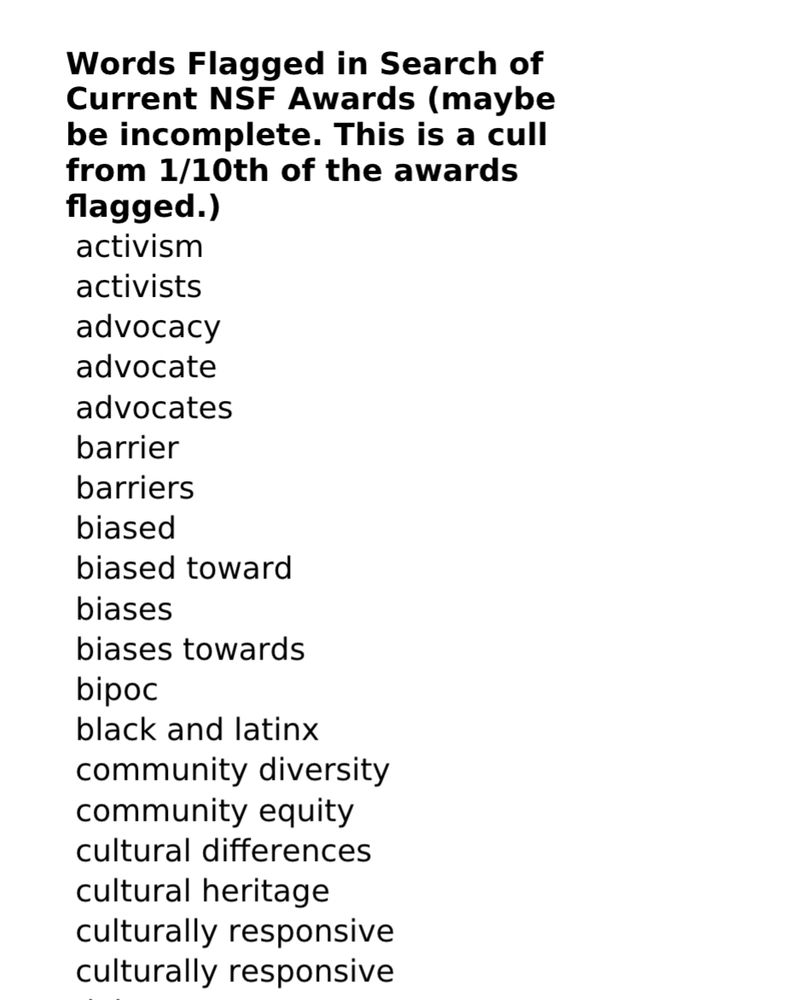
🚨BREAKING. From a program officer at the National Science Foundation, a list of keywords that can cause a grant to be pulled. I will be sharing screenshots of these keywords along with a decision tree. Please share widely. This is a crisis for academic freedom & science.
February 4, 2025 at 1:26 AM
🚨BREAKING. From a program officer at the National Science Foundation, a list of keywords that can cause a grant to be pulled. I will be sharing screenshots of these keywords along with a decision tree. Please share widely. This is a crisis for academic freedom & science.
Reposted by Ariel Greiner (she/her)
Had a wonderful time at #BES2024 presenting my master’s project research and watching some incredible presentations from colleagues @mcem-oxford.bsky.social (thanks @arielgreiner.bsky.social and @ecostone1.bsky.social for some great 📸s)


December 15, 2024 at 10:22 AM
Had a wonderful time at #BES2024 presenting my master’s project research and watching some incredible presentations from colleagues @mcem-oxford.bsky.social (thanks @arielgreiner.bsky.social and @ecostone1.bsky.social for some great 📸s)
Exciting to finally present the coral reef stepping stones work that I've been doing with @emilysdarling.bsky.social @thewcs.bsky.social and colleagues at #BES2024! Thank you @matthew-j-m-03.bsky.social @mcem-oxford.bsky.social for the 📸.

December 11, 2024 at 5:26 PM
Exciting to finally present the coral reef stepping stones work that I've been doing with @emilysdarling.bsky.social @thewcs.bsky.social and colleagues at #BES2024! Thank you @matthew-j-m-03.bsky.social @mcem-oxford.bsky.social for the 📸.
Reposted by Ariel Greiner (she/her)
The logical conclusion is - we need to reduce “human pressure levels” to save the world’s coral reefs.
www.nature.com/articles/nat...
www.nature.com/articles/nat...
December 3, 2024 at 11:01 AM
The logical conclusion is - we need to reduce “human pressure levels” to save the world’s coral reefs.
www.nature.com/articles/nat...
www.nature.com/articles/nat...
Reposted by Ariel Greiner (she/her)

Happy this is finally pre-printed! A fun piece to work on with @arielgreiner.bsky.social where we show that coral restoration needs to be complimented by other, more fundamental sustainability measures to be useful ! 🪸

Coral restoration is only practical when local human pressure levels are low https://www.biorxiv.org/content/10.1101/2024.11.26.622858v1

Coral restoration is only practical when local human pressure levels are low https://www.biorxiv.org/content/10.1101/2024.11.26.622858v1
Coral reefs are threatened by interacting local (fishing, coastal development) and global (climate c
www.biorxiv.org
December 3, 2024 at 10:37 PM
Happy this is finally pre-printed! A fun piece to work on with @arielgreiner.bsky.social where we show that coral restoration needs to be complimented by other, more fundamental sustainability measures to be useful ! 🪸
New preprint out w @colebrookson.bsky.social where we use a model to explore when coral restoration is a practical method of coral reef mgmt! Spoiler alert - paying attention to human pressure levels is 🔑, if they're too high, restoration attempts are unlikely to promote long-lasting healthy reefs!
Coral restoration is only practical when local human pressure levels are low https://www.biorxiv.org/content/10.1101/2024.11.26.622858v1
Coral restoration is only practical when local human pressure levels are low https://www.biorxiv.org/content/10.1101/2024.11.26.622858v1
Coral reefs are threatened by interacting local (fishing, coastal development) and global (climate c
www.biorxiv.org
December 3, 2024 at 10:38 PM
New preprint out w @colebrookson.bsky.social where we use a model to explore when coral restoration is a practical method of coral reef mgmt! Spoiler alert - paying attention to human pressure levels is 🔑, if they're too high, restoration attempts are unlikely to promote long-lasting healthy reefs!
Reposted by Ariel Greiner (she/her)

When is coral reef restoration effective? (Hint: when other pressures are low). Great work by Cole Brookson and Dr Ariel Greiner (soon to be on Blue Sky, I predict!) - a @uoft.bsky.social @ualberta.bsky.social collaboration on practical modelling insights for coral reef conservation.
Coral restoration is only practical when local human pressure levels are low https://www.biorxiv.org/content/10.1101/2024.11.26.622858v1
Coral restoration is only practical when local human pressure levels are low https://www.biorxiv.org/content/10.1101/2024.11.26.622858v1
Coral reefs are threatened by interacting local (fishing, coastal development) and global (climate c
www.biorxiv.org
December 3, 2024 at 6:33 PM
When is coral reef restoration effective? (Hint: when other pressures are low). Great work by Cole Brookson and Dr Ariel Greiner (soon to be on Blue Sky, I predict!) - a @uoft.bsky.social @ualberta.bsky.social collaboration on practical modelling insights for coral reef conservation.