



Anna Stansbury
@annastansbury.bsky.social
Economist: Labo(u)r, Macro, Inequality || Ass't Prof @MITSloan @MIT_IWER || Nonres fellow @piie
This was an issue pretty much for anyone without a parent with a PhD -even if from advantaged backgrounds. Those without a family member in academia had to find mentors. But finding mentors can be easier for those from more advantaged backgrounds -for reasons discussed above.

December 9, 2025 at 4:36 PM
This was an issue pretty much for anyone without a parent with a PhD -even if from advantaged backgrounds. Those without a family member in academia had to find mentors. But finding mentors can be easier for those from more advantaged backgrounds -for reasons discussed above.
The *hidden curriculum* was a VERY frequently mentioned topic here, including: how academic publishing worked, how to negotiate contracts, get pay raises, how tenure worked, how to approach faculty, how to apply for awards, how the academic hierarchy worked...

December 9, 2025 at 4:36 PM
The *hidden curriculum* was a VERY frequently mentioned topic here, including: how academic publishing worked, how to negotiate contracts, get pay raises, how tenure worked, how to approach faculty, how to apply for awards, how the academic hierarchy worked...
Of those who did recognize this advantage, they noted they often had the benefit of being considered "professional" or "polished".
The way we conceive of "excellence" in academia has a lot to do with markers of class. (harking back to @samfriedman.bsky.social and @daniellaurison.bsky.social work)
The way we conceive of "excellence" in academia has a lot to do with markers of class. (harking back to @samfriedman.bsky.social and @daniellaurison.bsky.social work)

December 9, 2025 at 4:36 PM
Of those who did recognize this advantage, they noted they often had the benefit of being considered "professional" or "polished".
The way we conceive of "excellence" in academia has a lot to do with markers of class. (harking back to @samfriedman.bsky.social and @daniellaurison.bsky.social work)
The way we conceive of "excellence" in academia has a lot to do with markers of class. (harking back to @samfriedman.bsky.social and @daniellaurison.bsky.social work)
While many, many respondents from less advantaged backgrounds talked about these factors, most academics from advantaged backgrounds did *not* identify cultural capital as a privilege.
Shout out to sociologists and poli sci who were (unsurprisingly) the most frequent exception
Shout out to sociologists and poli sci who were (unsurprisingly) the most frequent exception

December 9, 2025 at 4:36 PM
While many, many respondents from less advantaged backgrounds talked about these factors, most academics from advantaged backgrounds did *not* identify cultural capital as a privilege.
Shout out to sociologists and poli sci who were (unsurprisingly) the most frequent exception
Shout out to sociologists and poli sci who were (unsurprisingly) the most frequent exception
People not infrequently gave examples of outright bias. Many said they had changed their accent, dress, or behavior, or hid details about their background, to avoid being judged by colleagues. (I think a lot of US ppl underestimate the role of explicit or implicit bias here....)

December 9, 2025 at 4:36 PM
People not infrequently gave examples of outright bias. Many said they had changed their accent, dress, or behavior, or hid details about their background, to avoid being judged by colleagues. (I think a lot of US ppl underestimate the role of explicit or implicit bias here....)
Cultural knowledge or experiences were also a major factor brought up. Particularly international travel and so-called "high culture". This explicitly affected people's ability to form professional networks.

December 9, 2025 at 4:36 PM
Cultural knowledge or experiences were also a major factor brought up. Particularly international travel and so-called "high culture". This explicitly affected people's ability to form professional networks.
One key theme was **cultural capital**
Norms of speech, dress and behavior were very often raised. These "upper middle class" or "elite East Coast" norms were factors that made people feel excluded not just from first-gen or low-income backgrounds, but also from middle class
Norms of speech, dress and behavior were very often raised. These "upper middle class" or "elite East Coast" norms were factors that made people feel excluded not just from first-gen or low-income backgrounds, but also from middle class

December 9, 2025 at 4:36 PM
One key theme was **cultural capital**
Norms of speech, dress and behavior were very often raised. These "upper middle class" or "elite East Coast" norms were factors that made people feel excluded not just from first-gen or low-income backgrounds, but also from middle class
Norms of speech, dress and behavior were very often raised. These "upper middle class" or "elite East Coast" norms were factors that made people feel excluded not just from first-gen or low-income backgrounds, but also from middle class
We asked those who said that their socioeconomic background helped them why that was.
Family norms & values and financial/social support came up most prominently (note that this differs from what FGLI respondents thought mattered).
2/3rds also emphasize soft skills
Family norms & values and financial/social support came up most prominently (note that this differs from what FGLI respondents thought mattered).
2/3rds also emphasize soft skills

December 9, 2025 at 4:36 PM
We asked those who said that their socioeconomic background helped them why that was.
Family norms & values and financial/social support came up most prominently (note that this differs from what FGLI respondents thought mattered).
2/3rds also emphasize soft skills
Family norms & values and financial/social support came up most prominently (note that this differs from what FGLI respondents thought mattered).
2/3rds also emphasize soft skills
To first-gen or low-income background respondents who answered that their socioeconomic background disadvantaged them, we asked about mechanisms.
Again overwhelmingly, factors like: academic norms, the hidden curriculum, and limited access to networks or mentorship show up
Again overwhelmingly, factors like: academic norms, the hidden curriculum, and limited access to networks or mentorship show up

December 9, 2025 at 4:36 PM
To first-gen or low-income background respondents who answered that their socioeconomic background disadvantaged them, we asked about mechanisms.
Again overwhelmingly, factors like: academic norms, the hidden curriculum, and limited access to networks or mentorship show up
Again overwhelmingly, factors like: academic norms, the hidden curriculum, and limited access to networks or mentorship show up
Perceived impact of someone's own socioeconomic background on their academic career outcomes *during or after* their PhD
including initial placement after graduation, research productivity, grant and fellowship opps, long-term career trajectory (e.g. getting tenure)
including initial placement after graduation, research productivity, grant and fellowship opps, long-term career trajectory (e.g. getting tenure)

December 9, 2025 at 4:36 PM
Perceived impact of someone's own socioeconomic background on their academic career outcomes *during or after* their PhD
including initial placement after graduation, research productivity, grant and fellowship opps, long-term career trajectory (e.g. getting tenure)
including initial placement after graduation, research productivity, grant and fellowship opps, long-term career trajectory (e.g. getting tenure)
Reasons why people thought first-gen college grads would get worse academic placements than their PhD classmates from more advantaged backgrounds:
very overwhelmingly:
1. Hidden curriculum
2. Networks and mentorship
3. Geog, financial, time constraints
4. Soft skills and/or bias
very overwhelmingly:
1. Hidden curriculum
2. Networks and mentorship
3. Geog, financial, time constraints
4. Soft skills and/or bias

December 9, 2025 at 4:36 PM
Reasons why people thought first-gen college grads would get worse academic placements than their PhD classmates from more advantaged backgrounds:
very overwhelmingly:
1. Hidden curriculum
2. Networks and mentorship
3. Geog, financial, time constraints
4. Soft skills and/or bias
very overwhelmingly:
1. Hidden curriculum
2. Networks and mentorship
3. Geog, financial, time constraints
4. Soft skills and/or bias
Tight labor markets in the last decade reduced US community college enrollment.
Super interesting pic here showing just how countercyclical community college enrollment is (as compared to basically non-cyclical 4 year college enrollment)
From @joshua-goodman.com & Winkelman new NBER WP
Super interesting pic here showing just how countercyclical community college enrollment is (as compared to basically non-cyclical 4 year college enrollment)
From @joshua-goodman.com & Winkelman new NBER WP

December 1, 2025 at 3:57 PM
Tight labor markets in the last decade reduced US community college enrollment.
Super interesting pic here showing just how countercyclical community college enrollment is (as compared to basically non-cyclical 4 year college enrollment)
From @joshua-goodman.com & Winkelman new NBER WP
Super interesting pic here showing just how countercyclical community college enrollment is (as compared to basically non-cyclical 4 year college enrollment)
From @joshua-goodman.com & Winkelman new NBER WP
1. Schedule unpredictability means you don't work full time, but can't fill the other hours.
Avg hours worked per year in hospitality is 26, compared to 35-40 in most other industries.
But workers can't fill the spare hours with another job as they don't know when they'll be scheduled to work.
Avg hours worked per year in hospitality is 26, compared to 35-40 in most other industries.
But workers can't fill the spare hours with another job as they don't know when they'll be scheduled to work.

November 25, 2025 at 5:03 PM
1. Schedule unpredictability means you don't work full time, but can't fill the other hours.
Avg hours worked per year in hospitality is 26, compared to 35-40 in most other industries.
But workers can't fill the spare hours with another job as they don't know when they'll be scheduled to work.
Avg hours worked per year in hospitality is 26, compared to 35-40 in most other industries.
But workers can't fill the spare hours with another job as they don't know when they'll be scheduled to work.
Looking forward to presenting my Class Gap work at the RNIM Online Seminar on Zoom this Friday!
Anyone can register to attend here: sites.google.com/view/rnim-se...
Anyone can register to attend here: sites.google.com/view/rnim-se...

June 17, 2025 at 9:06 PM
Looking forward to presenting my Class Gap work at the RNIM Online Seminar on Zoom this Friday!
Anyone can register to attend here: sites.google.com/view/rnim-se...
Anyone can register to attend here: sites.google.com/view/rnim-se...
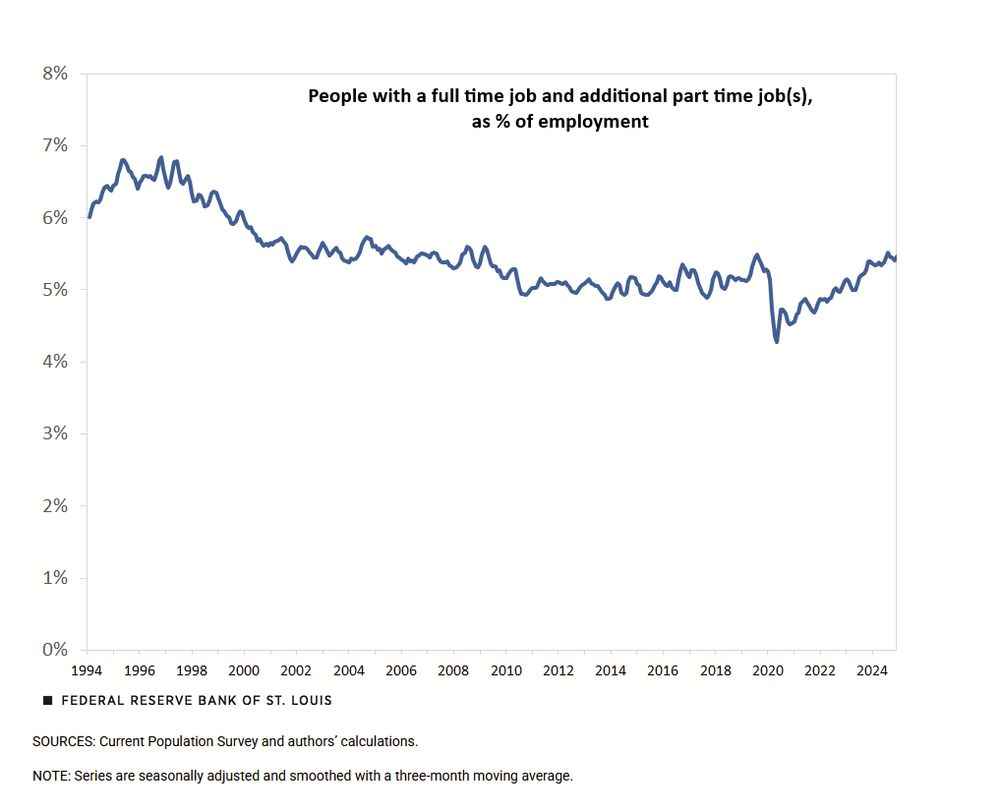
One fact that always surprises my students: It's not become more common for people to have multiple jobs in recent years
Counter to: "people need to work more jobs just to make ends meet" popular conception.
The % of people who work a full time job plus additional jobs has been stable for decades
Counter to: "people need to work more jobs just to make ends meet" popular conception.
The % of people who work a full time job plus additional jobs has been stable for decades
March 6, 2025 at 8:33 PM
One fact that always surprises my students: It's not become more common for people to have multiple jobs in recent years
Counter to: "people need to work more jobs just to make ends meet" popular conception.
The % of people who work a full time job plus additional jobs has been stable for decades
Counter to: "people need to work more jobs just to make ends meet" popular conception.
The % of people who work a full time job plus additional jobs has been stable for decades
Interestingly, this treatment effect is just about constant across th e whole firm productivity distribution! Doesn’t matter if the firm is low or high productivity, unionizing increases wages by about 9%

January 8, 2025 at 3:38 AM
Interestingly, this treatment effect is just about constant across th e whole firm productivity distribution! Doesn’t matter if the firm is low or high productivity, unionizing increases wages by about 9%
There’s a longstanding question: how much of the union wage premium is accounted for by selection (unions focus on more profitable firms to unionize) vs rent sharing (unions increase workers’ share of the profits)
Well, superb new work by Raffaele Saggio & co answers this…!
Well, superb new work by Raffaele Saggio & co answers this…!

January 8, 2025 at 3:38 AM
There’s a longstanding question: how much of the union wage premium is accounted for by selection (unions focus on more profitable firms to unionize) vs rent sharing (unions increase workers’ share of the profits)
Well, superb new work by Raffaele Saggio & co answers this…!
Well, superb new work by Raffaele Saggio & co answers this…!
What happens to companies who get more powerful institutional shareholders?
CEO pay falls by a cumulative 60% over 5 years
Top execs by 40%
Striking endorsement of the view that strong shareholders help solve the principal agent problem
Paper by Falato, Kim & von Wachter
CEO pay falls by a cumulative 60% over 5 years
Top execs by 40%
Striking endorsement of the view that strong shareholders help solve the principal agent problem
Paper by Falato, Kim & von Wachter

January 6, 2025 at 8:38 PM
What happens to companies who get more powerful institutional shareholders?
CEO pay falls by a cumulative 60% over 5 years
Top execs by 40%
Striking endorsement of the view that strong shareholders help solve the principal agent problem
Paper by Falato, Kim & von Wachter
CEO pay falls by a cumulative 60% over 5 years
Top execs by 40%
Striking endorsement of the view that strong shareholders help solve the principal agent problem
Paper by Falato, Kim & von Wachter


Superb paper by Dobbin&Zohar @ #ASSA2025
22% of intergenerational earnings persistence is accounted for by ACCESS to high paying firms (AKM firm effects). A lot of this probably due to networks/connections/discrimination
Data from Israel. Lots more in the paper.
22% of intergenerational earnings persistence is accounted for by ACCESS to high paying firms (AKM firm effects). A lot of this probably due to networks/connections/discrimination
Data from Israel. Lots more in the paper.


January 3, 2025 at 7:09 PM
Superb paper by Dobbin&Zohar @ #ASSA2025
22% of intergenerational earnings persistence is accounted for by ACCESS to high paying firms (AKM firm effects). A lot of this probably due to networks/connections/discrimination
Data from Israel. Lots more in the paper.
22% of intergenerational earnings persistence is accounted for by ACCESS to high paying firms (AKM firm effects). A lot of this probably due to networks/connections/discrimination
Data from Israel. Lots more in the paper.
Excited to have put together this #ASSA2025 session on
*Non-employment effects of the minimum wage*
Looking at…
- workplace injuries
- job satisfaction & amenities
- search effort
- company wage policy
- & effects of CA’s new $15 minimum wage
Tomorrow (Friday) 2.30-4.30pm
Join us !
*Non-employment effects of the minimum wage*
Looking at…
- workplace injuries
- job satisfaction & amenities
- search effort
- company wage policy
- & effects of CA’s new $15 minimum wage
Tomorrow (Friday) 2.30-4.30pm
Join us !


January 3, 2025 at 6:04 AM
Excited to have put together this #ASSA2025 session on
*Non-employment effects of the minimum wage*
Looking at…
- workplace injuries
- job satisfaction & amenities
- search effort
- company wage policy
- & effects of CA’s new $15 minimum wage
Tomorrow (Friday) 2.30-4.30pm
Join us !
*Non-employment effects of the minimum wage*
Looking at…
- workplace injuries
- job satisfaction & amenities
- search effort
- company wage policy
- & effects of CA’s new $15 minimum wage
Tomorrow (Friday) 2.30-4.30pm
Join us !
Who pays for the union wage premium?
Where does the union wage premium come from?
How do firms respond to the min wage?
What’s the role of firms in intergen mobility?
Very excited to be presenting in this #ASSA2025 session tomorrow (Friday) 10.15-12.15
Come join!
Where does the union wage premium come from?
How do firms respond to the min wage?
What’s the role of firms in intergen mobility?
Very excited to be presenting in this #ASSA2025 session tomorrow (Friday) 10.15-12.15
Come join!


January 3, 2025 at 1:40 AM
Who pays for the union wage premium?
Where does the union wage premium come from?
How do firms respond to the min wage?
What’s the role of firms in intergen mobility?
Very excited to be presenting in this #ASSA2025 session tomorrow (Friday) 10.15-12.15
Come join!
Where does the union wage premium come from?
How do firms respond to the min wage?
What’s the role of firms in intergen mobility?
Very excited to be presenting in this #ASSA2025 session tomorrow (Friday) 10.15-12.15
Come join!
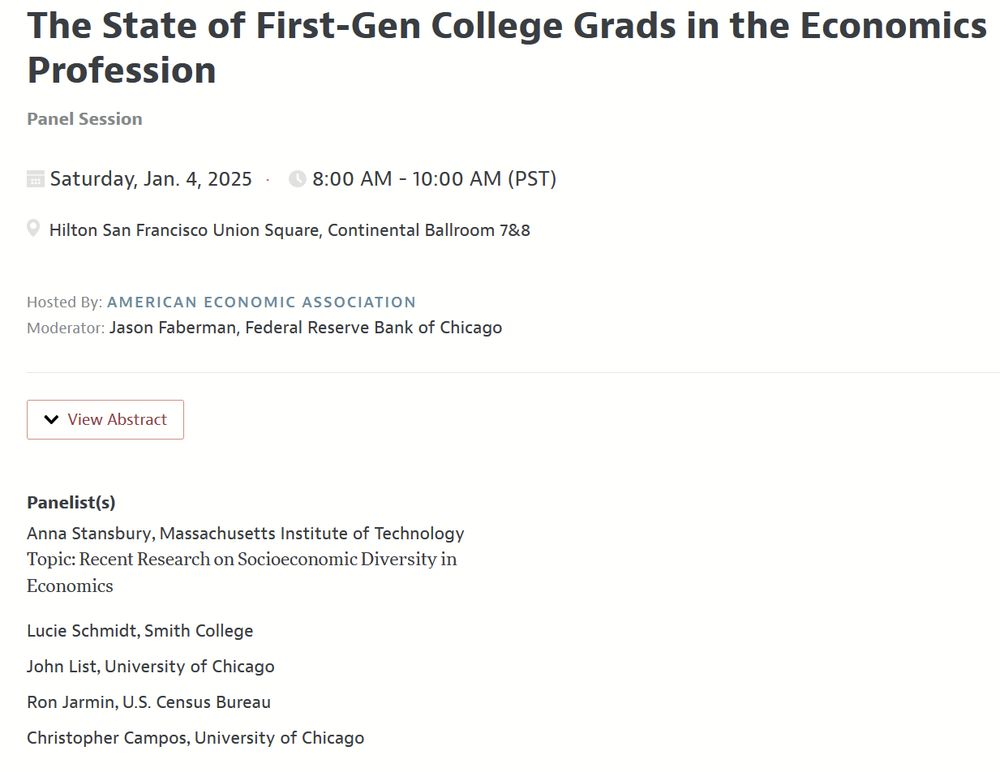
The AEA is having a panel for the *first time* on socoieconomic diversity in economics!
w/ @johnlist.bsky.social
@luciegschmidt.bsky.social
@ronjarmin.bsky.social
Chris Campos
Jason Faberman
& me
& lots of time for audience discussion
Please join us Saturday at (gulp) 8am
w/ @johnlist.bsky.social
@luciegschmidt.bsky.social
@ronjarmin.bsky.social
Chris Campos
Jason Faberman
& me
& lots of time for audience discussion
Please join us Saturday at (gulp) 8am
January 1, 2025 at 5:16 PM
The AEA is having a panel for the *first time* on socoieconomic diversity in economics!
w/ @johnlist.bsky.social
@luciegschmidt.bsky.social
@ronjarmin.bsky.social
Chris Campos
Jason Faberman
& me
& lots of time for audience discussion
Please join us Saturday at (gulp) 8am
w/ @johnlist.bsky.social
@luciegschmidt.bsky.social
@ronjarmin.bsky.social
Chris Campos
Jason Faberman
& me
& lots of time for audience discussion
Please join us Saturday at (gulp) 8am
Come to our ASSA LERA session on Compliance and Enforcement of Labor and Employment Law:
- New survey data on labor standards compliance
- Management practices & workplace injuries
- Wage theft by demographic group
- Compliance incentives
Sunday, 1-3pm
#ASSA2025 #LERA2025 #EconSky
- New survey data on labor standards compliance
- Management practices & workplace injuries
- Wage theft by demographic group
- Compliance incentives
Sunday, 1-3pm
#ASSA2025 #LERA2025 #EconSky

December 31, 2024 at 6:07 PM
Striking figure from Kochan & Hertel-Fernandez' new @ilrreview.bsky.social paper - survey of 4,000 workers' preferences about unions (conjoint experiment).
Each coefficient is the percentage point change in likelihood of joining the union, relative to the baseline condition (in parentheses)
Each coefficient is the percentage point change in likelihood of joining the union, relative to the baseline condition (in parentheses)

December 19, 2024 at 10:44 PM
Striking figure from Kochan & Hertel-Fernandez' new @ilrreview.bsky.social paper - survey of 4,000 workers' preferences about unions (conjoint experiment).
Each coefficient is the percentage point change in likelihood of joining the union, relative to the baseline condition (in parentheses)
Each coefficient is the percentage point change in likelihood of joining the union, relative to the baseline condition (in parentheses)