




Alona Fyshe
@alonaf.bsky.social
Associate prof @ UAlberta (CS and Psychology) studying language and semantic representations in the brain. TED speaker
That is pretty crazy - thanks for flagging it for me.
April 29, 2025 at 5:11 PM
That is pretty crazy - thanks for flagging it for me.

We loved looking through these results so much that we made a viewer to share all of them with the community: fyshelab.github.io/brain-viewer/
Have a look!
Have a look!
Flatmap Viewer
fyshelab.github.io
April 25, 2025 at 4:17 AM
We loved looking through these results so much that we made a viewer to share all of them with the community: fyshelab.github.io/brain-viewer/
Have a look!
Have a look!
Another cluster emphasized hands instead of legs. Positive images show people with their hands clearly visible, while the negative images are exclusively non-primate animals without hands. Thus, the brain's “body” area may be made up of multiple more refined concepts (i.e. legs and hands).

April 25, 2025 at 4:17 AM
Another cluster emphasized hands instead of legs. Positive images show people with their hands clearly visible, while the negative images are exclusively non-primate animals without hands. Thus, the brain's “body” area may be made up of multiple more refined concepts (i.e. legs and hands).
Our method also identified several body-related clusters (EBA in the figure). The positive representative images for one cluster showed people and animals outside with an emphasis on legs and active movement. The negative images typically depict people sitting with their legs obscured by tables.
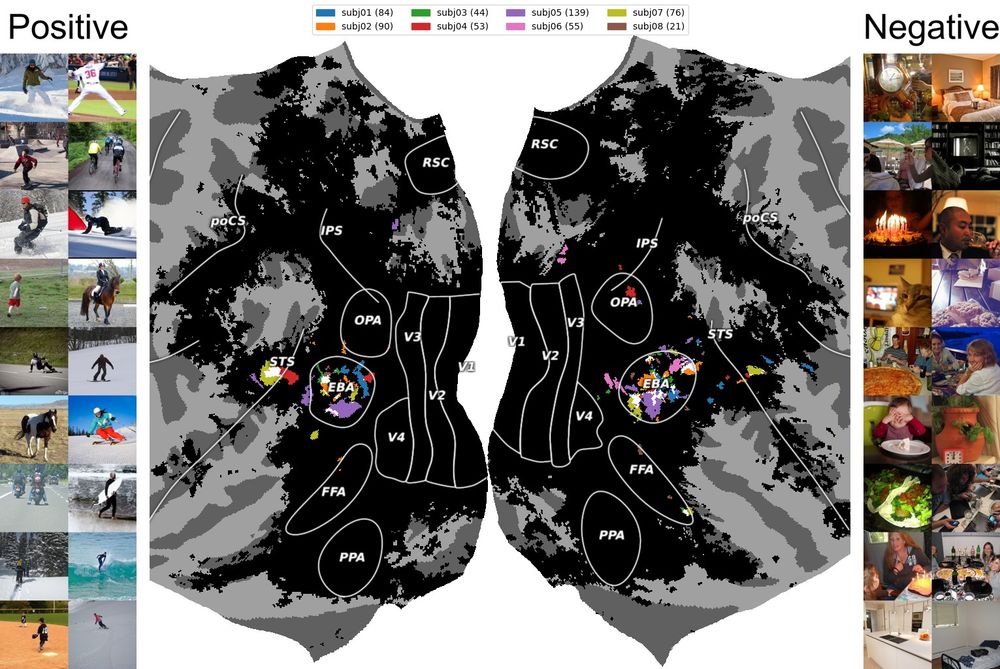
April 25, 2025 at 4:17 AM
Our method also identified several body-related clusters (EBA in the figure). The positive representative images for one cluster showed people and animals outside with an emphasis on legs and active movement. The negative images typically depict people sitting with their legs obscured by tables.
However, we also observed many vibrant and colorful positive images that contained no food. Strikingly, the negative representative images are entirely gray-scale! This provided very strong evidence that this brain area may be responding to color, not food.

April 25, 2025 at 4:17 AM
However, we also observed many vibrant and colorful positive images that contained no food. Strikingly, the negative representative images are entirely gray-scale! This provided very strong evidence that this brain area may be responding to color, not food.
Our method identified a large possibly food-related cluster with many positive food-related images, and the area aligned with a recently previously food area (i.e. the colored brain areas in the figure overlap with the reported food area).
April 25, 2025 at 4:17 AM
Our method identified a large possibly food-related cluster with many positive food-related images, and the area aligned with a recently previously food area (i.e. the colored brain areas in the figure overlap with the reported food area).
The positive and negative images provide additional evidence for the possible function of brain areas, helping us to refine hypotheses about the associated brain areas.
April 25, 2025 at 4:17 AM
The positive and negative images provide additional evidence for the possible function of brain areas, helping us to refine hypotheses about the associated brain areas.
These clusters allowed us to identify stimulus images that most drive neural activity in the voxels of a cluster (positive images), but also the images which are most associated with below-average voxel response (negative images).
April 25, 2025 at 4:17 AM
These clusters allowed us to identify stimulus images that most drive neural activity in the voxels of a cluster (positive images), but also the images which are most associated with below-average voxel response (negative images).
This clustering is done via our new variant of the DBSCAN algorithm, with adaptations to consider only clusters that contain voxels from more than 2 participants.
April 25, 2025 at 4:17 AM
This clustering is done via our new variant of the DBSCAN algorithm, with adaptations to consider only clusters that contain voxels from more than 2 participants.
We first trained a model to map fMRI to CLIP representations. We then clustered the *parameters* of that model to identify voxels that are driven by certain CLIP concepts. Because we cluster in model parameter space, we can look for concept representations across participants.
April 25, 2025 at 4:17 AM
We first trained a model to map fMRI to CLIP representations. We then clustered the *parameters* of that model to identify voxels that are driven by certain CLIP concepts. Because we cluster in model parameter space, we can look for concept representations across participants.
Still, only a few broad semantic categories have been identified, and they typically cover large areas of the brain. So… there may be other semantic categories localized in the brain (or a way to refine existing categories)!
April 25, 2025 at 4:17 AM
Still, only a few broad semantic categories have been identified, and they typically cover large areas of the brain. So… there may be other semantic categories localized in the brain (or a way to refine existing categories)!
There have been multiple attempts to identify new functionally localized regions of the brain with some converging evidence; for example, a possible “food area” was recently reported.
April 25, 2025 at 4:17 AM
There have been multiple attempts to identify new functionally localized regions of the brain with some converging evidence; for example, a possible “food area” was recently reported.
Neuroimaging has revealed a lot about how the brain processes and organizes visual information. For example, there is evidence that certain areas of the brain activate in response to images depicting specific semantic concepts like faces, places, bodies, and words.
April 25, 2025 at 4:17 AM
Neuroimaging has revealed a lot about how the brain processes and organizes visual information. For example, there is evidence that certain areas of the brain activate in response to images depicting specific semantic concepts like faces, places, bodies, and words.
Nice! Thanks for sharing! Do the colors of post it notes mean anything?
August 26, 2024 at 7:58 PM
Nice! Thanks for sharing! Do the colors of post it notes mean anything?
I took a comp. ling. class in grad school and the (Polish) prof said two words in Polish that were indistinguishable to me but he swore they had phonemes that he could differentiate but I couldn't. Then he told us we learn to speak without really being taught how to use our mouths to make phonemes
October 6, 2023 at 5:51 PM
I took a comp. ling. class in grad school and the (Polish) prof said two words in Polish that were indistinguishable to me but he swore they had phonemes that he could differentiate but I couldn't. Then he told us we learn to speak without really being taught how to use our mouths to make phonemes