


Aditya Kamat
@adityakamat.bsky.social
Postdoctoral fellow at Rudner Lab, Harvard Medical School | PhD at Badrinarayanan Lab, NCBS Bangalore (TIFR)
We instead find that intrinsic promoter strength of SOS response genes, governs the temporal order of the Caulobacter SOS response. Our observations also raises the exciting possibility of differential association of sigma factors as a modulator of the observed hierarchy.
December 10, 2025 at 1:46 PM
We instead find that intrinsic promoter strength of SOS response genes, governs the temporal order of the Caulobacter SOS response. Our observations also raises the exciting possibility of differential association of sigma factors as a modulator of the observed hierarchy.
A case in point is of two SOS response genes (ccna_01391 and ccna_02355), which possess identical LexA binding sites yet display distinct time to induction post exposure to DNA damage.
December 10, 2025 at 1:46 PM
A case in point is of two SOS response genes (ccna_01391 and ccna_02355), which possess identical LexA binding sites yet display distinct time to induction post exposure to DNA damage.
The timing of the SOS response has been typically attributed to the binding kinetics of the LexA repressor (with stronger LexA binding leading to delayed induction). We observe that LexA-associated properties are inadequate for explaining the temporal hierarchy of the Caulobacter SOS response.
December 10, 2025 at 1:46 PM
The timing of the SOS response has been typically attributed to the binding kinetics of the LexA repressor (with stronger LexA binding leading to delayed induction). We observe that LexA-associated properties are inadequate for explaining the temporal hierarchy of the Caulobacter SOS response.
When bacteria encounter DNA damage, they typically deploy the SOS response- a vast network of genes contributing to DNA damage repair and tolerance. These genes are not turned on simultaneously and exhibit variation in their time of induction. What determines such temporal order?
December 10, 2025 at 1:46 PM
When bacteria encounter DNA damage, they typically deploy the SOS response- a vast network of genes contributing to DNA damage repair and tolerance. These genes are not turned on simultaneously and exhibit variation in their time of induction. What determines such temporal order?
A case in point is of two SOS response genes (ccna_01391 and ccna_02355), which possess identical LexA binding sites yet display distinct time to induction post exposure to DNA damage.
December 10, 2025 at 1:42 PM
A case in point is of two SOS response genes (ccna_01391 and ccna_02355), which possess identical LexA binding sites yet display distinct time to induction post exposure to DNA damage.
The timing of the SOS response has been typically attributed to the binding kinetics of the LexA repressor (with stronger LexA binding leading to delayed induction). We observe that LexA-associated properties are inadequate for explaining the temporal hierarchy of the Caulobacter SOS response.
December 10, 2025 at 1:42 PM
The timing of the SOS response has been typically attributed to the binding kinetics of the LexA repressor (with stronger LexA binding leading to delayed induction). We observe that LexA-associated properties are inadequate for explaining the temporal hierarchy of the Caulobacter SOS response.
When bacteria encounter DNA damage, they typically deploy the SOS response- a vast network of genes contributing to DNA damage repair and tolerance. These genes are not turned on simultaneously and exhibit variation in their time of induction. What determines such temporal order?
December 10, 2025 at 1:42 PM
When bacteria encounter DNA damage, they typically deploy the SOS response- a vast network of genes contributing to DNA damage repair and tolerance. These genes are not turned on simultaneously and exhibit variation in their time of induction. What determines such temporal order?
Reposted by Aditya Kamat

Now published. Thank you very much to our collaborative team, and very supportive editors and reviewers!!!
www.pnas.org/doi/10.1073/...
www.pnas.org/doi/10.1073/...

Versatile NTP recognition and domain fusions expand the functional repertoire of the ParB-CTPase fold beyond chromosome segregation | PNAS
Nucleotide triphosphate (NTP)-dependent molecular switches regulate essential cellular
processes by cycling between active and inactive states thro...
www.pnas.org
December 4, 2025 at 7:23 PM
Now published. Thank you very much to our collaborative team, and very supportive editors and reviewers!!!
www.pnas.org/doi/10.1073/...
www.pnas.org/doi/10.1073/...
Reposted by Aditya Kamat
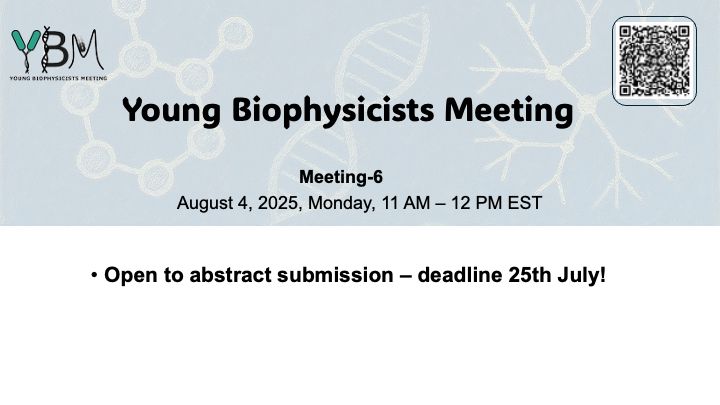
Theoretical physics enthusiasts, do consider submitting an abstract for the upcoming sixth YBM!
Submit your abstracts here: t.co/W1qGraRpAc
Submit your abstracts here: t.co/W1qGraRpAc
July 17, 2025 at 3:11 PM
Theoretical physics enthusiasts, do consider submitting an abstract for the upcoming sixth YBM!
Submit your abstracts here: t.co/W1qGraRpAc
Submit your abstracts here: t.co/W1qGraRpAc