



Jennifer Lang
@actuarialeye.bsky.social
Sydney based actuary and director looking at the world through an actuarial eye. Lots of statistics, often feminist. She/her
Oh, and unlike many other countries, Australia had very few COVID-19 deaths in 2020, because of those closed borders.
December 3, 2025 at 3:26 AM
Oh, and unlike many other countries, Australia had very few COVID-19 deaths in 2020, because of those closed borders.
My colleague @rhsl-fiaa.bsky.social who did the international analysis did try some of that analysis early on, but from memory there are too many variables!
December 2, 2025 at 9:58 PM
My colleague @rhsl-fiaa.bsky.social who did the international analysis did try some of that analysis early on, but from memory there are too many variables!
Yes we do, so far. Although we do it by cause of death, rather than in aggregate so (for example) cancer deaths stayed on the improvement trajectory throughout the period, whereas some other causes increased or stayed steady.
December 2, 2025 at 9:56 PM
Yes we do, so far. Although we do it by cause of death, rather than in aggregate so (for example) cancer deaths stayed on the improvement trajectory throughout the period, whereas some other causes increased or stayed steady.
In 2020 with the borders closed, Australia didn't have a flu season, and so winter deaths were much lower than normal.
December 2, 2025 at 9:38 PM
In 2020 with the borders closed, Australia didn't have a flu season, and so winter deaths were much lower than normal.
In our view, the “new normal” level of mortalitywill continue to improve, but we expect it to stay above the pre-pandemic trend for some time. Our baseline prediction for 2025 implies that the COVID-19 pandemic has resulted in a three-year pause in mortality improvement. #ends
December 2, 2025 at 6:21 AM
In our view, the “new normal” level of mortalitywill continue to improve, but we expect it to stay above the pre-pandemic trend for some time. Our baseline prediction for 2025 implies that the COVID-19 pandemic has resulted in a three-year pause in mortality improvement. #ends
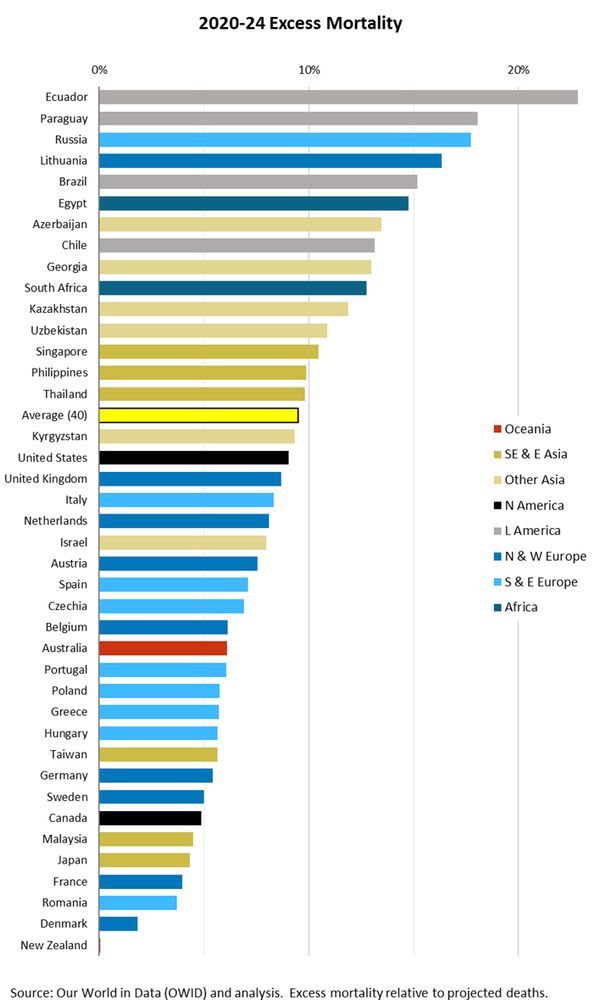
Worldwide mortality experience since the beginning of the COVID-19 pandemic (2020-2024) shows excess deaths over that period in almost every country measured. Australia (+6%) was below average, and New Zealand (+0.1%) the lowest we measured.
December 2, 2025 at 6:18 AM
Worldwide mortality experience since the beginning of the COVID-19 pandemic (2020-2024) shows excess deaths over that period in almost every country measured. Australia (+6%) was below average, and New Zealand (+0.1%) the lowest we measured.
Mortality rates from other causes were quite mixed compared with previous years, with other respiratory diseases (eg pneumonia +10%) and lower respiratory conditions (+5%) higher than anticipated, and deaths from cancer (-2%) and ischaemic heart disease (-3%) lower than the baseline.
December 2, 2025 at 6:15 AM
Mortality rates from other causes were quite mixed compared with previous years, with other respiratory diseases (eg pneumonia +10%) and lower respiratory conditions (+5%) higher than anticipated, and deaths from cancer (-2%) and ischaemic heart disease (-3%) lower than the baseline.
Covid-19 mortality was at a similar level in 2024 as 2023, contrary to our prediction of a reduction in mortality rates.

December 2, 2025 at 6:13 AM
Covid-19 mortality was at a similar level in 2024 as 2023, contrary to our prediction of a reduction in mortality rates.
You can see a very high level view of mortality rates over the last decade in this graph, which shows the standardised (for age and sex) mortality rate in each calendar year since 2015.

December 2, 2025 at 6:11 AM
You can see a very high level view of mortality rates over the last decade in this graph, which shows the standardised (for age and sex) mortality rate in each calendar year since 2015.
We predicted that overall mortality in Australia would return to the levels of improvement we'd seen before Covid-19. Actual mortality was slightly higher than that (0.4%), but not materially.
December 2, 2025 at 6:09 AM
We predicted that overall mortality in Australia would return to the levels of improvement we'd seen before Covid-19. Actual mortality was slightly higher than that (0.4%), but not materially.
That's a good question. I'm reading that this set of data essentially uses numbers of deaths from 2015-2019 as the baseline (rather than a mortality rate). If the immigration and ageing patterns are consistent, that isn't an issue, but if they've changed, the projection could be misleading.
December 1, 2025 at 5:27 AM
That's a good question. I'm reading that this set of data essentially uses numbers of deaths from 2015-2019 as the baseline (rather than a mortality rate). If the immigration and ageing patterns are consistent, that isn't an issue, but if they've changed, the projection could be misleading.
God rest ye merry gentlemen for the Christian song and
How to Make Gravy by Paul Kelly for the secular one (very Australian choice)
www.youtube.com/watch?v=iYqI...
How to Make Gravy by Paul Kelly for the secular one (very Australian choice)
www.youtube.com/watch?v=iYqI...

Paul Kelly - How To Make Gravy (Official Video)
YouTube video by Paul Kelly
www.youtube.com
December 1, 2025 at 5:04 AM
God rest ye merry gentlemen for the Christian song and
How to Make Gravy by Paul Kelly for the secular one (very Australian choice)
www.youtube.com/watch?v=iYqI...
How to Make Gravy by Paul Kelly for the secular one (very Australian choice)
www.youtube.com/watch?v=iYqI...
I use carshare (I don't own a car) and its half the price of owning the car. But people still are surprised that I'm happy to pay $30 to drive to my choir rehearsal if the weather is too bad to walk.
November 24, 2025 at 1:33 AM
I use carshare (I don't own a car) and its half the price of owning the car. But people still are surprised that I'm happy to pay $30 to drive to my choir rehearsal if the weather is too bad to walk.
When I did the Tour de Mont Blanc (France, Italy, Switzerland) there were public buses AND banned private parking at many trailheads. We were on a group tour, but still used the public buses in most cases as they were the best option! So much better than the overfull parking lots we have here in Oz.
November 10, 2025 at 4:52 AM
When I did the Tour de Mont Blanc (France, Italy, Switzerland) there were public buses AND banned private parking at many trailheads. We were on a group tour, but still used the public buses in most cases as they were the best option! So much better than the overfull parking lots we have here in Oz.
Thanks, yes will fix!
November 10, 2025 at 4:38 AM
Thanks, yes will fix!
Bottom line is, increased global heating caused by climate change is and will be directly bad for human health and mortality, as well as all the other impacts on our world.
November 10, 2025 at 4:21 AM
Bottom line is, increased global heating caused by climate change is and will be directly bad for human health and mortality, as well as all the other impacts on our world.
There's a whole lot of caveats around this - we could mitigate the worst experience - but there will also be other causes of death not counted here, like bushfire pollution, natural disasters, and increased tropical disasters.
November 10, 2025 at 4:20 AM
There's a whole lot of caveats around this - we could mitigate the worst experience - but there will also be other causes of death not counted here, like bushfire pollution, natural disasters, and increased tropical disasters.
Further research (repackaged by Our World In data) concluded that heat related deaths would increase by 7.68 per 100,000 people by 2030, 20.39 by 2050, and 49.93 by 2090. that’s an increased death rate of 1%, 3% and 7% in 2030, 2050 and 2090 respectively.
November 10, 2025 at 4:19 AM
Further research (repackaged by Our World In data) concluded that heat related deaths would increase by 7.68 per 100,000 people by 2030, 20.39 by 2050, and 49.93 by 2090. that’s an increased death rate of 1%, 3% and 7% in 2030, 2050 and 2090 respectively.
The research I found, from Our World in Data, shows that in the hotter months, Australia is already getting around 0.6% extra deaths every summer due to climate change related heatwaves, or 300-350 extra deaths.
November 10, 2025 at 4:18 AM
The research I found, from Our World in Data, shows that in the hotter months, Australia is already getting around 0.6% extra deaths every summer due to climate change related heatwaves, or 300-350 extra deaths.
Most deaths in heatwaves don't mention heat on the certificate. You probably pictured someone passing out from heat stroke. But this is not how most people die from “heat”. They die from conditions such as cardiovascular or kidney disease, respiratory infections, or diabetes.
November 10, 2025 at 4:17 AM
Most deaths in heatwaves don't mention heat on the certificate. You probably pictured someone passing out from heat stroke. But this is not how most people die from “heat”. They die from conditions such as cardiovascular or kidney disease, respiratory infections, or diabetes.
The extra deaths will mostly be at older age groups, and among those who find it harder to shelter from heat. There are likely to be other climate related reasons death rates will increase – extra pollution from fires, more tropical diseases, natural disasters not included in this number.
November 10, 2025 at 4:16 AM
The extra deaths will mostly be at older age groups, and among those who find it harder to shelter from heat. There are likely to be other climate related reasons death rates will increase – extra pollution from fires, more tropical diseases, natural disasters not included in this number.
In Australia, the number of deaths per annum is likely to increase by around 1% by 2030 up to 7% by the end of this century due to global heating.
November 10, 2025 at 4:16 AM
In Australia, the number of deaths per annum is likely to increase by around 1% by 2030 up to 7% by the end of this century due to global heating.
In Sydney, Australia, Citymapper does this, using the underlying open source map. It also gives you three options depending on your level of comfort with traffic. It's not perfect, but WAAAAY better than google, which doesn't even seem to notice bike lanes half the time.
October 8, 2025 at 4:24 AM
In Sydney, Australia, Citymapper does this, using the underlying open source map. It also gives you three options depending on your level of comfort with traffic. It's not perfect, but WAAAAY better than google, which doesn't even seem to notice bike lanes half the time.