


Zooarchaeology Lab Sheffield
@zooarchlabsheff.bsky.social
Zooarchaeology lab based at the University of Sheffield, home to an extensive animal bone reference collection and one of the most active zooarch research teams in the world
Reposted by Zooarchaeology Lab Sheffield
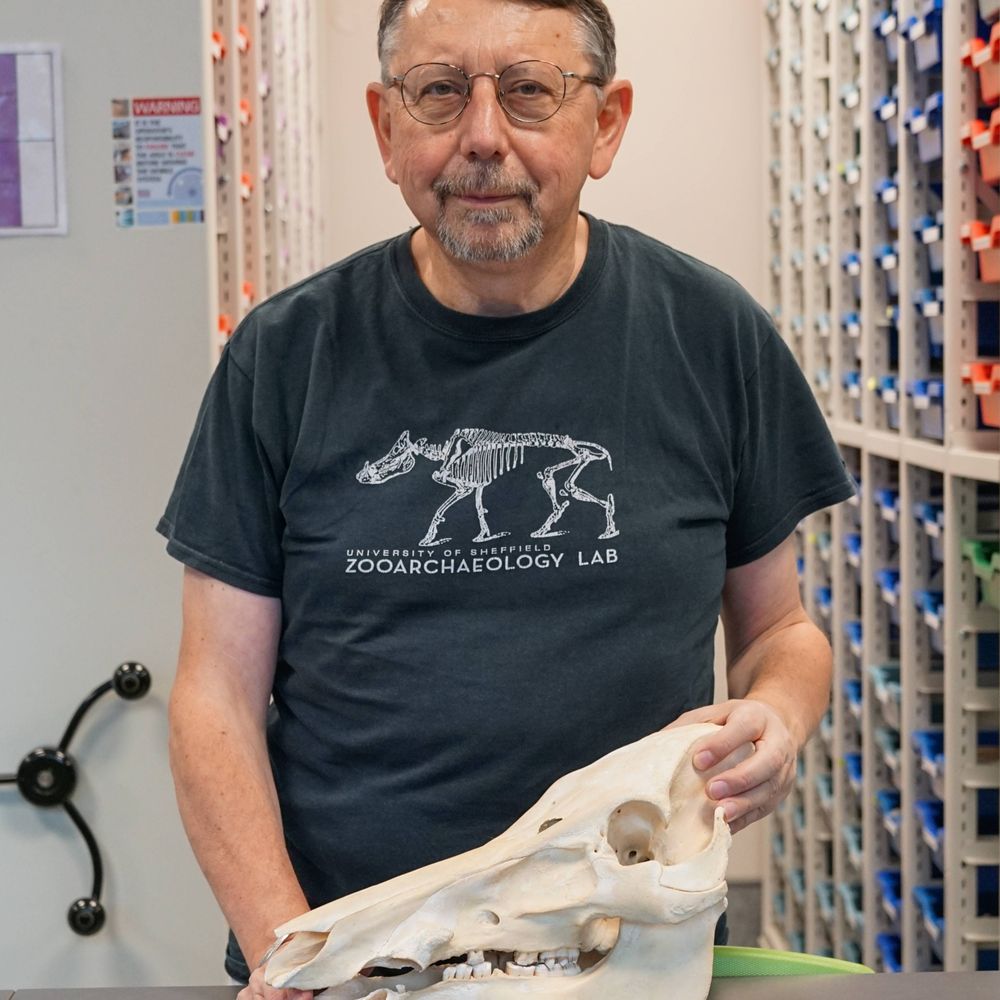
This was a great conference to be involved with. The stuff I talked about wasn't necessarily pleasant, but I'm glad that I had the opportunity to discuss it. Many thanks to Abu Siddiq et al. for the invitation. @zooarchlabsheff.bsky.social
www.youtube.com/watch?v=RFJv... #zooarchaeology
www.youtube.com/watch?v=RFJv... #zooarchaeology

Umberto Albarella | Mare Nostrum: Pursuing zooarchaeology in a world in turmoil
YouTube video by Mediterranean Zooarchaeology
www.youtube.com
February 5, 2026 at 4:46 PM
This was a great conference to be involved with. The stuff I talked about wasn't necessarily pleasant, but I'm glad that I had the opportunity to discuss it. Many thanks to Abu Siddiq et al. for the invitation. @zooarchlabsheff.bsky.social
www.youtube.com/watch?v=RFJv... #zooarchaeology
www.youtube.com/watch?v=RFJv... #zooarchaeology
📸 New kit alert! 📸
Thanks to RICHeS funding, we have added a new Leica camera and 3D analysis software to our Bioarchaeology collections 🙌
Perfect for archaeobotany imaging 🌾 but also incredibly valuable for zooarchaeological research, particularly for exploring taphonomic factors.
Thanks to RICHeS funding, we have added a new Leica camera and 3D analysis software to our Bioarchaeology collections 🙌
Perfect for archaeobotany imaging 🌾 but also incredibly valuable for zooarchaeological research, particularly for exploring taphonomic factors.


February 5, 2026 at 2:24 PM
📸 New kit alert! 📸
Thanks to RICHeS funding, we have added a new Leica camera and 3D analysis software to our Bioarchaeology collections 🙌
Perfect for archaeobotany imaging 🌾 but also incredibly valuable for zooarchaeological research, particularly for exploring taphonomic factors.
Thanks to RICHeS funding, we have added a new Leica camera and 3D analysis software to our Bioarchaeology collections 🙌
Perfect for archaeobotany imaging 🌾 but also incredibly valuable for zooarchaeological research, particularly for exploring taphonomic factors.
The much-awaited A&K no. 24 is out! 🎉
It showcases the work of Angela Trentacoste, former Sheffield PhD student and now involved in countless exciting projects. This paper builds on her PhD research 👉 doi:10.1179/1461957115Y.0000000015
It showcases the work of Angela Trentacoste, former Sheffield PhD student and now involved in countless exciting projects. This paper builds on her PhD research 👉 doi:10.1179/1461957115Y.0000000015
Etruscan Foodways and Demographic Demands: Contextualizing Protohistoric Livestock Husbandry in Northern Italy | European Journal of Archaeology | Cambridge Core
Etruscan Foodways and Demographic Demands: Contextualizing Protohistoric Livestock Husbandry in Northern Italy - Volume 19 Issue 2
www.cambridge.org
February 3, 2026 at 9:01 AM
The much-awaited A&K no. 24 is out! 🎉
It showcases the work of Angela Trentacoste, former Sheffield PhD student and now involved in countless exciting projects. This paper builds on her PhD research 👉 doi:10.1179/1461957115Y.0000000015
It showcases the work of Angela Trentacoste, former Sheffield PhD student and now involved in countless exciting projects. This paper builds on her PhD research 👉 doi:10.1179/1461957115Y.0000000015
Reposted by Zooarchaeology Lab Sheffield
The International Council of Archaeozoology www.alexandriaarchive.org/icaz/ has published a statement to condemn the Gaza genocide. You can download it here (Newsletter p.7): www.alexandriaarchive.org/icaz/publica...
@archagainstaparth.bsky.social
@blacktrowel.bsky.social
@icaz-news.bsky.social
@archagainstaparth.bsky.social
@blacktrowel.bsky.social
@icaz-news.bsky.social

February 1, 2026 at 7:31 PM
The International Council of Archaeozoology www.alexandriaarchive.org/icaz/ has published a statement to condemn the Gaza genocide. You can download it here (Newsletter p.7): www.alexandriaarchive.org/icaz/publica...
@archagainstaparth.bsky.social
@blacktrowel.bsky.social
@icaz-news.bsky.social
@archagainstaparth.bsky.social
@blacktrowel.bsky.social
@icaz-news.bsky.social
Really nice first day of the Mediterranean Zooarchaeology Symposium www.artuklu.edu.tr/medzooarch/a...


January 29, 2026 at 7:18 PM
Really nice first day of the Mediterranean Zooarchaeology Symposium www.artuklu.edu.tr/medzooarch/a...
For A&K n.23, we are pleased to move to the Pacific Ocean for this interesting paper about mass fish capture! Check it out!
👉https://onlinelibrary.wiley.com/doi/10.1002/arco.5320
👉https://onlinelibrary.wiley.com/doi/10.1002/arco.5320
January 26, 2026 at 10:55 AM
For A&K n.23, we are pleased to move to the Pacific Ocean for this interesting paper about mass fish capture! Check it out!
👉https://onlinelibrary.wiley.com/doi/10.1002/arco.5320
👉https://onlinelibrary.wiley.com/doi/10.1002/arco.5320
Back to hands-on work after our move and reunited with a long-time freezer resident: Mr Badger 🦡
Once alive, now honoured for the contribution he’ll make to science. After a well-earned hot bath, Mr Badger will soon join our Zooarchaeology Research Collection.
CW: images show a deceased animal
Once alive, now honoured for the contribution he’ll make to science. After a well-earned hot bath, Mr Badger will soon join our Zooarchaeology Research Collection.
CW: images show a deceased animal


January 22, 2026 at 4:47 PM
Back to hands-on work after our move and reunited with a long-time freezer resident: Mr Badger 🦡
Once alive, now honoured for the contribution he’ll make to science. After a well-earned hot bath, Mr Badger will soon join our Zooarchaeology Research Collection.
CW: images show a deceased animal
Once alive, now honoured for the contribution he’ll make to science. After a well-earned hot bath, Mr Badger will soon join our Zooarchaeology Research Collection.
CW: images show a deceased animal
A&K n.22. This work comes from a collaboration between two of our former Marie Curie postdocs, Claudia Minniti and Silvia Valenzuela-Lamas, now in Rome and Barcelona. They continue to be close collaborators and played a key role in building our team. Enjoy! www.sciencedirect.com/science/arti...

Widening the market. Strontium isotope analysis on cattle teeth from Owslebury (Hampshire, UK) highlights changes in livestock supply between the Iron Age and the Roman period
87Sr/86Sr isotopic analysis was performed on 95 cattle teeth from the Iron Age and Roman rural site of Owslebury (Hampshire). This constitutes one of …
www.sciencedirect.com
January 19, 2026 at 9:20 AM
A&K n.22. This work comes from a collaboration between two of our former Marie Curie postdocs, Claudia Minniti and Silvia Valenzuela-Lamas, now in Rome and Barcelona. They continue to be close collaborators and played a key role in building our team. Enjoy! www.sciencedirect.com/science/arti...
As part of our A&K series (n.21) we are keen to promote the vibrancy of zooarchaeology across the world. This is a classic paper based on South Africa and Lesotho by Ina Plug, the inspirational pioneer of African zooarchaeology. 👉https://www.sciencedirect.com/science/article/pii/S0305440396901533

Late Pleistocene and Holocene Hunter–Gatherers in the Eastern Highlands of South Africa and Lesotho: A Faunal Interpretation
Recent research in the eastern highlands of South Africa and Lesotho has increased our knowledge of Late Pleistocene and Holocene human activities in …
www.sciencedirect.com
January 13, 2026 at 10:21 AM
As part of our A&K series (n.21) we are keen to promote the vibrancy of zooarchaeology across the world. This is a classic paper based on South Africa and Lesotho by Ina Plug, the inspirational pioneer of African zooarchaeology. 👉https://www.sciencedirect.com/science/article/pii/S0305440396901533
🐎 Excited to share a new project led by friend and colleague Maaike Groot at Freie Universität Berlin: “Management, supply and mobility of equids in the northwestern Roman Empire” (DFG-funded).
The project explores how horses and mules supported the Roman army.
Congratulations Maaike!!!
The project explores how horses and mules supported the Roman army.
Congratulations Maaike!!!

January 12, 2026 at 2:47 PM
🐎 Excited to share a new project led by friend and colleague Maaike Groot at Freie Universität Berlin: “Management, supply and mobility of equids in the northwestern Roman Empire” (DFG-funded).
The project explores how horses and mules supported the Roman army.
Congratulations Maaike!!!
The project explores how horses and mules supported the Roman army.
Congratulations Maaike!!!
The wait is over 😉 A&K no. 20 is here!
Featuring Giorgos Kazantzis, former Sheffield MSc and PhD student, now researching and teaching in Greece. Still part of our team, always fondly remembered.
This innovative paper from his PhD deserves far more attention: www.sciencedirect.com/science/arti...
Featuring Giorgos Kazantzis, former Sheffield MSc and PhD student, now researching and teaching in Greece. Still part of our team, always fondly remembered.
This innovative paper from his PhD deserves far more attention: www.sciencedirect.com/science/arti...

Size and shape of Greek Late Neolithic livestock suggest the existence of multiple and distinctive animal husbandry cultures
In this paper we discuss domestic livestock morphometric data from the Late Neolithic Greek regions of Macedonia and Thessaly. Six sites are considere…
www.sciencedirect.com
January 8, 2026 at 3:00 PM
The wait is over 😉 A&K no. 20 is here!
Featuring Giorgos Kazantzis, former Sheffield MSc and PhD student, now researching and teaching in Greece. Still part of our team, always fondly remembered.
This innovative paper from his PhD deserves far more attention: www.sciencedirect.com/science/arti...
Featuring Giorgos Kazantzis, former Sheffield MSc and PhD student, now researching and teaching in Greece. Still part of our team, always fondly remembered.
This innovative paper from his PhD deserves far more attention: www.sciencedirect.com/science/arti...
Reposted by Zooarchaeology Lab Sheffield

#EAAforDemocracy Democracy is at stake at EAA: all archaeologists should be very concerned
A Special Meeting for members will take place on Jan 9th 2026 about the dysfunctioning of the current EAA leadership. See below:
A Special Meeting for members will take place on Jan 9th 2026 about the dysfunctioning of the current EAA leadership. See below:

January 7, 2026 at 1:35 PM
#EAAforDemocracy Democracy is at stake at EAA: all archaeologists should be very concerned
A Special Meeting for members will take place on Jan 9th 2026 about the dysfunctioning of the current EAA leadership. See below:
A Special Meeting for members will take place on Jan 9th 2026 about the dysfunctioning of the current EAA leadership. See below:

A&K n.19 spotlights the work of Pam Crabtree, one of the most influential zooarchaeologists of the past few decades 🦴
Best known for her work at West Stow, this issue highlights her lesser-known but vital research on middle Saxon sites. Enjoy! eaareports.org.uk/publication/...
Best known for her work at West Stow, this issue highlights her lesser-known but vital research on middle Saxon sites. Enjoy! eaareports.org.uk/publication/...

Middle Saxon Animal Husbandry in East Anglia
Pam Crabtree, 2012. 'Middle Saxon Animal Husbandry in East Anglia', East Anglian Archaeology 143
eaareports.org.uk
December 29, 2025 at 1:50 PM
A&K n.19 spotlights the work of Pam Crabtree, one of the most influential zooarchaeologists of the past few decades 🦴
Best known for her work at West Stow, this issue highlights her lesser-known but vital research on middle Saxon sites. Enjoy! eaareports.org.uk/publication/...
Best known for her work at West Stow, this issue highlights her lesser-known but vital research on middle Saxon sites. Enjoy! eaareports.org.uk/publication/...
Congratulations to our former student and still great friend of our team, Marcos García García, for his very interesting new output! www.sciencedirect.com/science/arti...

Animalising the Islamic Green Revolution: zooarchaeology and socio-ecological change in the Islamic Far West
The impact of the medieval Arab expansion on agriculture in the Middle East, Central Asia, and the Mediterranean was defined by Andrew M. Watson, 1974…
www.sciencedirect.com
December 22, 2025 at 11:11 AM
Congratulations to our former student and still great friend of our team, Marcos García García, for his very interesting new output! www.sciencedirect.com/science/arti...
Yesterday, as part of our RICHeS open day, we were delighted to welcome Dr Liz Quinlan from the University of Exeter 🐟
Liz’s project explores medieval to early modern freshwater and migratory fisheries, and our fish bone collection provides a valuable resource to support this exciting research.
Liz’s project explores medieval to early modern freshwater and migratory fisheries, and our fish bone collection provides a valuable resource to support this exciting research.


December 17, 2025 at 4:51 PM
Yesterday, as part of our RICHeS open day, we were delighted to welcome Dr Liz Quinlan from the University of Exeter 🐟
Liz’s project explores medieval to early modern freshwater and migratory fisheries, and our fish bone collection provides a valuable resource to support this exciting research.
Liz’s project explores medieval to early modern freshwater and migratory fisheries, and our fish bone collection provides a valuable resource to support this exciting research.
Great to welcome a former MSc student back to the Zooarch collection today 🦴
Alex Waterman completed his MSc with us a few years ago and now works as a field archaeologist at PCAS Archaeology. He made the most of the RICHeS open days to refresh his zooarch skills. Bravo, Alex!
Alex Waterman completed his MSc with us a few years ago and now works as a field archaeologist at PCAS Archaeology. He made the most of the RICHeS open days to refresh his zooarch skills. Bravo, Alex!


December 16, 2025 at 4:04 PM
Great to welcome a former MSc student back to the Zooarch collection today 🦴
Alex Waterman completed his MSc with us a few years ago and now works as a field archaeologist at PCAS Archaeology. He made the most of the RICHeS open days to refresh his zooarch skills. Bravo, Alex!
Alex Waterman completed his MSc with us a few years ago and now works as a field archaeologist at PCAS Archaeology. He made the most of the RICHeS open days to refresh his zooarch skills. Bravo, Alex!
We’re excited to share this fantastic conference, kindly brought to our attention by our former MSc Osteo student Klaudia Kvockova, who is now pursuing her PhD 🎓
This is a brilliant opportunity to meet like-minded researchers and discover exciting projects. Don’t miss out! www.iansa.eu/cea
This is a brilliant opportunity to meet like-minded researchers and discover exciting projects. Don’t miss out! www.iansa.eu/cea
www.iansa.eu
December 15, 2025 at 9:45 AM
We’re excited to share this fantastic conference, kindly brought to our attention by our former MSc Osteo student Klaudia Kvockova, who is now pursuing her PhD 🎓
This is a brilliant opportunity to meet like-minded researchers and discover exciting projects. Don’t miss out! www.iansa.eu/cea
This is a brilliant opportunity to meet like-minded researchers and discover exciting projects. Don’t miss out! www.iansa.eu/cea
Reposted by Zooarchaeology Lab Sheffield
Fantastic last day of @sheffielducu.bsky.social strike. Great speech by our president @davidhayes4.bsky.social. Disgust for the behaviour of the #Sheffield Uni management is growing. Great support from Students' Union, @greenparty.org.uk. Students & staff united in a common front. @ucu.org.uk


December 12, 2025 at 9:05 PM
Fantastic last day of @sheffielducu.bsky.social strike. Great speech by our president @davidhayes4.bsky.social. Disgust for the behaviour of the #Sheffield Uni management is growing. Great support from Students' Union, @greenparty.org.uk. Students & staff united in a common front. @ucu.org.uk

Reposted by Zooarchaeology Lab Sheffield
@ucu.org.uk striking staff at the Uni of Sheffield must deal with a confrontational management showing no interest in a fair-running Uni, but the students are with us! Join our mass picket (Arts Tower on Fri morning) & rally at 12 (Student Union's Concourse) @sheffielducu.bsky.social

December 10, 2025 at 11:03 AM
@ucu.org.uk striking staff at the Uni of Sheffield must deal with a confrontational management showing no interest in a fair-running Uni, but the students are with us! Join our mass picket (Arts Tower on Fri morning) & rally at 12 (Student Union's Concourse) @sheffielducu.bsky.social
A&K n.18! We were lucky to host Maaike Groot in Sheffield on a Marie Curie Fellowship a few years ago. A leading expert on Roman husbandry, she’s now building an outstanding zooarch lab at Freie Universität Berlin.
This piece is one of several outputs from her Sheffield work doi.org/10.1515/PZ-2...
This piece is one of several outputs from her Sheffield work doi.org/10.1515/PZ-2...

Cattle husbandry in the Iron Age and Roman Netherlands: chronological developments and regional differences in cattle frequencies, management, size and shape
Cattle are the dominant species in most archaeological sites in the Netherlands during the Iron Age and Roman period. However, there are differences in the relative importance of cattle and in how cat...
doi.org
December 9, 2025 at 5:44 AM
A&K n.18! We were lucky to host Maaike Groot in Sheffield on a Marie Curie Fellowship a few years ago. A leading expert on Roman husbandry, she’s now building an outstanding zooarch lab at Freie Universität Berlin.
This piece is one of several outputs from her Sheffield work doi.org/10.1515/PZ-2...
This piece is one of several outputs from her Sheffield work doi.org/10.1515/PZ-2...
Missed Alive & Kicking? Wait no more!
With A&K no. 17, we highlight the work of the brilliant Willie Mengoni, whose research has hugely advanced our understanding of camelid domestication in South America. 🦙✨. Here is the paper: www.sciencedirect.com/science/arti...
With A&K no. 17, we highlight the work of the brilliant Willie Mengoni, whose research has hugely advanced our understanding of camelid domestication in South America. 🦙✨. Here is the paper: www.sciencedirect.com/science/arti...

Camelids in ancient Andean societies: A review of the zooarchaeological evidence
South American Camelids (SAC) have occupied a central role in the development of Andean societies, both for ancient hunter-gatherers and for more rece…
www.sciencedirect.com
December 3, 2025 at 10:56 AM
Missed Alive & Kicking? Wait no more!
With A&K no. 17, we highlight the work of the brilliant Willie Mengoni, whose research has hugely advanced our understanding of camelid domestication in South America. 🦙✨. Here is the paper: www.sciencedirect.com/science/arti...
With A&K no. 17, we highlight the work of the brilliant Willie Mengoni, whose research has hugely advanced our understanding of camelid domestication in South America. 🦙✨. Here is the paper: www.sciencedirect.com/science/arti...
With this week’s A&K n.16, we are returning to our lab’s activities to spotlight Dr. Mauro Rizzetto and his ground-breaking research on livestock changes during the late Roman–early medieval transition in Northwestern Europe.
Enjoy! link.springer.com/article/10.1...
Enjoy! link.springer.com/article/10.1...

Livestock size and the Roman-Early Anglo-Saxon transition: Britain in North-West Europe - Archaeological and Anthropological Sciences
This study contributes to reconstruct the socio-economic dynamics of change at the Roman-Early Anglo-Saxon transition in Britain through zooarchaeological analysis. Contemporary assemblages from the n...
link.springer.com
November 28, 2025 at 4:10 PM
With this week’s A&K n.16, we are returning to our lab’s activities to spotlight Dr. Mauro Rizzetto and his ground-breaking research on livestock changes during the late Roman–early medieval transition in Northwestern Europe.
Enjoy! link.springer.com/article/10.1...
Enjoy! link.springer.com/article/10.1...
Reposted by Zooarchaeology Lab Sheffield
I hope that the Leicester management will learn the lesson from Sheffield and will avoid bringing shame to its university in front of the whole world. #SaveLeicesterGeography @jennypickerill.bsky.social @ucu.org.uk @leicesterucu.bsky.social @sheffielducu.bsky.social www.change.org/p/save-geogr...

Sign the Petition
Save Geography at the University of Leicester
www.change.org
November 24, 2025 at 9:07 PM
I hope that the Leicester management will learn the lesson from Sheffield and will avoid bringing shame to its university in front of the whole world. #SaveLeicesterGeography @jennypickerill.bsky.social @ucu.org.uk @leicesterucu.bsky.social @sheffielducu.bsky.social www.change.org/p/save-geogr...