



Plant & Cell Physiology
@plantcellphysiol.bsky.social
Plant & Cell Physiology (PCP) – an academic society journal supporting the plant science community #OUP #JSPP
Follow us on Bluesky for news and updates from the journal.
Website https://academic.oup.com/pcp
E-mail: [email protected]
Follow us on Bluesky for news and updates from the journal.
Website https://academic.oup.com/pcp
E-mail: [email protected]
Pinned
Advance articles | Plant and Cell Physiology | Oxford Academic
academic.oup.com
Read it here first…
💡Discover the latest manuscripts accepted in PCP:
academic.oup.com/pcp/advance-...
📧 And subscribe to our e-mail alerts so you don’t miss out!
#plantscience
💡Discover the latest manuscripts accepted in PCP:
academic.oup.com/pcp/advance-...
📧 And subscribe to our e-mail alerts so you don’t miss out!
#plantscience
🌟Featured Review!🌟
Imaizumi & Ifuku provide a comprehensive review discussing the structural, functional & evolutionary aspects of PSII in oxyphototrophs
🔗 doi.org/10.1093/pcp/...
#Photosynthesis
#PlantScience
Imaizumi & Ifuku provide a comprehensive review discussing the structural, functional & evolutionary aspects of PSII in oxyphototrophs
🔗 doi.org/10.1093/pcp/...
#Photosynthesis
#PlantScience

December 5, 2025 at 5:01 PM
🌟Featured Review!🌟
Imaizumi & Ifuku provide a comprehensive review discussing the structural, functional & evolutionary aspects of PSII in oxyphototrophs
🔗 doi.org/10.1093/pcp/...
#Photosynthesis
#PlantScience
Imaizumi & Ifuku provide a comprehensive review discussing the structural, functional & evolutionary aspects of PSII in oxyphototrophs
🔗 doi.org/10.1093/pcp/...
#Photosynthesis
#PlantScience
Spinning around...💫
Shikanai et al discuss the evolution of the chloroplast NADH dehydrogenase-like/Photosystem I supercomplex and how it has been optimised to maintain photosynthetic activity in terrestrial angiosperms exposed to harsh light environments
doi.org/10.1093/pcp/...
#PlantScience
Shikanai et al discuss the evolution of the chloroplast NADH dehydrogenase-like/Photosystem I supercomplex and how it has been optimised to maintain photosynthetic activity in terrestrial angiosperms exposed to harsh light environments
doi.org/10.1093/pcp/...
#PlantScience

The chloroplast NADH dehydrogenase-like complex: evolutionary considerations
Abstract. The chloroplast NADH dehydrogenase (NDH)-like complex facilitates the ferredoxin-dependent reduction of plastoquinone, coupled with proton transl
doi.org
December 4, 2025 at 1:40 PM
Spinning around...💫
Shikanai et al discuss the evolution of the chloroplast NADH dehydrogenase-like/Photosystem I supercomplex and how it has been optimised to maintain photosynthetic activity in terrestrial angiosperms exposed to harsh light environments
doi.org/10.1093/pcp/...
#PlantScience
Shikanai et al discuss the evolution of the chloroplast NADH dehydrogenase-like/Photosystem I supercomplex and how it has been optimised to maintain photosynthetic activity in terrestrial angiosperms exposed to harsh light environments
doi.org/10.1093/pcp/...
#PlantScience
Special bumper issue on #Photosynthesis out now!🔆🌿
Read the accompanying editorial by organising editors:
⭐ Jian-Ren Shen
⭐ Toshiharu Shikanai
⭐ Mei Li
⭐ Maria Ermakova @mariaermakova.bsky.social
⭐ Wataru Sakamoto @watarusakamoto.bsky.social
🔗 doi.org/10.1093/pcp/...
#PlantScience
Read the accompanying editorial by organising editors:
⭐ Jian-Ren Shen
⭐ Toshiharu Shikanai
⭐ Mei Li
⭐ Maria Ermakova @mariaermakova.bsky.social
⭐ Wataru Sakamoto @watarusakamoto.bsky.social
🔗 doi.org/10.1093/pcp/...
#PlantScience

December 3, 2025 at 9:49 AM
Special bumper issue on #Photosynthesis out now!🔆🌿
Read the accompanying editorial by organising editors:
⭐ Jian-Ren Shen
⭐ Toshiharu Shikanai
⭐ Mei Li
⭐ Maria Ermakova @mariaermakova.bsky.social
⭐ Wataru Sakamoto @watarusakamoto.bsky.social
🔗 doi.org/10.1093/pcp/...
#PlantScience
Read the accompanying editorial by organising editors:
⭐ Jian-Ren Shen
⭐ Toshiharu Shikanai
⭐ Mei Li
⭐ Maria Ermakova @mariaermakova.bsky.social
⭐ Wataru Sakamoto @watarusakamoto.bsky.social
🔗 doi.org/10.1093/pcp/...
#PlantScience
Reposted by Plant & Cell Physiology

PsbS as a Conserved Regulator of Non-photochemical Quenching Across Green Lineage Evolution academic.oup.com/pcp/article-... @plantcellphysiol.bsky.social
PsbS as a Conserved Regulator of Non-photochemical Quenching Across Green Lineage Evolution
Abstract. Excess light during photosynthesis induces harmful reactive oxygen species. As a defense mechanism, plants possess rapidly reversible energy-depe
academic.oup.com
November 20, 2025 at 2:41 PM
PsbS as a Conserved Regulator of Non-photochemical Quenching Across Green Lineage Evolution academic.oup.com/pcp/article-... @plantcellphysiol.bsky.social
Harnessing light energy🔆
Special Issue #Photosynthesis out now!
19 articles on the basics, mechanisms & applications of photosynthesis
With thx to Guest Editors: J-R. Shen, T. Shikanai, M. Li, @mariaermakova.bsky.social @watarusakamoto.bsky.social
academic.oup.com/pcp/issue/66...
#PlantScience
Special Issue #Photosynthesis out now!
19 articles on the basics, mechanisms & applications of photosynthesis
With thx to Guest Editors: J-R. Shen, T. Shikanai, M. Li, @mariaermakova.bsky.social @watarusakamoto.bsky.social
academic.oup.com/pcp/issue/66...
#PlantScience

Volume 66 Issue 11 | Plant and Cell Physiology | Oxford Academic
The official journal of the Japanese Society of Plant Physiologists. Publishes original articles reporting significant findings in broad aspects of plant biology.
academic.oup.com
December 1, 2025 at 12:31 PM
Harnessing light energy🔆
Special Issue #Photosynthesis out now!
19 articles on the basics, mechanisms & applications of photosynthesis
With thx to Guest Editors: J-R. Shen, T. Shikanai, M. Li, @mariaermakova.bsky.social @watarusakamoto.bsky.social
academic.oup.com/pcp/issue/66...
#PlantScience
Special Issue #Photosynthesis out now!
19 articles on the basics, mechanisms & applications of photosynthesis
With thx to Guest Editors: J-R. Shen, T. Shikanai, M. Li, @mariaermakova.bsky.social @watarusakamoto.bsky.social
academic.oup.com/pcp/issue/66...
#PlantScience
Reposted by Plant & Cell Physiology
⏳ Final weekend to apply!
Students & Early Career Researchers — secure your travel award and free registration for #IWC2026Bologna 🇮🇹
Deadline: Sunday, 30 Nov 2025
Apply now 👉 www.wheatinitiative.org/opportunities
Students & Early Career Researchers — secure your travel award and free registration for #IWC2026Bologna 🇮🇹
Deadline: Sunday, 30 Nov 2025
Apply now 👉 www.wheatinitiative.org/opportunities

November 28, 2025 at 3:02 PM
⏳ Final weekend to apply!
Students & Early Career Researchers — secure your travel award and free registration for #IWC2026Bologna 🇮🇹
Deadline: Sunday, 30 Nov 2025
Apply now 👉 www.wheatinitiative.org/opportunities
Students & Early Career Researchers — secure your travel award and free registration for #IWC2026Bologna 🇮🇹
Deadline: Sunday, 30 Nov 2025
Apply now 👉 www.wheatinitiative.org/opportunities
November Research Highlights - meet the first authors behind the work!
academic.oup.com/pcp/pages/re...
Kaori Kohzuma @kohzuma.bsky.social
Ko Imaizumi
Keisuke Kawakami
Zhang Jingqi
academic.oup.com/pcp/pages/re...
Kaori Kohzuma @kohzuma.bsky.social
Ko Imaizumi
Keisuke Kawakami
Zhang Jingqi

November 28, 2025 at 6:53 PM
November Research Highlights - meet the first authors behind the work!
academic.oup.com/pcp/pages/re...
Kaori Kohzuma @kohzuma.bsky.social
Ko Imaizumi
Keisuke Kawakami
Zhang Jingqi
academic.oup.com/pcp/pages/re...
Kaori Kohzuma @kohzuma.bsky.social
Ko Imaizumi
Keisuke Kawakami
Zhang Jingqi
November Research Highlights 🤩
- featuring select papers from our special issue on #Photosynthesis #PlantScience
- and the #earlycareer first-authors behind the work!
🔗 academic.oup.com/pcp/pages/re...
- featuring select papers from our special issue on #Photosynthesis #PlantScience
- and the #earlycareer first-authors behind the work!
🔗 academic.oup.com/pcp/pages/re...

November 2025 Research Highlights
Role and diversification of plastid ATP synthase
Editor’s Choice – Free access!
ATP synthase is a universally conserved rotary enzyme that couples proton moti
academic.oup.com
November 28, 2025 at 6:20 PM
November Research Highlights 🤩
- featuring select papers from our special issue on #Photosynthesis #PlantScience
- and the #earlycareer first-authors behind the work!
🔗 academic.oup.com/pcp/pages/re...
- featuring select papers from our special issue on #Photosynthesis #PlantScience
- and the #earlycareer first-authors behind the work!
🔗 academic.oup.com/pcp/pages/re...
Reposted by Plant & Cell Physiology

International Marchantia Workshop 2026
Nov. 27th – 29th, 2026
Kobe, Japan
sites.google.com/view/marchan...
Nov. 27th – 29th, 2026
Kobe, Japan
sites.google.com/view/marchan...

Marchantia Workshop 2026
News
sites.google.com
November 28, 2025 at 12:51 PM
International Marchantia Workshop 2026
Nov. 27th – 29th, 2026
Kobe, Japan
sites.google.com/view/marchan...
Nov. 27th – 29th, 2026
Kobe, Japan
sites.google.com/view/marchan...
Pick of the bunch! 🫵
View the latest Editor's choice paper: doi.org/10.1093/pcp/...
Don't miss out on past Editor's Choice articles, click here:
academic.oup.com/pcp/search-r...
View the latest Editor's choice paper: doi.org/10.1093/pcp/...
Don't miss out on past Editor's Choice articles, click here:
academic.oup.com/pcp/search-r...

November 27, 2025 at 12:44 PM
Pick of the bunch! 🫵
View the latest Editor's choice paper: doi.org/10.1093/pcp/...
Don't miss out on past Editor's Choice articles, click here:
academic.oup.com/pcp/search-r...
View the latest Editor's choice paper: doi.org/10.1093/pcp/...
Don't miss out on past Editor's Choice articles, click here:
academic.oup.com/pcp/search-r...
Smoking...!
Xu et al. present Nicotiana multi-dimensional omics database - NMOD biodb.com.cn/NMOD/index.h..., a user-friendly database integrating tools useful for research into disease resistance mechanisms & molecular breeding in #tobacco
🔗 doi.org/10.1093/pcp/...
#DatabasePaper💻
#PlantScience🌱
Xu et al. present Nicotiana multi-dimensional omics database - NMOD biodb.com.cn/NMOD/index.h..., a user-friendly database integrating tools useful for research into disease resistance mechanisms & molecular breeding in #tobacco
🔗 doi.org/10.1093/pcp/...
#DatabasePaper💻
#PlantScience🌱

November 26, 2025 at 10:22 AM
Smoking...!
Xu et al. present Nicotiana multi-dimensional omics database - NMOD biodb.com.cn/NMOD/index.h..., a user-friendly database integrating tools useful for research into disease resistance mechanisms & molecular breeding in #tobacco
🔗 doi.org/10.1093/pcp/...
#DatabasePaper💻
#PlantScience🌱
Xu et al. present Nicotiana multi-dimensional omics database - NMOD biodb.com.cn/NMOD/index.h..., a user-friendly database integrating tools useful for research into disease resistance mechanisms & molecular breeding in #tobacco
🔗 doi.org/10.1093/pcp/...
#DatabasePaper💻
#PlantScience🌱
Going nuts for tea... 🌰🍵
Bai et al. have discovered that tea plants become more resilient to biotic and abiotic stresses when intercropped with chestnuts due to upregulation of the CsWRKY15 transcription factor
See doi.org/10.1093/pcp/...
#PlantScience
Bai et al. have discovered that tea plants become more resilient to biotic and abiotic stresses when intercropped with chestnuts due to upregulation of the CsWRKY15 transcription factor
See doi.org/10.1093/pcp/...
#PlantScience

CsWRKY15 from tea plant promotes its auto-resistance when intercropped with chestnut
Abstract. To explore the role of WRKY transcription factors in resistance, a WRKY15 homologous gene, CsWRKY15, and its promoter were isolated from tea plan
doi.org
November 25, 2025 at 10:50 AM
Going nuts for tea... 🌰🍵
Bai et al. have discovered that tea plants become more resilient to biotic and abiotic stresses when intercropped with chestnuts due to upregulation of the CsWRKY15 transcription factor
See doi.org/10.1093/pcp/...
#PlantScience
Bai et al. have discovered that tea plants become more resilient to biotic and abiotic stresses when intercropped with chestnuts due to upregulation of the CsWRKY15 transcription factor
See doi.org/10.1093/pcp/...
#PlantScience
Congratulations to PCP Editor, Kenichi Tsuda @kenichitsuda.bsky.social for his great contribution to the plant science community! 💐🔬
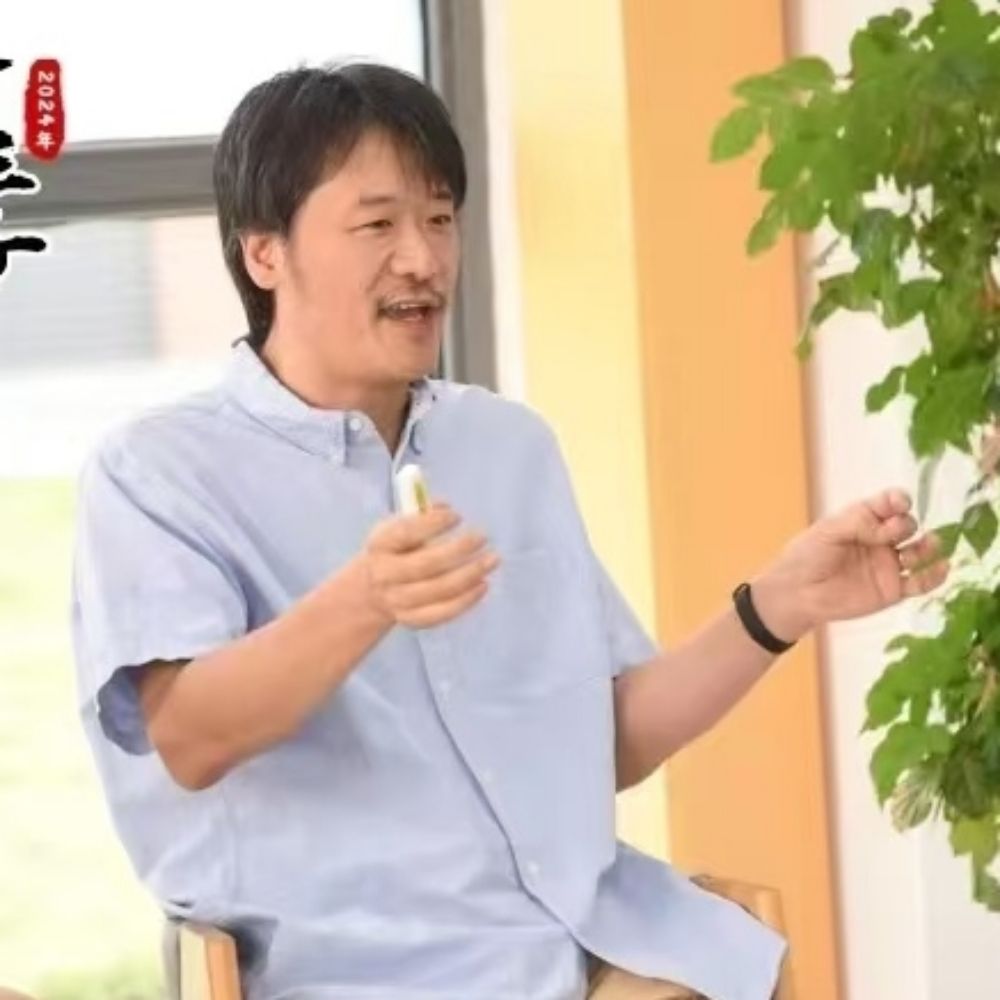
Thank you for citing our work. I will continue contributing to the scientific community by publishing rigorous and reliable research.
#HighlyCited2025
@clarivate.com
#HighlyCited2025
@clarivate.com


November 21, 2025 at 8:46 AM
Congratulations to PCP Editor, Kenichi Tsuda @kenichitsuda.bsky.social for his great contribution to the plant science community! 💐🔬
Reposted by Plant & Cell Physiology
TOR kinase involved in regulating the development of maize radicle through starch metabolism academic.oup.com/pcp/article-... @plantcellphysiol.bsky.social
TOR kinase involved in regulating the development of maize radicle through starch metabolism
Abstract. Target of Rapamycin (TOR) signaling plays a pivotal role in regulating various cellular processes, including energy metabolism and growth. In thi
academic.oup.com
October 24, 2025 at 1:24 PM
TOR kinase involved in regulating the development of maize radicle through starch metabolism academic.oup.com/pcp/article-... @plantcellphysiol.bsky.social
Psychedelic plants... 🌿✌️
Nolan et al. have identified morphological & molecular differences in modern & traditional Cannabis cultivars, showing how selective breeding for larger trichomes enhances phytocannabinoid production for improved drug cultivars
🔗 doi.org/10.1093/pcp/...
#PlantScience
Nolan et al. have identified morphological & molecular differences in modern & traditional Cannabis cultivars, showing how selective breeding for larger trichomes enhances phytocannabinoid production for improved drug cultivars
🔗 doi.org/10.1093/pcp/...
#PlantScience

Bigger is better: modern Cannabis trichomes are larger and more productive than their landrace ancestors
Abstract. Cannabis sativa L. (Cannabis) is a medicinal plant that produces and stores an abundance of therapeutic and psychoactive secondary metabolites, i
doi.org
November 18, 2025 at 6:28 PM
Psychedelic plants... 🌿✌️
Nolan et al. have identified morphological & molecular differences in modern & traditional Cannabis cultivars, showing how selective breeding for larger trichomes enhances phytocannabinoid production for improved drug cultivars
🔗 doi.org/10.1093/pcp/...
#PlantScience
Nolan et al. have identified morphological & molecular differences in modern & traditional Cannabis cultivars, showing how selective breeding for larger trichomes enhances phytocannabinoid production for improved drug cultivars
🔗 doi.org/10.1093/pcp/...
#PlantScience
Reposted by Plant & Cell Physiology
In her article on @plantcellphysiol.bsky.social , botanist @l-teixeiracosta.bsky.social hypothesizes that reduction of negative effects (from parasitic flowering plants) may be hampered by other causes of climate change, such as extremely high temperatures and severe drought.
doi.org/10.1093/pcp/...
doi.org/10.1093/pcp/...

Strange Plants And The Weirding Climate: Parasitic Plant Physiology Under Climate Change
Abstract. Parasitic flowering plants are often seen as keystone species due to the broad influence they exert on communities worldwide. Positive and negati
doi.org
November 14, 2025 at 11:17 AM
In her article on @plantcellphysiol.bsky.social , botanist @l-teixeiracosta.bsky.social hypothesizes that reduction of negative effects (from parasitic flowering plants) may be hampered by other causes of climate change, such as extremely high temperatures and severe drought.
doi.org/10.1093/pcp/...
doi.org/10.1093/pcp/...
3-in-1 action...
Yamamoto et al. report the efficient way in which Arabidopsis encodes a unique protein necessary for threonate metabolism (instead of the 3 enzymes required for the bacterial pathway), as part of the ascorbate degradation process in plants
🔗 doi.org/10.1093/pcp/...
#PlantScience
Yamamoto et al. report the efficient way in which Arabidopsis encodes a unique protein necessary for threonate metabolism (instead of the 3 enzymes required for the bacterial pathway), as part of the ascorbate degradation process in plants
🔗 doi.org/10.1093/pcp/...
#PlantScience
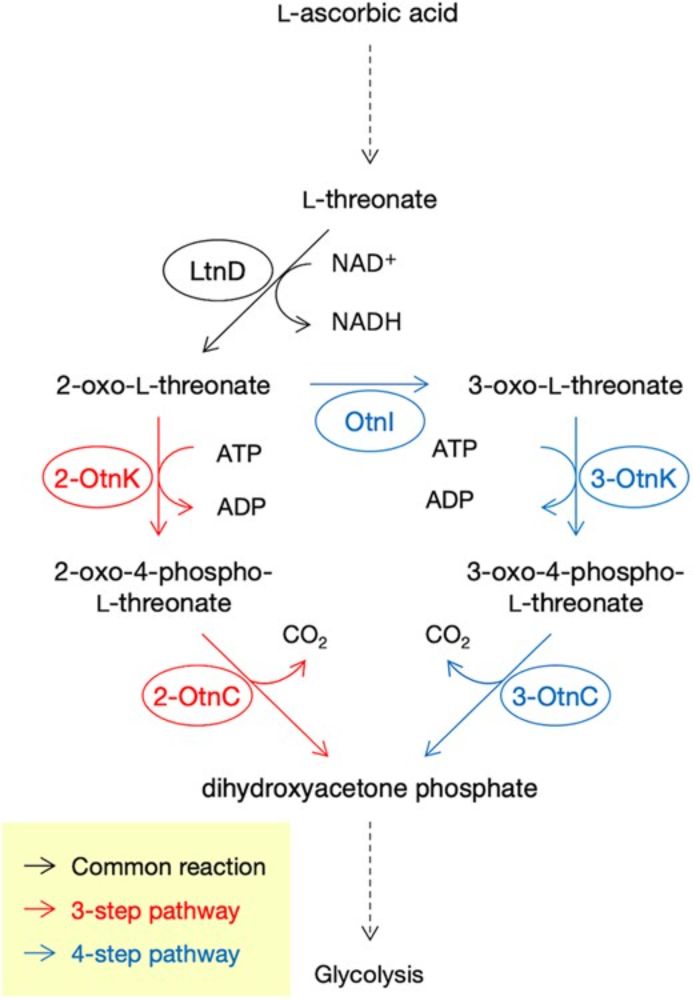
Metabolism of L-threonate, an ascorbate degradation product, requires a protein with L-threonate metabolizing domains in Arabidopsis
Abstract. L-Threonate is one of the major degradation products of ascorbate in plants. While bacteria can utilize L-threonate as a sole carbon source by co
doi.org
November 17, 2025 at 3:43 PM
3-in-1 action...
Yamamoto et al. report the efficient way in which Arabidopsis encodes a unique protein necessary for threonate metabolism (instead of the 3 enzymes required for the bacterial pathway), as part of the ascorbate degradation process in plants
🔗 doi.org/10.1093/pcp/...
#PlantScience
Yamamoto et al. report the efficient way in which Arabidopsis encodes a unique protein necessary for threonate metabolism (instead of the 3 enzymes required for the bacterial pathway), as part of the ascorbate degradation process in plants
🔗 doi.org/10.1093/pcp/...
#PlantScience
Reposted by Plant & Cell Physiology

Countdown: there are only 9 days left ... if you want to join
Molecular Biology of Plants (#MBP2026) Conference in Hennef
Registration + abstract submission end on
🗓️ 23rd November 2025
www.pflanzen-molekularbiologie.de/en/conferenc...
Molecular Biology of Plants (#MBP2026) Conference in Hennef
Registration + abstract submission end on
🗓️ 23rd November 2025
www.pflanzen-molekularbiologie.de/en/conferenc...
Registration is open to take part in the Molecular Biology of Plants (#MBP2026), which especially invites early career scientists to present their molecular #plantsci research www.pflanzen-molekularbiologie.de/en/conferenc...

November 14, 2025 at 11:01 AM
Countdown: there are only 9 days left ... if you want to join
Molecular Biology of Plants (#MBP2026) Conference in Hennef
Registration + abstract submission end on
🗓️ 23rd November 2025
www.pflanzen-molekularbiologie.de/en/conferenc...
Molecular Biology of Plants (#MBP2026) Conference in Hennef
Registration + abstract submission end on
🗓️ 23rd November 2025
www.pflanzen-molekularbiologie.de/en/conferenc...
Right on track...🛤️
Obara & Tominaga have characterised the subcellular dynamics of plant myosin XI and found that it acts as part of a novel transport mechanism to co-ordinate cargo movement & #actin track remodelling
🔗 doi.org/10.1093/pcp/...
#PlantScience
#PlantCellBiology
Obara & Tominaga have characterised the subcellular dynamics of plant myosin XI and found that it acts as part of a novel transport mechanism to co-ordinate cargo movement & #actin track remodelling
🔗 doi.org/10.1093/pcp/...
#PlantScience
#PlantCellBiology

November 14, 2025 at 2:35 PM
Right on track...🛤️
Obara & Tominaga have characterised the subcellular dynamics of plant myosin XI and found that it acts as part of a novel transport mechanism to co-ordinate cargo movement & #actin track remodelling
🔗 doi.org/10.1093/pcp/...
#PlantScience
#PlantCellBiology
Obara & Tominaga have characterised the subcellular dynamics of plant myosin XI and found that it acts as part of a novel transport mechanism to co-ordinate cargo movement & #actin track remodelling
🔗 doi.org/10.1093/pcp/...
#PlantScience
#PlantCellBiology
Standing tall...🌾
Yamaguchi et al. have identified a novel membrane protein (BRITTLE CULM 4) that affects cellulose composition in the secondary cell walls of #rice
📖 doi.org/10.1093/pcp/...
#PlantScience
#PlantCellWalls
Yamaguchi et al. have identified a novel membrane protein (BRITTLE CULM 4) that affects cellulose composition in the secondary cell walls of #rice
📖 doi.org/10.1093/pcp/...
#PlantScience
#PlantCellWalls

The rice BRITTLE CULM 4 gene encodes a membrane protein affecting cellulose synthesis in the secondary cell wall
Abstract. The formation of secondary cell walls, which provide mechanical strength to the plant body, depends on numerous factors. Studies on rice brittle
doi.org
November 13, 2025 at 2:51 PM
Standing tall...🌾
Yamaguchi et al. have identified a novel membrane protein (BRITTLE CULM 4) that affects cellulose composition in the secondary cell walls of #rice
📖 doi.org/10.1093/pcp/...
#PlantScience
#PlantCellWalls
Yamaguchi et al. have identified a novel membrane protein (BRITTLE CULM 4) that affects cellulose composition in the secondary cell walls of #rice
📖 doi.org/10.1093/pcp/...
#PlantScience
#PlantCellWalls
Stress hub...🤯
Korek et al. characterised the #strigolactone repressor HvD53A in #barley, providing evidence for its role as a central node connecting SL signalling to stress resilience - at the expense of #photosynthesis
📖 doi.org/10.1093/pcp/...
👩🔬 academic.oup.com/pcp/pages/re...
#PlantScience
Korek et al. characterised the #strigolactone repressor HvD53A in #barley, providing evidence for its role as a central node connecting SL signalling to stress resilience - at the expense of #photosynthesis
📖 doi.org/10.1093/pcp/...
👩🔬 academic.oup.com/pcp/pages/re...
#PlantScience

November 12, 2025 at 1:18 PM
Stress hub...🤯
Korek et al. characterised the #strigolactone repressor HvD53A in #barley, providing evidence for its role as a central node connecting SL signalling to stress resilience - at the expense of #photosynthesis
📖 doi.org/10.1093/pcp/...
👩🔬 academic.oup.com/pcp/pages/re...
#PlantScience
Korek et al. characterised the #strigolactone repressor HvD53A in #barley, providing evidence for its role as a central node connecting SL signalling to stress resilience - at the expense of #photosynthesis
📖 doi.org/10.1093/pcp/...
👩🔬 academic.oup.com/pcp/pages/re...
#PlantScience
Reposted by Plant & Cell Physiology

🚨 I'm excited to share that my new publication is now available at @plantcellphysiol.bsky.social 📃 Building on numerous publications and on my own recent research, I discuss several ways in which #GlobalChange 🌎🌍🌏 affects the physiology of #ParasiticPlants 🌱
doi.org/10.1093/pcp/...
doi.org/10.1093/pcp/...
Strange Plants And The Weirding Climate: Parasitic Plant Physiology Under Climate Change
Abstract. Parasitic flowering plants are often seen as keystone species due to the broad influence they exert on communities worldwide. Positive and negati
doi.org
November 11, 2025 at 5:50 PM
🚨 I'm excited to share that my new publication is now available at @plantcellphysiol.bsky.social 📃 Building on numerous publications and on my own recent research, I discuss several ways in which #GlobalChange 🌎🌍🌏 affects the physiology of #ParasiticPlants 🌱
doi.org/10.1093/pcp/...
doi.org/10.1093/pcp/...
💡Great insight from PCP Editor @jennyrussinova.bsky.social on the use of #brassinosteroids to precision engineer crops
-see original post below
Find out more about BRs in action in our special issue
➡️ academic.oup.com/pcp/issue/65...
Organised by B. Poppenberger, J. Russinova & S Savaldi-Goldstein
-see original post below
Find out more about BRs in action in our special issue
➡️ academic.oup.com/pcp/issue/65...
Organised by B. Poppenberger, J. Russinova & S Savaldi-Goldstein
November 7, 2025 at 5:25 PM
💡Great insight from PCP Editor @jennyrussinova.bsky.social on the use of #brassinosteroids to precision engineer crops
-see original post below
Find out more about BRs in action in our special issue
➡️ academic.oup.com/pcp/issue/65...
Organised by B. Poppenberger, J. Russinova & S Savaldi-Goldstein
-see original post below
Find out more about BRs in action in our special issue
➡️ academic.oup.com/pcp/issue/65...
Organised by B. Poppenberger, J. Russinova & S Savaldi-Goldstein
Seasons of change...
To understand climate impact on plant clock biology, Muranaka et al. studied diel rhythmic genes in #Arabidopsis halleri over 4 seasons, finding cooperation in the temperature-dependent regulations of circadian rhythmicity & growth
doi.org/10.1093/pcp/...
#PlantScience
To understand climate impact on plant clock biology, Muranaka et al. studied diel rhythmic genes in #Arabidopsis halleri over 4 seasons, finding cooperation in the temperature-dependent regulations of circadian rhythmicity & growth
doi.org/10.1093/pcp/...
#PlantScience

November 6, 2025 at 3:04 PM
Seasons of change...
To understand climate impact on plant clock biology, Muranaka et al. studied diel rhythmic genes in #Arabidopsis halleri over 4 seasons, finding cooperation in the temperature-dependent regulations of circadian rhythmicity & growth
doi.org/10.1093/pcp/...
#PlantScience
To understand climate impact on plant clock biology, Muranaka et al. studied diel rhythmic genes in #Arabidopsis halleri over 4 seasons, finding cooperation in the temperature-dependent regulations of circadian rhythmicity & growth
doi.org/10.1093/pcp/...
#PlantScience
Surviving Arctic conditions... 🥶
Kolomiiets et al. identify a new Klebsormidium strain from the High Arctic Svalbard region & investigate the mechanisms underpinning its extreme resilience to cold, desiccation, N-starvation, & freezing stress
doi.org/10.1093/pcp/...
#PlantScience
#ExtremeBiology
Kolomiiets et al. identify a new Klebsormidium strain from the High Arctic Svalbard region & investigate the mechanisms underpinning its extreme resilience to cold, desiccation, N-starvation, & freezing stress
doi.org/10.1093/pcp/...
#PlantScience
#ExtremeBiology

November 5, 2025 at 10:47 AM
Surviving Arctic conditions... 🥶
Kolomiiets et al. identify a new Klebsormidium strain from the High Arctic Svalbard region & investigate the mechanisms underpinning its extreme resilience to cold, desiccation, N-starvation, & freezing stress
doi.org/10.1093/pcp/...
#PlantScience
#ExtremeBiology
Kolomiiets et al. identify a new Klebsormidium strain from the High Arctic Svalbard region & investigate the mechanisms underpinning its extreme resilience to cold, desiccation, N-starvation, & freezing stress
doi.org/10.1093/pcp/...
#PlantScience
#ExtremeBiology