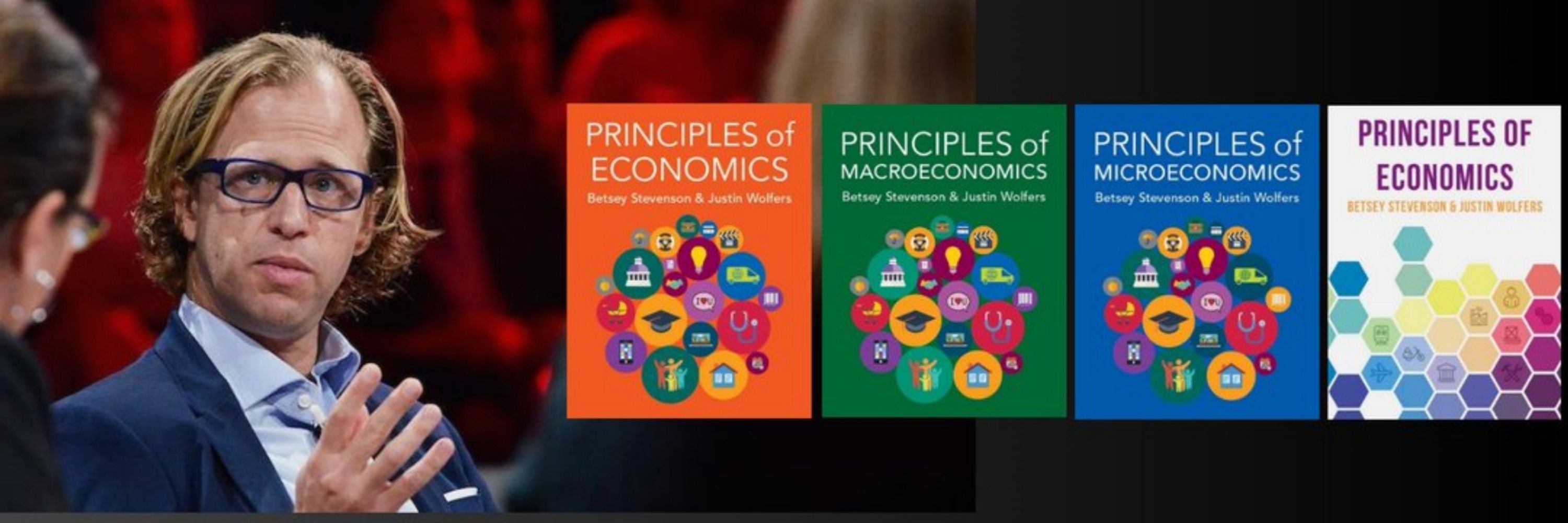

Justin Wolfers
banner
justinwolfers.bsky.social
Justin Wolfers
@justinwolfers.bsky.social

Econ professor at Michigan ● Senior fellow, Brookings ● Intro econ textbook author ● Think Like An Economist podcast ● An economist willing to admit that the glass really is half full.

Justin James Michael Wolfers is an Australian economist and public policy scholar. He is professor of economics and public policy at the Gerald R. Ford School of Public Policy at the University of Michigan, and a Senior Fellow at the Peterson Institute for International Economics. .. more

Economics 62%
Psychology 14%

Powell signals that the Fed believes the October household survey (which I think he means the unemployment) could well be highly distorted by the shutdown. He also said that there may be similar distortions in the CPI. ("Technical factors.")

So new data isn't going to be persuasive for a bit.

Reposted by Greg Linden

Powell just explained that the FOMC is largely on the same page in terms of the future path for the economy. He said they're *all* worried about inflation being too high, and they're *all* worried about rising unemployment. It's what to do next that they disagree on.

Powell notes that the FOMC believes the Fed Funds rate "is now within a broad range of estimates of its neutral value." It's no longer got a foot on the brake or accelerator.

And that means it's likely comfortable sticking where it is until the economy screams for change.

Powell's post Fed-meeting presser is live, here: www.federalreserve.gov/live-broadca...

The official statement was quite uninformative. If last month is anything to go by, this might be where the real news is.
Live Video
The Federal Reserve Board of Governors in Washington DC.
www.federalreserve.gov

Current interest rate projections at the Fed suggest that Hassett might promise the President lower rates, but -- unless something dramatic happens -- he won't be able to deliver.

Fun thing about the December FOMC meeting is that forecasts for 2025 effectively reveal where each participant wants the fund rate to be.

This says 1 wanted a bigger cut, 12 wanted a quarter point cut, and 6 wanted no change.

For the Fed, that's what passes as a starkly divided board.

Reposted by Greg Linden

A revealing set of Fed projections:
1. Inflation is expected to be above target for years.
2. Unemployment is above long-term rate and will be for a while.
3. Surprisingly large uptick in expected growth for 2026.
4. We may get one or two more interest rate cuts, but don't hold your breath.

The Fed just cut rates by a quarter of a percentage point.

The revised statement is remarkably buttoned down, probably due to the shutdown-inflicted data blackout.

And we are now up to three dissents - one for lower rates, and two for no change. But the committee is more deeply divided than that.

Q: "I do want to look at President Trump set to start his economic sales pitch in Pennsylvania in the coming hours -- going to coal country with a message that affordability is a hoax and his economy is doing well. How's that message likely to land?"

Me: "Good luck, mate."

Well, I guess that's a decision.
Status update on House Republicans and a health care plan, after this morning’s conference meeting:

“The consensus is we need to come up with something,” Rep. Ralph Norman says.
Status update on House Republicans and a health care plan, after this morning’s conference meeting:

“The consensus is we need to come up with something,” Rep. Ralph Norman says.

A measure of the market's confidence in Trump's decisions:
- 84% of market economists expect Trump to tap Kevin Hassett to lead the Fed.
- Only 11% think that's a good idea (and that's only relative to Trump's existing shortlist).

www.cnbc.com/amp/2025/12/...

Katy Tur: The President just gave the economy an A plus plus.
Me: "Wow, so grade inflation, huh?"

Is Trump right that the problems confronting soybean farmers are all due to Biden?

There's an old Australian expression: Yeah nah.

The President's Affordability Tour begins with a central message: Cheer up. You can easily do without and enjoy it. And it teaches your entitled kids a healthy lesson. Also steel. That's a real need.
Trump: "You can give up certain products. You could give up pencils. Because under the China policy, every child can get 37 pencils. They only need 1 or 2. They don't need that many. You always need steel. You don't need 37 dolls for your daughter. 2 or 3 is nice. So we're doing things right."

Some moments in the econ news cycle tip my responses from blunt and direct into lightly unhinged territory. I fear the farm bailout just did that. youtu.be/S0ElcMZjvOE?...

(You can subscribe to my YouTube channel for more unhinged directness: www.youtube.com/@JustinWolfers)
Who Gets A Bailout And Who Pays? Justin Wolfers on the Mounting Costs of Trump's Trade War
What if the money for billion‑dollar bailouts is quietly coming from your grocery cart and holiday shopping? Economist Justin Wolfers lays out a blunt account of how tariffs and bailouts really…
youtu.be

The chance of the NBER declaring a recession in any given* year* is about 1-in-7. Prediction markets reckon there's roughly a 1-in-7 chance a recession began *this quarter*, with a similar chance one begins *next quarter*. (No odds yet for later quarters.)
kalshi.com/markets/kxnb...

They need to be independent.
They need to be courageous.. even when it feels difficult.
They need to serve the American people rather than the White House.
They need to have good judgment and a sensible model.. of how the economy works overall.
And they need to show intellectual leadership

The latest script: Prices are high? Must be “big business.”

Need a Trump-y twist? Make it “foreign businesses.”

It’s like political Mad Libs: just fill in the villain and skip the economics.

Add in the President's solution — a task force(!)— and you'll understand my fear nothing goo will happen.

Monetary policy is a screwdriver; tariffs, immigration rules, and trust in government are nails, pipes, and wiring. If the problem is bad trade policy or lost confidence in the White House, turning the interest‑rate screwdriver harder won’t fix it.

Good news. I think I've come up with a policy idea that can both eliminate the harm that Trump's trade war is doing to farmers AND also reduce the cost of groceries for regular Americans. (You'll never guess what it is.)
Farmers get a bail out in the face of the costs they've born from Trump's trade war. Quite an admission that his policies have hurt Americans.

Now riddle me this: Why not bail out consumers who are paying more for imported goods?
www.nytimes.com/2025/12/08/u...

"We've seen tariffs that have raised costs. We've seen a big rise in deportations, making it difficult for farmers to bring in their crops. We've seen health insurance premiums rise as Congress has fiddled with Obamacare..."

"Affordability is the direct result of the actions of the White House."