



Chenyan Jia
@jiachenyan.bsky.social
Assistant Professor @Northeastern. Previously @Stanford postdoc. @UTAustin @PKU1898 alum. Interested in human-centered AI, HCI, and misinformation.
Reposted by Chenyan Jia

🚨 New in Nature+Science!🚨
AI chatbots can shift voter attitudes on candidates & policies, often by 10+pp
🔹Exps in US Canada Poland & UK
🔹More “facts”→more persuasion (not psych tricks)
🔹Increasing persuasiveness reduces "fact" accuracy
🔹Right-leaning bots=more inaccurate
AI chatbots can shift voter attitudes on candidates & policies, often by 10+pp
🔹Exps in US Canada Poland & UK
🔹More “facts”→more persuasion (not psych tricks)
🔹Increasing persuasiveness reduces "fact" accuracy
🔹Right-leaning bots=more inaccurate


December 4, 2025 at 8:43 PM
🚨 New in Nature+Science!🚨
AI chatbots can shift voter attitudes on candidates & policies, often by 10+pp
🔹Exps in US Canada Poland & UK
🔹More “facts”→more persuasion (not psych tricks)
🔹Increasing persuasiveness reduces "fact" accuracy
🔹Right-leaning bots=more inaccurate
AI chatbots can shift voter attitudes on candidates & policies, often by 10+pp
🔹Exps in US Canada Poland & UK
🔹More “facts”→more persuasion (not psych tricks)
🔹Increasing persuasiveness reduces "fact" accuracy
🔹Right-leaning bots=more inaccurate
Reposted by Chenyan Jia

What if you could see fewer hostile political posts on social media? A new paper out in Science by Martin Saveski @msaveski.bsky.social of the iSchool, along with @tiziano.bsky.social, @jiachenyan.bsky.social, Jeff Hancock, Jeanne Tsai and @mbernst.bsky.social, explores this: doi.org/10.1126/scie...

December 4, 2025 at 10:14 PM
What if you could see fewer hostile political posts on social media? A new paper out in Science by Martin Saveski @msaveski.bsky.social of the iSchool, along with @tiziano.bsky.social, @jiachenyan.bsky.social, Jeff Hancock, Jeanne Tsai and @mbernst.bsky.social, explores this: doi.org/10.1126/scie...
Reposted by Chenyan Jia

CSCW folks, I wanted to highlight how excited and proud I am to see work from our community (dl.acm.org/doi/10.1145/..., CSCW '24 best paper winner led by @jiachenyan.bsky.social and @mlam.bsky.social) grow and expand ambition into this Science paper. CSCW has a ton to offer the world.
Our new article in @science.org enables social media reranking outside of platforms' walled gardens.
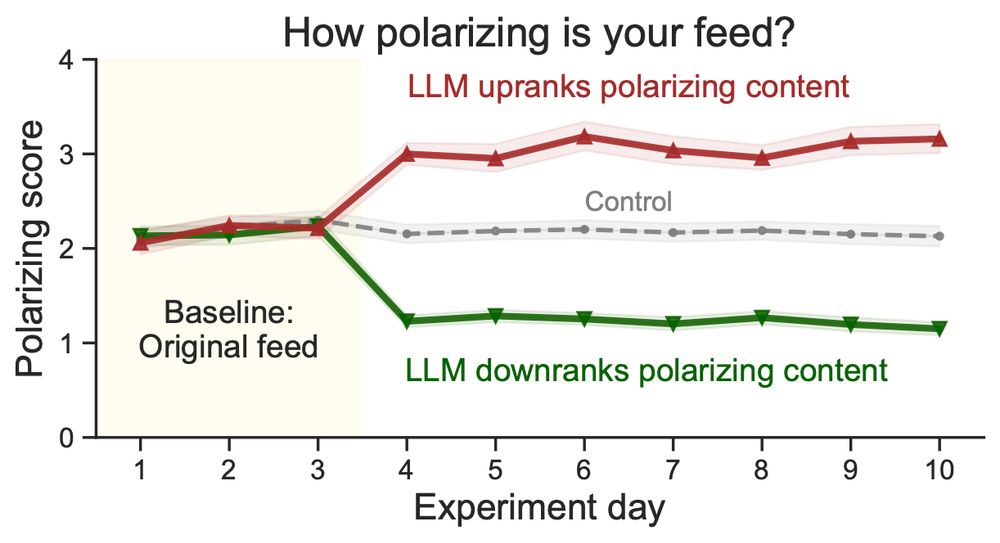
We add an LLM-powered reranking of highly polarizing political content into N=1256 participants' feeds. Downranking cools tensions with the opposite party—but upranking inflames them.
We add an LLM-powered reranking of highly polarizing political content into N=1256 participants' feeds. Downranking cools tensions with the opposite party—but upranking inflames them.

December 3, 2025 at 7:46 PM
CSCW folks, I wanted to highlight how excited and proud I am to see work from our community (dl.acm.org/doi/10.1145/..., CSCW '24 best paper winner led by @jiachenyan.bsky.social and @mlam.bsky.social) grow and expand ambition into this Science paper. CSCW has a ton to offer the world.
Our new study in @science.org built an LLM-powered browser extension to rerank social media feeds without requiring platform cooperation. In a preregistered 10-day field experiment (N=1,256), we found that algorithmic ranking can both raise and lower levels of affective political polarization.

December 3, 2025 at 12:45 AM
Our new study in @science.org built an LLM-powered browser extension to rerank social media feeds without requiring platform cooperation. In a preregistered 10-day field experiment (N=1,256), we found that algorithmic ranking can both raise and lower levels of affective political polarization.
Reposted by Chenyan Jia

A novel new study finds you can reduce polarization on X simply with a simple change to the algorithm. I spoke with the researchers: www.platformer.news/stanford-pol...

December 2, 2025 at 12:58 AM
A novel new study finds you can reduce polarization on X simply with a simple change to the algorithm. I spoke with the researchers: www.platformer.news/stanford-pol...
Reposted by Chenyan Jia

New paper in Science:
In a platform-independent field experiment, we show that reranking content expressing antidemocratic attitudes and partisan animosity in social media feeds alters affective polarization.
🧵
In a platform-independent field experiment, we show that reranking content expressing antidemocratic attitudes and partisan animosity in social media feeds alters affective polarization.
🧵

December 1, 2025 at 7:59 AM
New paper in Science:
In a platform-independent field experiment, we show that reranking content expressing antidemocratic attitudes and partisan animosity in social media feeds alters affective polarization.
🧵
In a platform-independent field experiment, we show that reranking content expressing antidemocratic attitudes and partisan animosity in social media feeds alters affective polarization.
🧵
Reposted by Chenyan Jia
Joint work with @tiziano.bsky.social, @jiachenyan.bsky.social, Jeff Hancock, Jeanne Tsai, @mbernst.bsky.social
Link: doi.org/10.1126/scie...
And a very thoughtful perspective by @jennyallen.bsky.social and @jatucker.bsky.social: doi.org/10.1126/scie...
/1
Link: doi.org/10.1126/scie...
And a very thoughtful perspective by @jennyallen.bsky.social and @jatucker.bsky.social: doi.org/10.1126/scie...
/1
December 1, 2025 at 7:59 AM
Joint work with @tiziano.bsky.social, @jiachenyan.bsky.social, Jeff Hancock, Jeanne Tsai, @mbernst.bsky.social
Link: doi.org/10.1126/scie...
And a very thoughtful perspective by @jennyallen.bsky.social and @jatucker.bsky.social: doi.org/10.1126/scie...
/1
Link: doi.org/10.1126/scie...
And a very thoughtful perspective by @jennyallen.bsky.social and @jatucker.bsky.social: doi.org/10.1126/scie...
/1
Reposted by Chenyan Jia
Article with @tiziano.bsky.social, @msaveski.bsky.social, @jiachenyan.bsky.social, Jeff Hancock, and Jeanne Tsai
www.science.org/doi/10.1126/...
www.science.org/doi/10.1126/...

Reranking partisan animosity in algorithmic social media feeds alters affective polarization
Today, social media platforms hold the sole power to study the effects of feed-ranking algorithms. We developed a platform-independent method that reranks participants’ feeds in real time and used thi...
www.science.org
December 1, 2025 at 7:33 PM
Article with @tiziano.bsky.social, @msaveski.bsky.social, @jiachenyan.bsky.social, Jeff Hancock, and Jeanne Tsai
www.science.org/doi/10.1126/...
www.science.org/doi/10.1126/...
Reposted by Chenyan Jia
Our new article in @science.org enables social media reranking outside of platforms' walled gardens.
We add an LLM-powered reranking of highly polarizing political content into N=1256 participants' feeds. Downranking cools tensions with the opposite party—but upranking inflames them.
We add an LLM-powered reranking of highly polarizing political content into N=1256 participants' feeds. Downranking cools tensions with the opposite party—but upranking inflames them.
December 1, 2025 at 7:33 PM
Our new article in @science.org enables social media reranking outside of platforms' walled gardens.
We add an LLM-powered reranking of highly polarizing political content into N=1256 participants' feeds. Downranking cools tensions with the opposite party—but upranking inflames them.
We add an LLM-powered reranking of highly polarizing political content into N=1256 participants' feeds. Downranking cools tensions with the opposite party—but upranking inflames them.
Reposted by Chenyan Jia
Realtime LLM social media reranking enables field experiments demonstrating how we can depolarize. Congratulations @tiziano.bsky.social, @msaveski.bsky.social, and @jiachenyan.bsky.social!

New paper: Do social media algorithms shape affective polarization?
We ran a field experiment on X/Twitter (N=1,256) using LLMs to rerank content in real-time, adjusting exposure to polarizing posts. Result: Algorithmic ranking impacts feelings toward the political outgroup! 🧵⬇️
We ran a field experiment on X/Twitter (N=1,256) using LLMs to rerank content in real-time, adjusting exposure to polarizing posts. Result: Algorithmic ranking impacts feelings toward the political outgroup! 🧵⬇️
November 26, 2024 at 12:08 AM
Realtime LLM social media reranking enables field experiments demonstrating how we can depolarize. Congratulations @tiziano.bsky.social, @msaveski.bsky.social, and @jiachenyan.bsky.social!