




Marc A. Milne
@forthespiders.bsky.social
Spider taxonomist / conservationist / ecologist. Professor of Biology at the University of Indianapolis. Canadian. Lover of metal, cats, and hockey. 🌹
Oh to be a little tank living my life out in the soil.


December 6, 2025 at 10:21 PM
Oh to be a little tank living my life out in the soil.
RE-DISCOVERY #3
Scotinella pennimani Platnick and Chamé-Vázquez, 2024 (Phrurolithidae) was described just last year from specimens collected in 1967 (58 years ago). We found this lady in Okefenokee NWR on Trembling Earth Nature Trail just north of Stephen C. Foster State Park in SE Georgia.
Scotinella pennimani Platnick and Chamé-Vázquez, 2024 (Phrurolithidae) was described just last year from specimens collected in 1967 (58 years ago). We found this lady in Okefenokee NWR on Trembling Earth Nature Trail just north of Stephen C. Foster State Park in SE Georgia.


December 2, 2025 at 5:47 PM
RE-DISCOVERY #3
Scotinella pennimani Platnick and Chamé-Vázquez, 2024 (Phrurolithidae) was described just last year from specimens collected in 1967 (58 years ago). We found this lady in Okefenokee NWR on Trembling Earth Nature Trail just north of Stephen C. Foster State Park in SE Georgia.
Scotinella pennimani Platnick and Chamé-Vázquez, 2024 (Phrurolithidae) was described just last year from specimens collected in 1967 (58 years ago). We found this lady in Okefenokee NWR on Trembling Earth Nature Trail just north of Stephen C. Foster State Park in SE Georgia.
Introduce yourself with 5 animals you've seen in the wild:
[this spider has no common name]
[this spider has no common name]
[this spider has no common name]
[this spider has no common name]
[this spider has no common name]
[this spider has no common name]
[this spider has no common name]
[this spider has no common name]
[this spider has no common name]
[this spider has no common name]
Introduce yourself with 5 animals you’ve seen in the wild:
Galapagos penguin
Kagu
Red Sea anemonefish
Florida cottonmouth
Water ouzel
Galapagos penguin
Kagu
Red Sea anemonefish
Florida cottonmouth
Water ouzel
Introduce yourself with 5 animals you've seen in the wild:
Caribou
Ravens
Seals
Kea
Turkeys
Caribou
Ravens
Seals
Kea
Turkeys
November 28, 2025 at 11:32 PM
Introduce yourself with 5 animals you've seen in the wild:
[this spider has no common name]
[this spider has no common name]
[this spider has no common name]
[this spider has no common name]
[this spider has no common name]
[this spider has no common name]
[this spider has no common name]
[this spider has no common name]
[this spider has no common name]
[this spider has no common name]
Also featuring the incredible @mhedin.bsky.social and Kefyn Catley!
A love letter to #spiders and everything they do for us, referencing a 2023 ZooKeys study by @mhedin.bsky.social and @forthespiders.bsky.social where they described 10 new cave spider species!
eu.knoxnews.com/story/life/2...
eu.knoxnews.com/story/life/2...
Wait, don’t kill that spider! They protect us from disease
When you see a spider in your house, stop and think before you kill it. Spiders do more good for humans than harm.
eu.knoxnews.com
November 24, 2025 at 3:44 PM
Also featuring the incredible @mhedin.bsky.social and Kefyn Catley!
RE-DISCOVERY #2
Our trip to Okefenokee NWR has resulted in another re-discovery of a long-lost species. Ceratinopsis sutoris Bishop & Crosby 1930 was last seen in 1927 (98 years ago!) and we collected several males and females. The species has a orange-red carapace with black around the eyes.
Our trip to Okefenokee NWR has resulted in another re-discovery of a long-lost species. Ceratinopsis sutoris Bishop & Crosby 1930 was last seen in 1927 (98 years ago!) and we collected several males and females. The species has a orange-red carapace with black around the eyes.


November 22, 2025 at 7:18 PM
RE-DISCOVERY #2
Our trip to Okefenokee NWR has resulted in another re-discovery of a long-lost species. Ceratinopsis sutoris Bishop & Crosby 1930 was last seen in 1927 (98 years ago!) and we collected several males and females. The species has a orange-red carapace with black around the eyes.
Our trip to Okefenokee NWR has resulted in another re-discovery of a long-lost species. Ceratinopsis sutoris Bishop & Crosby 1930 was last seen in 1927 (98 years ago!) and we collected several males and females. The species has a orange-red carapace with black around the eyes.
RE-DISCOVERY #1!
Our trip to Okefenokee NWR has already resulted in a re-discovery of a long-lost species. Ceratinopsis bona Chamberlin & Ivie, 1944 was last seen in 1943, 82 years ago. In addition to possessing genitalia that match the descriptions, their black tibia IVs are also diagnostic.
Our trip to Okefenokee NWR has already resulted in a re-discovery of a long-lost species. Ceratinopsis bona Chamberlin & Ivie, 1944 was last seen in 1943, 82 years ago. In addition to possessing genitalia that match the descriptions, their black tibia IVs are also diagnostic.


November 18, 2025 at 5:24 PM
RE-DISCOVERY #1!
Our trip to Okefenokee NWR has already resulted in a re-discovery of a long-lost species. Ceratinopsis bona Chamberlin & Ivie, 1944 was last seen in 1943, 82 years ago. In addition to possessing genitalia that match the descriptions, their black tibia IVs are also diagnostic.
Our trip to Okefenokee NWR has already resulted in a re-discovery of a long-lost species. Ceratinopsis bona Chamberlin & Ivie, 1944 was last seen in 1943, 82 years ago. In addition to possessing genitalia that match the descriptions, their black tibia IVs are also diagnostic.
A shiny beetle collected from tall grass on Billy's Island in the middle of Okefenokee National Wildlife Refuge, Georgia.

November 17, 2025 at 7:43 PM
A shiny beetle collected from tall grass on Billy's Island in the middle of Okefenokee National Wildlife Refuge, Georgia.
Day 4 of our Okefenokee NWF collecting trip took us to Mixons Hammock east of Stephen C Foster State Park. We canoed the two miles and then sampled mossy patches and magnolia litter in cypress swamps. Not the most productive, but we found many linyphiids for study.


October 31, 2025 at 11:27 PM
Day 4 of our Okefenokee NWF collecting trip took us to Mixons Hammock east of Stephen C Foster State Park. We canoed the two miles and then sampled mossy patches and magnolia litter in cypress swamps. Not the most productive, but we found many linyphiids for study.
Day 3 of our collecting trip was to the east side of Okefenokee NWF (a 1.5hr drive around the southern edge) where we collected in swampy thatch/moss patches along the Chesser Island boardwalk. Found lots of erigonines, a pygmy rattlesnake, and a water moccasin. Didn't collect the snakes, though. 🙂


October 30, 2025 at 11:52 PM
Day 3 of our collecting trip was to the east side of Okefenokee NWF (a 1.5hr drive around the southern edge) where we collected in swampy thatch/moss patches along the Chesser Island boardwalk. Found lots of erigonines, a pygmy rattlesnake, and a water moccasin. Didn't collect the snakes, though. 🙂
Day 2 of our Okefenokee spider collecting trip went well. We were joined by Brett Tyler, a spider enthusiast at Georgia DNR. To collect, we vacuumed under Sphagnum moss mats and among Cypress knees in wet swamps and jumped off of boardwalks to get to emergent wetland vegetation. Long, tiring day.


October 29, 2025 at 10:51 PM
Day 2 of our Okefenokee spider collecting trip went well. We were joined by Brett Tyler, a spider enthusiast at Georgia DNR. To collect, we vacuumed under Sphagnum moss mats and among Cypress knees in wet swamps and jumped off of boardwalks to get to emergent wetland vegetation. Long, tiring day.
Day 1 of our Okefenokee NWF trip completed. We canoed to Billy's Island (~2mi.), collected spiders all day via litter sift and vacuum, and canoed back to camp. Very productive and hopefully we collected some lost species.


October 28, 2025 at 11:24 PM
Day 1 of our Okefenokee NWF trip completed. We canoed to Billy's Island (~2mi.), collected spiders all day via litter sift and vacuum, and canoed back to camp. Very productive and hopefully we collected some lost species.
A fourth spider we're searching for at Okefenokee NWF later this month is Floricomus setosus. This tiny spider was last collected 82 years ago, in 1943 and was previously found "E. side of Okefenokee Swamp" in 1933. Only one male and two females have ever been collected.

October 19, 2025 at 6:29 PM
A fourth spider we're searching for at Okefenokee NWF later this month is Floricomus setosus. This tiny spider was last collected 82 years ago, in 1943 and was previously found "E. side of Okefenokee Swamp" in 1933. Only one male and two females have ever been collected.
A third spider we'll be searching for in Okefenokee Swamp is Floricomus floricomus. A tiny, 1.5mm spider with a distinct plumose setae-covered horn on the head of males, this spider was first discovered in 1922 when it was CUT OUT OF THE STOMACH OF A TOAD that was hopping around in Okefenokee Swamp.

October 16, 2025 at 4:12 PM
A third spider we'll be searching for in Okefenokee Swamp is Floricomus floricomus. A tiny, 1.5mm spider with a distinct plumose setae-covered horn on the head of males, this spider was first discovered in 1922 when it was CUT OUT OF THE STOMACH OF A TOAD that was hopping around in Okefenokee Swamp.
Another spider we are searching for on our Okefenokee NWF journey is Idionella titivillitium. It was first collected in 1912 on Billy's Island at the edge of the swamp, which is where we are traveling to in late October. It was collected, "by sifting decaying leaves in dense shade at edge of swamp."

October 13, 2025 at 6:41 PM
Another spider we are searching for on our Okefenokee NWF journey is Idionella titivillitium. It was first collected in 1912 on Billy's Island at the edge of the swamp, which is where we are traveling to in late October. It was collected, "by sifting decaying leaves in dense shade at edge of swamp."
One of the spiders we are searching for on our Okefenokee NWF trip later this month is Ceratinopsis bona. Described from southeastern Georgia, this specimen hasn't been seen since it was collected for that description in 1943. It is reddish brown with black around the eyes with a gray abdomen.

October 6, 2025 at 3:12 PM
One of the spiders we are searching for on our Okefenokee NWF trip later this month is Ceratinopsis bona. Described from southeastern Georgia, this specimen hasn't been seen since it was collected for that description in 1943. It is reddish brown with black around the eyes with a gray abdomen.
In three weeks, Mike Draney (U. Wisconsin) and I will travel to Okefenokee Swamp NWF in southern Georgia in hopes of finding some lost spider species. We'll be collecting on Billy's Island and we'll have to travel by boat through the swamp to reach it. It was last sampled for spiders in 1921.
October 2, 2025 at 6:09 PM
In three weeks, Mike Draney (U. Wisconsin) and I will travel to Okefenokee Swamp NWF in southern Georgia in hopes of finding some lost spider species. We'll be collecting on Billy's Island and we'll have to travel by boat through the swamp to reach it. It was last sampled for spiders in 1921.
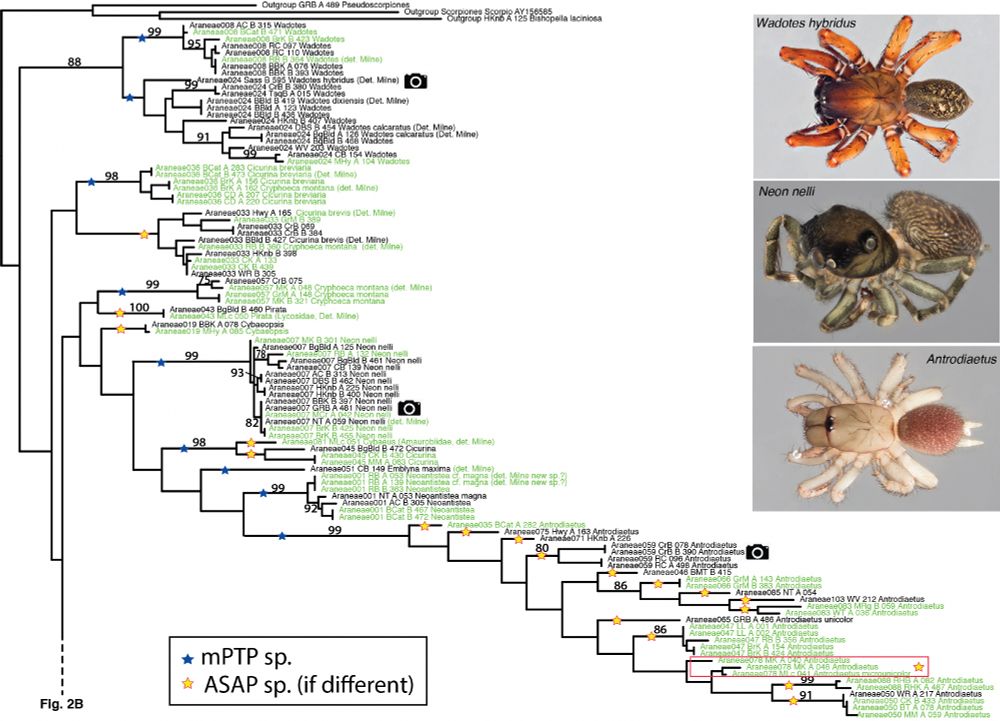
Thrilled our paper is finally out! A great collaboration between @mcaterino.bsky.social, Ernesto Recuero, and myself. We looked at endemism in spiders in southern Appalachia (largely NC).
This is also likely the most species-rich phylogeny (although just COI-based) of linyphiids yet published!
This is also likely the most species-rich phylogeny (although just COI-based) of linyphiids yet published!
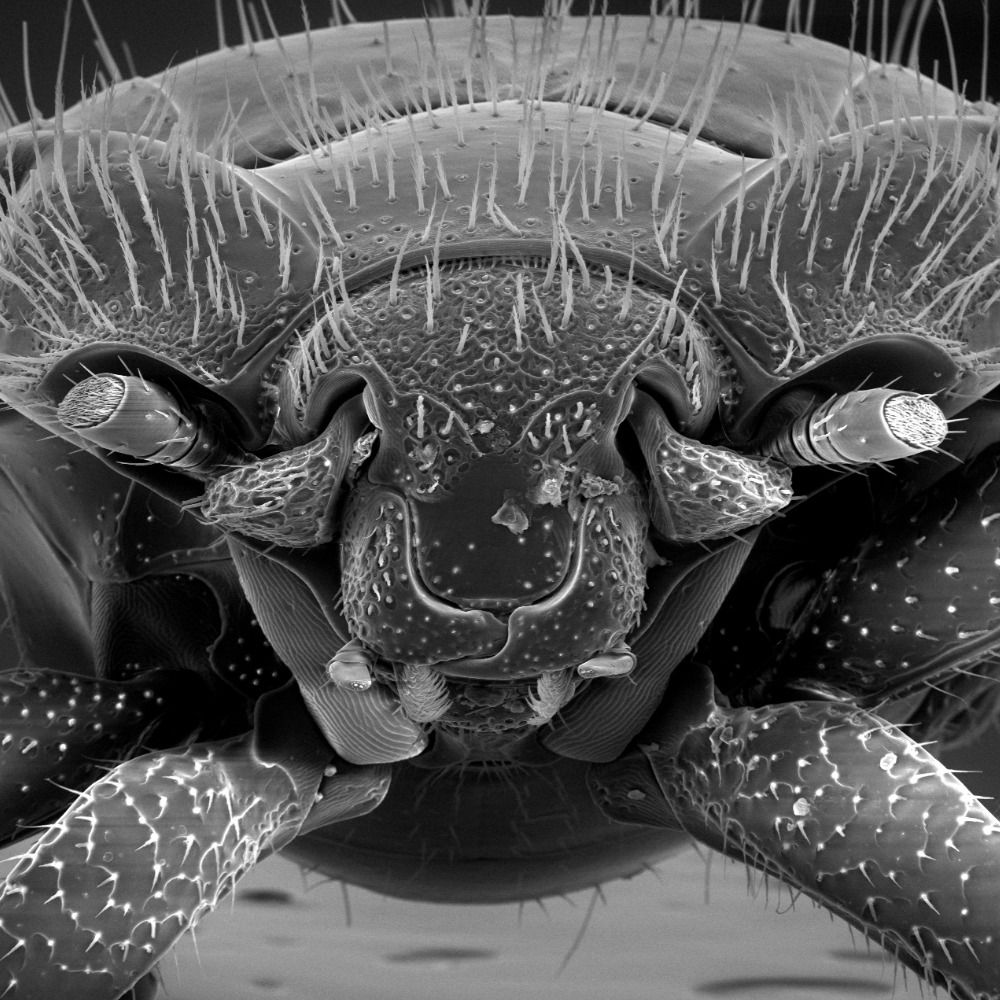
High elevation litter spiders of southern Appalachia show less local endemism than other arthropods - ballooning by spiderlings apparently overcomes geographic isolation. A great collaboration with @forthespiders.bsky.social & Ernesto Recuero
doi.org/10.1636/JoA-... (if paywalled write me for pdf)
doi.org/10.1636/JoA-... (if paywalled write me for pdf)


September 30, 2025 at 3:22 PM
Thrilled our paper is finally out! A great collaboration between @mcaterino.bsky.social, Ernesto Recuero, and myself. We looked at endemism in spiders in southern Appalachia (largely NC).
This is also likely the most species-rich phylogeny (although just COI-based) of linyphiids yet published!
This is also likely the most species-rich phylogeny (although just COI-based) of linyphiids yet published!
The Popeye of mites.

September 24, 2025 at 5:47 PM
The Popeye of mites.
This was one super-gravid spider!
I hear people sometimes think spiders look like ticks and usually it seems a bit silly to me, but in this case I can make an exception.
Ceratinella parvula (Araneae, Linyphiidae) from Eagle Marsh, IN.
#arthropod #taxonomy #pregnancy
I hear people sometimes think spiders look like ticks and usually it seems a bit silly to me, but in this case I can make an exception.
Ceratinella parvula (Araneae, Linyphiidae) from Eagle Marsh, IN.
#arthropod #taxonomy #pregnancy

September 24, 2025 at 3:27 PM
This was one super-gravid spider!
I hear people sometimes think spiders look like ticks and usually it seems a bit silly to me, but in this case I can make an exception.
Ceratinella parvula (Araneae, Linyphiidae) from Eagle Marsh, IN.
#arthropod #taxonomy #pregnancy
I hear people sometimes think spiders look like ticks and usually it seems a bit silly to me, but in this case I can make an exception.
Ceratinella parvula (Araneae, Linyphiidae) from Eagle Marsh, IN.
#arthropod #taxonomy #pregnancy
It's hard to express to you how beautiful this creature is. It's like a living galaxy. #arthropod #beetle

September 22, 2025 at 10:35 PM
It's hard to express to you how beautiful this creature is. It's like a living galaxy. #arthropod #beetle
For the last day of #InverteFest, I give you a male of Ceratinops latus (Araneae: Linyphiidae) from Big Oaks National Wildlife Refuge in SE Indiana. This lil guy is about 1.5 mm in length.


August 31, 2025 at 6:11 PM
For the last day of #InverteFest, I give you a male of Ceratinops latus (Araneae: Linyphiidae) from Big Oaks National Wildlife Refuge in SE Indiana. This lil guy is about 1.5 mm in length.

Taxonomy has been asleep for 525 million years.
June 17, 2025 at 10:19 PM
Taxonomy has been asleep for 525 million years.
An infuriating article from U. Rochester school newspaper in 1957 that reflects the scientific attitude at mid-century towards taxonomy, biodiversity, and the perceived value of specimen collections.

June 6, 2025 at 2:43 PM
An infuriating article from U. Rochester school newspaper in 1957 that reflects the scientific attitude at mid-century towards taxonomy, biodiversity, and the perceived value of specimen collections.
A 12-shot stack of the curious silkhenge spider egg sac (more info here: www.rainforestexpeditions.com/we-solved-an...). This is currently being studied by brilliant arachnologists, including the amazing @henriquesbio.bsky.social. It's still not clear what type of spider builds this structure.

June 2, 2025 at 8:52 PM
A 12-shot stack of the curious silkhenge spider egg sac (more info here: www.rainforestexpeditions.com/we-solved-an...). This is currently being studied by brilliant arachnologists, including the amazing @henriquesbio.bsky.social. It's still not clear what type of spider builds this structure.