


Official account of the United Nations Environment Programme
https://www.unep.org/
The United Nations Environment Programme (UNEP) is responsible for coordinating responses to environmental issues within the United Nations System. It was established by Maurice Strong, its first director, after the United Nations Conference on the Human Environment in Stockholm in June 1972. Its mandate is to provide leadership, deliver science and develop solutions on a wide range of issues, including climate change, the management of marine and terrestrial ecosystems, and green economic development. The organization also develops international environmental agreements; publishes and promotes environmental science and helps national governments achieve environmental targets. .. more

Investing in nature offers a smart, cost-effective way to protect lives and strengthen economies.
Learn more: https://tinyurl.com/4zcbfbxk

Kenya is updating its nature action plan by integrating science, policy, and business while empowering local communities.
Find out more: https://shorturl.at/Pod9V

But many of these countries are fighting back: https://www.unep.org/news-and-stories/story/ridges-reefs-small-island-states-lead-big-environmental-moves

Investing in sustainable cold chains protects both people and the planet.
Here’s how UNEP helps scale #BeatWastePollution solutions: https://bit.ly/3NA7nj0

National Biodiversity Strategies and Action Plans (NBSAPs) are each country’s plan to protect nature and reverse this loss.
Here’s why they matter: https://shorturl.at/3qX7R

Explore more facts from Montreal Protocol Ozone Secretariat on ozone protection: https://ow.ly/ghRx50XWyY5

See how the Global Biodiversity Framework supports the #GlobalGoals in this interactive: www.unep.org/interactives...
Meet the 2025 UNEP #YoungChamps of the Earth and watch their full journey, including a surprise opportunity to pitch for a $1.1 million prize: youtu.be/Rg87g26kDG8

That’s why we must #BeatChemicalPollution at its source, using a #OneHealth approach: bit.ly/3Nxmjyl

Initiatives like UNEP’s Seed Capital Assistance Facility help de-risk clean energy projects with small grants that unlock big change.
Learn more: https://ow.ly/OUcZ50XVsCs

Cameroon is cutting taxes on electric vehicles, batteries and charging infrastructure by 50% for the next two years.
Read more about this bold move to reduce emissions and accelerate cleaner mobility: https://bit.ly/4bjeXIH
Reposted by Markus W. Gehring
Learn why POPs matter, how people are exposed, and how the Stockholm Convention works to eliminate them worldwide: bit.ly/4pThazb
More about this #EarthChamps: www.unep.org/championsofe...
Reposted by Rob Marchant

From India to the Sahel, real-life examples show how economies can benefit both people and the planet.
Learn how countries are transforming their relationship with nature: tinyurl.com/mutvrcj5

UNEP works with partners to ensure climate adaptation and biodiversity conservation go hand in hand to protect these species.
tinyurl.com/y7ve32e9
Reposted by Rob Marchant, Esther Monzó-Nebot

Explore how the Global Biodiversity Framework supports the #GlobalGoals: tinyurl.com/mv789yam @unbiodiversity.bsky.social

UNEP supports policies that balance conservation with community needs, like sustainable fisheries & wildlife management.
Learn more: https://ow.ly/mMKl50XTW2n

But pollution, overuse, and warming threaten them.
Without action, the value of lake ecosystem services could drop by up to 20% by 2050: https://ow.ly/mEzL50XTVZP

Since 2010, solar and wind energy costs have plummeted due to technological advancements, making #ClimateAction more affordable.
Check out this UN article for facts: https://ow.ly/5HNl50XTVYI

Visit: https://www.unep.org/topics/digital-transformations/digital-accelerator-lab/digital-accelerator-lab-solutions

These ecosystems store up to 1,000 tonnes of carbon per hectare in their biomass and soils.
More info on the many benefits of mangroves: https://bit.ly/3KMibE0
Reposted by Mark Lubell

These ecosystems store up to 1,000 tonnes of carbon per hectare in their biomass and soils.
More info on the many benefits of mangroves: https://bit.ly/3KMibE0

Guided by science and empathy for people, he believed progress could gather pace and spent his life helping make it so.
His legacy lives on: bit.ly/3NalkEs
Reposted by UN Environment



His science-based, community-led work shaped policy and helped protect the biodiverse Western Ghats.
And why, in 2024, @unep.org honoured Madhav as a Champion of the Earth.
Read about his legacy: www.unep.org/championsofe...
The ocean supports humanity in countless ways, and when the ocean suffers, so do we. Instead of protecting it, we’ve polluted its depths and pushed it to the brink.
Learn about our efforts to #SaveOurOcean: www.unep.org/topics/ocean...

Yet, 10 million hectares are cleared annually by humans—equivalent to the size of Portugal.
UNEP supports the protection of these ecosystems: https://ow.ly/5UQP50XSSVm

Explore the latest #ClimateAction data and what can be done: bit.ly/44DCKyQ
Reposted by Beatriz Gallardo Paúls

More than 1,000 young people from 70 countries came together at the Youth Environment Assembly, a youth-led forum to shape priorities and policy solutions to some of the planet’s most pressing environmental challenges.
Read the 6 takeaways: www.unep.org/news-and-sto...
Reposted by Markus W. Gehring
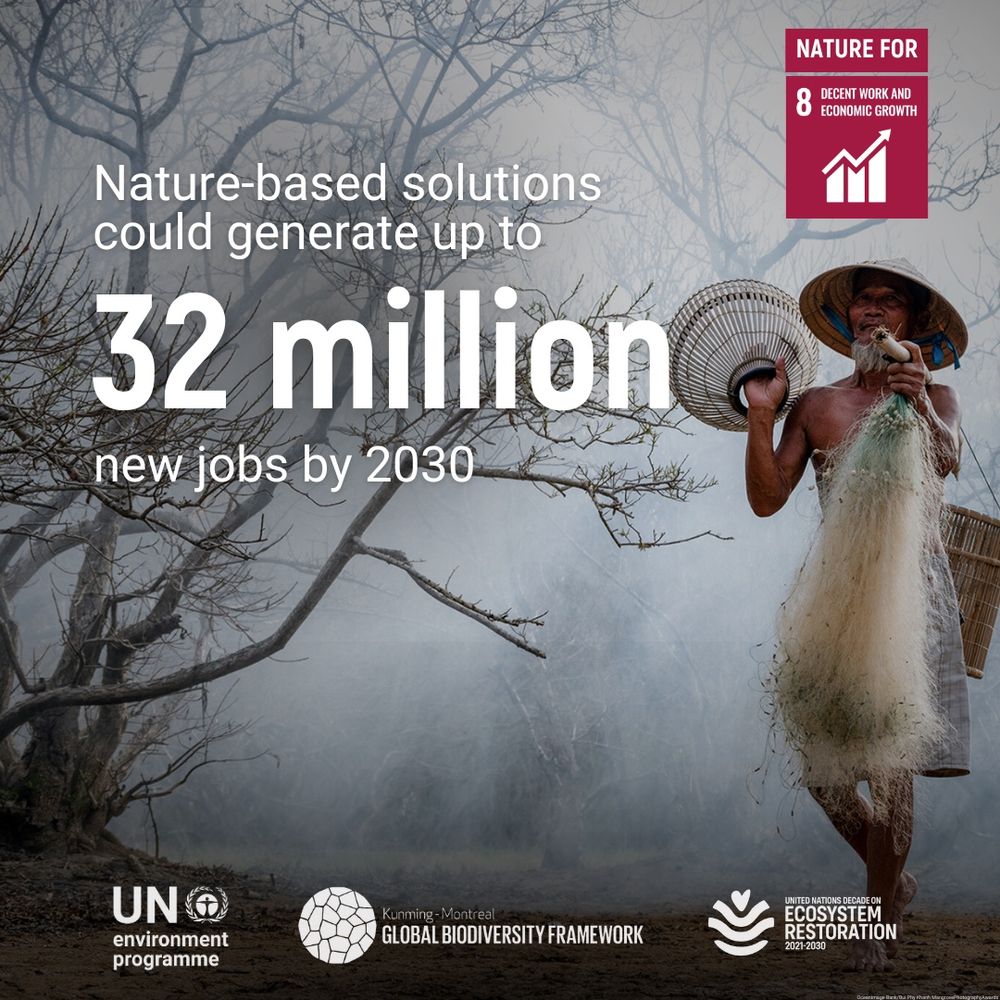
They offer affordable, effective ways to tackle climate change, biodiversity loss and pollution.
Explore how this approach works: unep.org/unep-and-nat...
Learn about these #EarthChamps fight for justice: www.unep.org/championsofe...