



Zach Liscow
@zliscow.bsky.social
Economist & lawyer. Professor at Yale Law School: economic and tax policy, infrastructure costs. Formerly OMB Chief Economist. https://law.yale.edu/zachary-liscow
🚨NEW RESULTS (w/ Slattery & Nober)
- When gov't engineers retire, highway projects cost more: the engineers pay for themselves 6 times over
- Improving gov’t engineer quality from the 25th to 75th percentile reduces costs by 14%, equal to 3x avg. engineer pay
Paper: papers.ssrn.com/sol3/papers....
- When gov't engineers retire, highway projects cost more: the engineers pay for themselves 6 times over
- Improving gov’t engineer quality from the 25th to 75th percentile reduces costs by 14%, equal to 3x avg. engineer pay
Paper: papers.ssrn.com/sol3/papers....

September 12, 2025 at 1:43 PM
🚨NEW RESULTS (w/ Slattery & Nober)
- When gov't engineers retire, highway projects cost more: the engineers pay for themselves 6 times over
- Improving gov’t engineer quality from the 25th to 75th percentile reduces costs by 14%, equal to 3x avg. engineer pay
Paper: papers.ssrn.com/sol3/papers....
- When gov't engineers retire, highway projects cost more: the engineers pay for themselves 6 times over
- Improving gov’t engineer quality from the 25th to 75th percentile reduces costs by 14%, equal to 3x avg. engineer pay
Paper: papers.ssrn.com/sol3/papers....
No way to run a railroad
www.wsj.com/economy/cpi-...
www.wsj.com/economy/cpi-...

June 4, 2025 at 4:45 PM
No way to run a railroad
www.wsj.com/economy/cpi-...
www.wsj.com/economy/cpi-...
🚨NEW PAPER🚨 w/ Elmendorf & Hubbard. We find:
- Growth-enhancing policies almost certainly cannot stabilize federal debt on their own
- But such policies can reduce the tax hikes/spending cuts needed to stabilize debt
- We need more research here
Paper: papers.ssrn.com/sol3/papers....
- Growth-enhancing policies almost certainly cannot stabilize federal debt on their own
- But such policies can reduce the tax hikes/spending cuts needed to stabilize debt
- We need more research here
Paper: papers.ssrn.com/sol3/papers....

May 27, 2025 at 12:58 PM
🚨NEW PAPER🚨 w/ Elmendorf & Hubbard. We find:
- Growth-enhancing policies almost certainly cannot stabilize federal debt on their own
- But such policies can reduce the tax hikes/spending cuts needed to stabilize debt
- We need more research here
Paper: papers.ssrn.com/sol3/papers....
- Growth-enhancing policies almost certainly cannot stabilize federal debt on their own
- But such policies can reduce the tax hikes/spending cuts needed to stabilize debt
- We need more research here
Paper: papers.ssrn.com/sol3/papers....
🚨NEW RESULTS (w/ Slattery & @wnober.bsky.social) When gov't engineers retire, projects take longer & costs (& cost overruns) go up. It’s harder to manage projects well w/ reduced staffing. Important to remember as DOGE cuts: reduced staffing can actually hurt efficiency.
Paper: tinyurl.com/yvy2jt93
Paper: tinyurl.com/yvy2jt93

February 21, 2025 at 4:50 PM
🚨NEW RESULTS (w/ Slattery & @wnober.bsky.social) When gov't engineers retire, projects take longer & costs (& cost overruns) go up. It’s harder to manage projects well w/ reduced staffing. Important to remember as DOGE cuts: reduced staffing can actually hurt efficiency.
Paper: tinyurl.com/yvy2jt93
Paper: tinyurl.com/yvy2jt93
This is how DOGE is making our government *less* efficient. Firing the people who conduct the benefit-cost analysis of transportation grants will cause worse decisions. It's penny wise, pound foolish. Their salaries are tiny compared to what they can do to deliver cost savings.

February 18, 2025 at 6:54 PM
This is how DOGE is making our government *less* efficient. Firing the people who conduct the benefit-cost analysis of transportation grants will cause worse decisions. It's penny wise, pound foolish. Their salaries are tiny compared to what they can do to deliver cost savings.
This NYT article "inside the chaotic rollout" of the funding freeze is somewhat guileless. It implies that OMB went rogue in not doing enough vetting with the West Wing. But the idea that the acting OMB director, a sophisticated career civil servant who knows the rules, ...

January 31, 2025 at 1:43 PM
This NYT article "inside the chaotic rollout" of the funding freeze is somewhat guileless. It implies that OMB went rogue in not doing enough vetting with the West Wing. But the idea that the acting OMB director, a sophisticated career civil servant who knows the rules, ...
Why don’t the rich borrow more? They don’t need to. They consume less than their already-taxed liquid income b/c 1) they have a lot of such income and 2) they save a lot, so they don't need to borrow.
The rich avoid tax primarily through “buy-save-die,” not “buy-borrow-die.”
The rich avoid tax primarily through “buy-save-die,” not “buy-borrow-die.”

January 22, 2025 at 4:14 PM
Why don’t the rich borrow more? They don’t need to. They consume less than their already-taxed liquid income b/c 1) they have a lot of such income and 2) they save a lot, so they don't need to borrow.
The rich avoid tax primarily through “buy-save-die,” not “buy-borrow-die.”
The rich avoid tax primarily through “buy-save-die,” not “buy-borrow-die.”
Overall, for the richest Americans, borrowing is a very small share of unrealized gains. Rather, borrowing while holding unrealized gains is more of a middle-class phenomenon.

January 22, 2025 at 4:12 PM
Overall, for the richest Americans, borrowing is a very small share of unrealized gains. Rather, borrowing while holding unrealized gains is more of a middle-class phenomenon.
We also measure the amount of new borrowing each year, to get a sense of how big the “buy-borrow-die” tax strategy is. We find that, in the top 1%, only between 1-2.4% of economic income is borrowed each year, whereas unrealized gains are about 40%.

January 22, 2025 at 4:11 PM
We also measure the amount of new borrowing each year, to get a sense of how big the “buy-borrow-die” tax strategy is. We find that, in the top 1%, only between 1-2.4% of economic income is borrowed each year, whereas unrealized gains are about 40%.
The reason that unrealized gains are not a higher share is the top 1% actually has quite a bit of realized income each year – from businesses, realized gains, wages and salaries, and interest and dividends.

January 22, 2025 at 4:10 PM
The reason that unrealized gains are not a higher share is the top 1% actually has quite a bit of realized income each year – from businesses, realized gains, wages and salaries, and interest and dividends.
Accounting for unrealized gains, income taxes are progressive below the 99.9th percentile, but are not progressive above that. Overall, accounting for unrealized gains makes the income tax look less progressive.

January 22, 2025 at 4:10 PM
Accounting for unrealized gains, income taxes are progressive below the 99.9th percentile, but are not progressive above that. Overall, accounting for unrealized gains makes the income tax look less progressive.
You can measure how much not taxing unrealized gains reduces the tax base a variety of ways – all of which yield a similar story.

January 22, 2025 at 4:09 PM
You can measure how much not taxing unrealized gains reduces the tax base a variety of ways – all of which yield a similar story.
We want to measure the importance of unsold gains in asset value. Here’s already-taxed income “AGI” as a share of (AGI + new unrealized gains), which we call “economic income.” While there are a lot of unrealized gains, most economic income for the top 1% overall is in the tax base.

January 22, 2025 at 4:08 PM
We want to measure the importance of unsold gains in asset value. Here’s already-taxed income “AGI” as a share of (AGI + new unrealized gains), which we call “economic income.” While there are a lot of unrealized gains, most economic income for the top 1% overall is in the tax base.
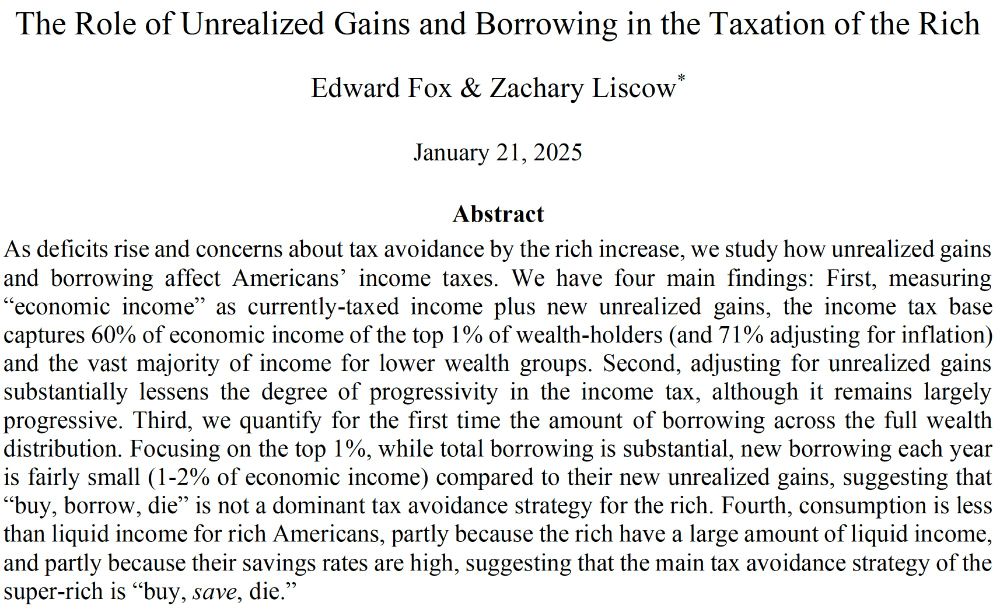
NEW PAPER! (w/ Ed Fox) We study 1) how much the wealthy borrow, quantifying “buy-borrow-die” for the first time, and 2) how much unrealized gains impact their taxes. The results changed (some of) our thinking on how to tax those at the top.
🧵 w/ findings ⬇️
Paper is here: ssrn.com/abstract=510...
🧵 w/ findings ⬇️
Paper is here: ssrn.com/abstract=510...
January 22, 2025 at 4:05 PM
NEW PAPER! (w/ Ed Fox) We study 1) how much the wealthy borrow, quantifying “buy-borrow-die” for the first time, and 2) how much unrealized gains impact their taxes. The results changed (some of) our thinking on how to tax those at the top.
🧵 w/ findings ⬇️
Paper is here: ssrn.com/abstract=510...
🧵 w/ findings ⬇️
Paper is here: ssrn.com/abstract=510...
@nbagley.bsky.social, @niskanencenter.bsky.social, and I are organizing a conference on the Law of Abundance in early 2026. Please spread word -- and submit a paper proposal!

January 13, 2025 at 4:19 PM
@nbagley.bsky.social, @niskanencenter.bsky.social, and I are organizing a conference on the Law of Abundance in early 2026. Please spread word -- and submit a paper proposal!
Art imitates life imitates art. The Murdochs motivate "Succession," who then learn from the TV show that they should work on succession planning.

December 9, 2024 at 8:49 PM
Art imitates life imitates art. The Murdochs motivate "Succession," who then learn from the TV show that they should work on succession planning.
What to do? The paper suggests a series of reforms. On personnel, it would be helpful to:
• Hire more government infrastructure experts as employees
• Bring public workers’ pay in line with that of their private-sector counterparts
• Insource more planning
• Hire more government infrastructure experts as employees
• Bring public workers’ pay in line with that of their private-sector counterparts
• Insource more planning

December 5, 2024 at 8:21 PM
What to do? The paper suggests a series of reforms. On personnel, it would be helpful to:
• Hire more government infrastructure experts as employees
• Bring public workers’ pay in line with that of their private-sector counterparts
• Insource more planning
• Hire more government infrastructure experts as employees
• Bring public workers’ pay in line with that of their private-sector counterparts
• Insource more planning
Turning to issues with procedure, permitting projects is slow and has gotten slower over time (though there have been recent improvements). And often there’s long litigation after the environmental review.
More in my paper on permitting: papers.ssrn.com/sol3/papers....
More in my paper on permitting: papers.ssrn.com/sol3/papers....

December 5, 2024 at 8:21 PM
Turning to issues with procedure, permitting projects is slow and has gotten slower over time (though there have been recent improvements). And often there’s long litigation after the environmental review.
More in my paper on permitting: papers.ssrn.com/sol3/papers....
More in my paper on permitting: papers.ssrn.com/sol3/papers....
Relatedly, the private sector is increasing paying more than the public sector, making it hard for the government to retain talent.

December 5, 2024 at 8:20 PM
Relatedly, the private sector is increasing paying more than the public sector, making it hard for the government to retain talent.
Here are civil engineers: Employment has been flat in government, & gone up a lot in the private sector, reflecting outsourcing, which experts think drives up costs, since consultants often have poor incentives & are poorly managed without enough in-house capacity.
More here: tinyurl.com/y5sbfdux
More here: tinyurl.com/y5sbfdux

December 5, 2024 at 8:19 PM
Here are civil engineers: Employment has been flat in government, & gone up a lot in the private sector, reflecting outsourcing, which experts think drives up costs, since consultants often have poor incentives & are poorly managed without enough in-house capacity.
More here: tinyurl.com/y5sbfdux
More here: tinyurl.com/y5sbfdux
Turning first to personnel. One issue is that state infrastructure employment has declining, making it harder to design good projects, pick good contractors, and monitor construction well.

December 5, 2024 at 8:16 PM
Turning first to personnel. One issue is that state infrastructure employment has declining, making it harder to design good projects, pick good contractors, and monitor construction well.
The US is also a lot more expensive to build in than it used to be (in real terms), here in the case of Interstate highways. Over the long term, this isn’t explained by higher prices or wages – or by building in more expensive places, as Brooks and I show: papers.ssrn.com/sol3/papers....

December 5, 2024 at 8:15 PM
The US is also a lot more expensive to build in than it used to be (in real terms), here in the case of Interstate highways. Over the long term, this isn’t explained by higher prices or wages – or by building in more expensive places, as Brooks and I show: papers.ssrn.com/sol3/papers....
The US is an expensive place to build infrastructure compared to other developed countries – about 2.5x the OECD average for urban transit

December 5, 2024 at 8:13 PM
The US is an expensive place to build infrastructure compared to other developed countries – about 2.5x the OECD average for urban transit
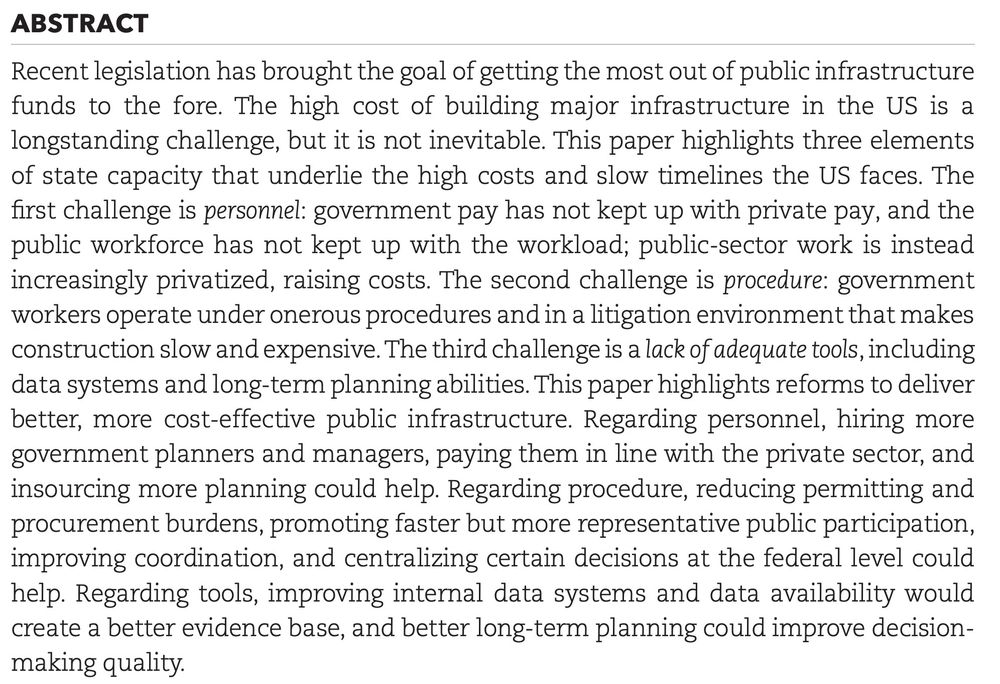
🚨New paper: State Capacity for Building Infrastructure
US infrastructure construction (transportation, energy, etc.) is often costly & slow.
I discuss the data & propose reforms. 🧵
Here is the paper: papers.ssrn.com/sol3/papers....
US infrastructure construction (transportation, energy, etc.) is often costly & slow.
I discuss the data & propose reforms. 🧵
Here is the paper: papers.ssrn.com/sol3/papers....
December 5, 2024 at 8:12 PM
🚨New paper: State Capacity for Building Infrastructure
US infrastructure construction (transportation, energy, etc.) is often costly & slow.
I discuss the data & propose reforms. 🧵
Here is the paper: papers.ssrn.com/sol3/papers....
US infrastructure construction (transportation, energy, etc.) is often costly & slow.
I discuss the data & propose reforms. 🧵
Here is the paper: papers.ssrn.com/sol3/papers....
Come work with me @Yale! I'm hiring a full-time RA to start in summer 2025, to work on understanding how to tax the super-rich and what drives sky-high US infrastructure construction costs.
tobin.yale.edu/programs/pre...
tobin.yale.edu/programs/pre...

October 22, 2024 at 12:53 PM
Come work with me @Yale! I'm hiring a full-time RA to start in summer 2025, to work on understanding how to tax the super-rich and what drives sky-high US infrastructure construction costs.
tobin.yale.edu/programs/pre...
tobin.yale.edu/programs/pre...