




Shayne Longpre
@shaynelongpre.bsky.social
PhD @ MIT. Prev: Google Deepmind, Apple, Stanford. 🇨🇦 Interests: AI/ML/NLP, Data-centric AI, transparency & societal impact
We (mainly Emily chen) built a live dashboard to monitor concentration, participation, and technical trends—so policy, research, and industry can stay evidence-driven.
huggingface.co/spaces/econo...
huggingface.co/spaces/econo...

November 26, 2025 at 4:03 PM
We (mainly Emily chen) built a live dashboard to monitor concentration, participation, and technical trends—so policy, research, and industry can stay evidence-driven.
huggingface.co/spaces/econo...
huggingface.co/spaces/econo...
Finding 4: Transparency is slipping.
Models disclosing training data fell ~79% (2022) → ~39% (2025). And for the first time, open-weights > truly open-source—raising accountability and reproducibility concerns.
Models disclosing training data fell ~79% (2022) → ~39% (2025). And for the first time, open-weights > truly open-source—raising accountability and reproducibility concerns.

November 26, 2025 at 4:03 PM
Finding 4: Transparency is slipping.
Models disclosing training data fell ~79% (2022) → ~39% (2025). And for the first time, open-weights > truly open-source—raising accountability and reproducibility concerns.
Models disclosing training data fell ~79% (2022) → ~39% (2025). And for the first time, open-weights > truly open-source—raising accountability and reproducibility concerns.
Finding 3: A new intermediary dev layer:
Community repos that quantize, repack, and adapt base models now move a large fraction of real-world usage.
MLX-Community, SD Concepts Library, LMStudio-Community and others are consolidating models for deployment, & artistic adaptation.
Community repos that quantize, repack, and adapt base models now move a large fraction of real-world usage.
MLX-Community, SD Concepts Library, LMStudio-Community and others are consolidating models for deployment, & artistic adaptation.

November 26, 2025 at 4:03 PM
Finding 3: A new intermediary dev layer:
Community repos that quantize, repack, and adapt base models now move a large fraction of real-world usage.
MLX-Community, SD Concepts Library, LMStudio-Community and others are consolidating models for deployment, & artistic adaptation.
Community repos that quantize, repack, and adapt base models now move a large fraction of real-world usage.
MLX-Community, SD Concepts Library, LMStudio-Community and others are consolidating models for deployment, & artistic adaptation.
Finding 2: Models are getting large, multimodal—and efficient.
Average downloaded size rose 17× with 7× MoE and 5× quantization adoption; multimodal & video downloads grew ~3.4×.
Average downloaded size rose 17× with 7× MoE and 5× quantization adoption; multimodal & video downloads grew ~3.4×.

November 26, 2025 at 4:03 PM
Finding 2: Models are getting large, multimodal—and efficient.
Average downloaded size rose 17× with 7× MoE and 5× quantization adoption; multimodal & video downloads grew ~3.4×.
Average downloaded size rose 17× with 7× MoE and 5× quantization adoption; multimodal & video downloads grew ~3.4×.
Finding 1: Power is rebalancing.
US big-tech share (Google/Meta/OpenAI) dominance has dissipated while community/unaffiliated devs surged, and Chinese industry (DeepSeek, Qwen) now commands a major share—hinting at a new consolidation wave among open-weights.
US big-tech share (Google/Meta/OpenAI) dominance has dissipated while community/unaffiliated devs surged, and Chinese industry (DeepSeek, Qwen) now commands a major share—hinting at a new consolidation wave among open-weights.


November 26, 2025 at 4:03 PM
Finding 1: Power is rebalancing.
US big-tech share (Google/Meta/OpenAI) dominance has dissipated while community/unaffiliated devs surged, and Chinese industry (DeepSeek, Qwen) now commands a major share—hinting at a new consolidation wave among open-weights.
US big-tech share (Google/Meta/OpenAI) dominance has dissipated while community/unaffiliated devs surged, and Chinese industry (DeepSeek, Qwen) now commands a major share—hinting at a new consolidation wave among open-weights.
Who is winning the open AI race?
Our new study Economies of Open Intelligence maps @hf.co 851k models' downloads 2020→2025.
1) Power rebalance: US tech ↓; China + community ↑
2) Models size & efficient ↑ (MoE, quant, multimodal)
3) Intermediary layers ↑ (adapters/quantizers)
4) Transparency ↓
/🧵
Our new study Economies of Open Intelligence maps @hf.co 851k models' downloads 2020→2025.
1) Power rebalance: US tech ↓; China + community ↑
2) Models size & efficient ↑ (MoE, quant, multimodal)
3) Intermediary layers ↑ (adapters/quantizers)
4) Transparency ↓
/🧵

November 26, 2025 at 4:03 PM
Who is winning the open AI race?
Our new study Economies of Open Intelligence maps @hf.co 851k models' downloads 2020→2025.
1) Power rebalance: US tech ↓; China + community ↑
2) Models size & efficient ↑ (MoE, quant, multimodal)
3) Intermediary layers ↑ (adapters/quantizers)
4) Transparency ↓
/🧵
Our new study Economies of Open Intelligence maps @hf.co 851k models' downloads 2020→2025.
1) Power rebalance: US tech ↓; China + community ↑
2) Models size & efficient ↑ (MoE, quant, multimodal)
3) Intermediary layers ↑ (adapters/quantizers)
4) Transparency ↓
/🧵
Q4: When should you pretrain from scratch vs finetune a multilingual checkpoint?
🌟Answer: We found compute-optimal crossover points for every model size.
Rough rule of thumb: finetune if your compute budget C is < 10^10 x N ^1.54, otherwise pretrain.
8/
🌟Answer: We found compute-optimal crossover points for every model size.
Rough rule of thumb: finetune if your compute budget C is < 10^10 x N ^1.54, otherwise pretrain.
8/


October 28, 2025 at 2:03 PM
Q4: When should you pretrain from scratch vs finetune a multilingual checkpoint?
🌟Answer: We found compute-optimal crossover points for every model size.
Rough rule of thumb: finetune if your compute budget C is < 10^10 x N ^1.54, otherwise pretrain.
8/
🌟Answer: We found compute-optimal crossover points for every model size.
Rough rule of thumb: finetune if your compute budget C is < 10^10 x N ^1.54, otherwise pretrain.
8/
Q3: How much do you need to scale when adding languages? (The "curse of multilinguality")
🌟Answer: We derived closed-form equations! To go from K to 4K languages while maintaining performance: scale data by 2.74×, model size by 1.4×.
6/
🌟Answer: We derived closed-form equations! To go from K to 4K languages while maintaining performance: scale data by 2.74×, model size by 1.4×.
6/

October 28, 2025 at 2:03 PM
Q3: How much do you need to scale when adding languages? (The "curse of multilinguality")
🌟Answer: We derived closed-form equations! To go from K to 4K languages while maintaining performance: scale data by 2.74×, model size by 1.4×.
6/
🌟Answer: We derived closed-form equations! To go from K to 4K languages while maintaining performance: scale data by 2.74×, model size by 1.4×.
6/
🌟Key insight:🌟 shared script beats shared language family for positive transfer!
Languages sharing writing systems (e.g., Latin) show dramatically better transfer (mean: -0.23) vs different scripts (mean: -0.39).
Also important: transfer is often asymmetric—A helping B ≠ B helping A.
5/
Languages sharing writing systems (e.g., Latin) show dramatically better transfer (mean: -0.23) vs different scripts (mean: -0.39).
Also important: transfer is often asymmetric—A helping B ≠ B helping A.
5/

October 28, 2025 at 2:03 PM
🌟Key insight:🌟 shared script beats shared language family for positive transfer!
Languages sharing writing systems (e.g., Latin) show dramatically better transfer (mean: -0.23) vs different scripts (mean: -0.39).
Also important: transfer is often asymmetric—A helping B ≠ B helping A.
5/
Languages sharing writing systems (e.g., Latin) show dramatically better transfer (mean: -0.23) vs different scripts (mean: -0.39).
Also important: transfer is often asymmetric—A helping B ≠ B helping A.
5/
Q2: Which languages actually help each other during training? And how much?
🌟Answer: We measure this empirically. We built a 38×38 transfer matrix, or 1,444 language pairs—the largest such resource to date.
We highlight the top 5 most beneficial source languages for each target language.
4/
🌟Answer: We measure this empirically. We built a 38×38 transfer matrix, or 1,444 language pairs—the largest such resource to date.
We highlight the top 5 most beneficial source languages for each target language.
4/

October 28, 2025 at 2:03 PM
Q2: Which languages actually help each other during training? And how much?
🌟Answer: We measure this empirically. We built a 38×38 transfer matrix, or 1,444 language pairs—the largest such resource to date.
We highlight the top 5 most beneficial source languages for each target language.
4/
🌟Answer: We measure this empirically. We built a 38×38 transfer matrix, or 1,444 language pairs—the largest such resource to date.
We highlight the top 5 most beneficial source languages for each target language.
4/
ATLAS models cross-lingual transfer explicitly: separating (1) target language data, (2) beneficial transfer languages, and (3) other languages.
Without modeling transfer, existing laws fail on multilingual settings.
3/
Without modeling transfer, existing laws fail on multilingual settings.
3/

October 28, 2025 at 2:03 PM
ATLAS models cross-lingual transfer explicitly: separating (1) target language data, (2) beneficial transfer languages, and (3) other languages.
Without modeling transfer, existing laws fail on multilingual settings.
3/
Without modeling transfer, existing laws fail on multilingual settings.
3/
Q1: Can we build a scaling law that generalizes to unseen model sizes (N), data amounts (D), AND language mixtures (M)?
🌟Answer: Yes! ATLAS outperforms prior work with R²(N)=0.88 vs 0.68, and R²(M)=0.82 vs 0.69 for mixture generalization.
2/
🌟Answer: Yes! ATLAS outperforms prior work with R²(N)=0.88 vs 0.68, and R²(M)=0.82 vs 0.69 for mixture generalization.
2/

October 28, 2025 at 2:03 PM
Q1: Can we build a scaling law that generalizes to unseen model sizes (N), data amounts (D), AND language mixtures (M)?
🌟Answer: Yes! ATLAS outperforms prior work with R²(N)=0.88 vs 0.68, and R²(M)=0.82 vs 0.69 for mixture generalization.
2/
🌟Answer: Yes! ATLAS outperforms prior work with R²(N)=0.88 vs 0.68, and R²(M)=0.82 vs 0.69 for mixture generalization.
2/
📢Thrilled to introduce ATLAS 🗺️: the largest multilingual scaling study to-date—we ran 774 exps (10M-8B params, 400+ languages) to answer:
🌍 Is scaling diff by lang?
🧙♂️ Can we model the curse of multilinguality?
⚖️ Pretrain vs finetune from checkpoint?
🔀 X-lingual transfer scores across langs?
1/🧵
🌍 Is scaling diff by lang?
🧙♂️ Can we model the curse of multilinguality?
⚖️ Pretrain vs finetune from checkpoint?
🔀 X-lingual transfer scores across langs?
1/🧵


October 28, 2025 at 2:03 PM
📢Thrilled to introduce ATLAS 🗺️: the largest multilingual scaling study to-date—we ran 774 exps (10M-8B params, 400+ languages) to answer:
🌍 Is scaling diff by lang?
🧙♂️ Can we model the curse of multilinguality?
⚖️ Pretrain vs finetune from checkpoint?
🔀 X-lingual transfer scores across langs?
1/🧵
🌍 Is scaling diff by lang?
🧙♂️ Can we model the curse of multilinguality?
⚖️ Pretrain vs finetune from checkpoint?
🔀 X-lingual transfer scores across langs?
1/🧵
Delighted to see BigGen Bench paper receive the 🏆best paper award 🏆at NAACL 2025!
BigGen Bench introduces fine-grained, scalable, & human-aligned evaluations:
📈 77 hard, diverse tasks
🛠️ 765 exs w/ ex-specific rubrics
📋 More human-aligned than previous rubrics
🌍 10 languages, by native speakers
1/
BigGen Bench introduces fine-grained, scalable, & human-aligned evaluations:
📈 77 hard, diverse tasks
🛠️ 765 exs w/ ex-specific rubrics
📋 More human-aligned than previous rubrics
🌍 10 languages, by native speakers
1/

May 6, 2025 at 1:50 PM
Delighted to see BigGen Bench paper receive the 🏆best paper award 🏆at NAACL 2025!
BigGen Bench introduces fine-grained, scalable, & human-aligned evaluations:
📈 77 hard, diverse tasks
🛠️ 765 exs w/ ex-specific rubrics
📋 More human-aligned than previous rubrics
🌍 10 languages, by native speakers
1/
BigGen Bench introduces fine-grained, scalable, & human-aligned evaluations:
📈 77 hard, diverse tasks
🛠️ 765 exs w/ ex-specific rubrics
📋 More human-aligned than previous rubrics
🌍 10 languages, by native speakers
1/
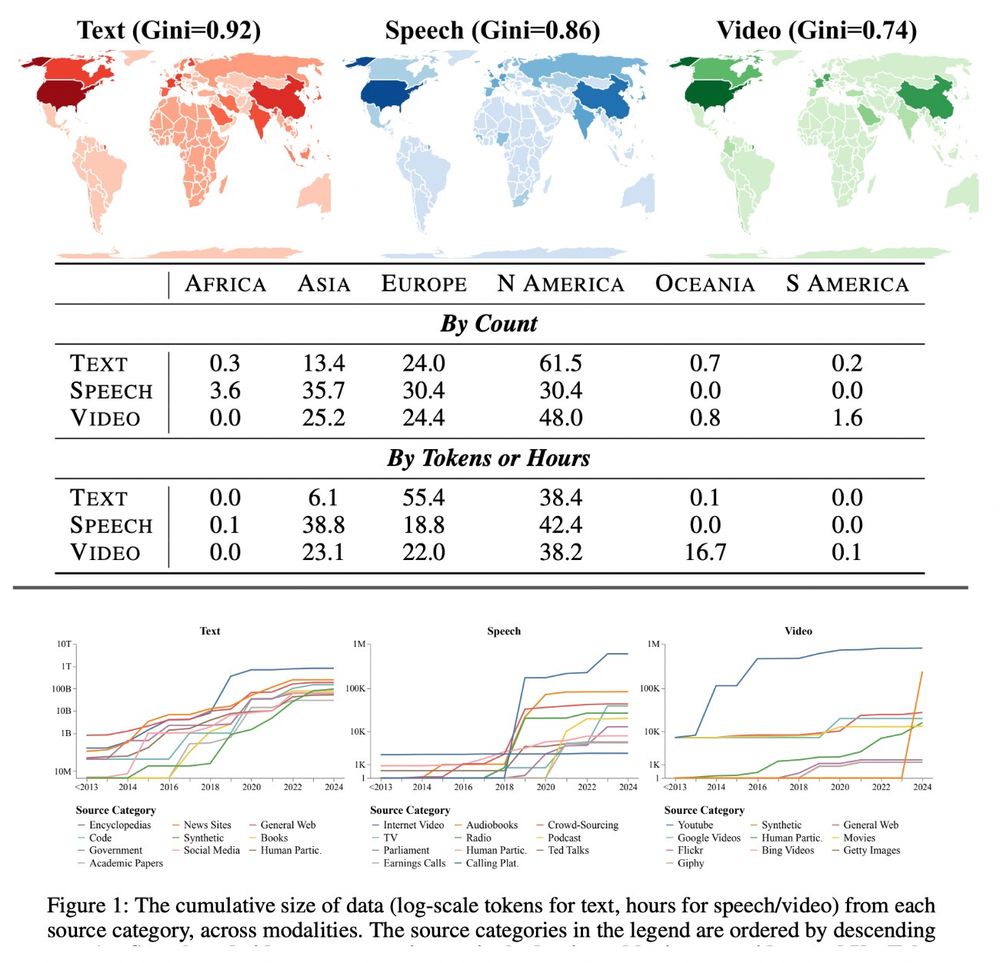
Thrilled our global data ecosystem audit was accepted to #ICLR2025!
Empirically, it shows:
1️⃣ Soaring synthetic text data: ~10M tokens (pre-2018) to 100B+ (2024).
2️⃣ YouTube is now 70%+ of speech/video data but could block third-party collection.
3️⃣ <0.2% of data from Africa/South America.
1/
Empirically, it shows:
1️⃣ Soaring synthetic text data: ~10M tokens (pre-2018) to 100B+ (2024).
2️⃣ YouTube is now 70%+ of speech/video data but could block third-party collection.
3️⃣ <0.2% of data from Africa/South America.
1/
April 14, 2025 at 3:28 PM
Thrilled our global data ecosystem audit was accepted to #ICLR2025!
Empirically, it shows:
1️⃣ Soaring synthetic text data: ~10M tokens (pre-2018) to 100B+ (2024).
2️⃣ YouTube is now 70%+ of speech/video data but could block third-party collection.
3️⃣ <0.2% of data from Africa/South America.
1/
Empirically, it shows:
1️⃣ Soaring synthetic text data: ~10M tokens (pre-2018) to 100B+ (2024).
2️⃣ YouTube is now 70%+ of speech/video data but could block third-party collection.
3️⃣ <0.2% of data from Africa/South America.
1/
This week, @stanfordhai.bsky.social released the 2025 AI Index. It’s well worth reading to understand the evolving ecosystem of AI. Some highlights that stood out to me:
1/
1/


April 9, 2025 at 3:25 PM
This week, @stanfordhai.bsky.social released the 2025 AI Index. It’s well worth reading to understand the evolving ecosystem of AI. Some highlights that stood out to me:
1/
1/
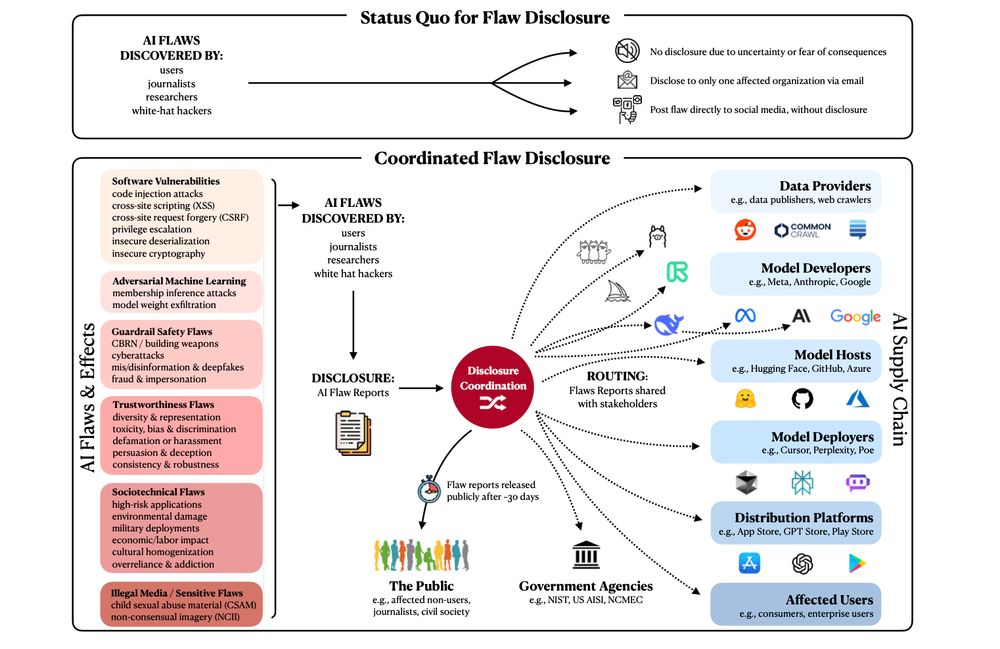
3️⃣ A centralized disclosure coordination center.
For transferable AI flaws (e.g., jailbreaks affecting multiple systems), we need to inform all relevant developers and stakeholders who must act to mitigate these issues.
See the Figure to understand the before and after of flaw disclosure.
6/
For transferable AI flaws (e.g., jailbreaks affecting multiple systems), we need to inform all relevant developers and stakeholders who must act to mitigate these issues.
See the Figure to understand the before and after of flaw disclosure.
6/

March 13, 2025 at 3:59 PM
3️⃣ A centralized disclosure coordination center.
For transferable AI flaws (e.g., jailbreaks affecting multiple systems), we need to inform all relevant developers and stakeholders who must act to mitigate these issues.
See the Figure to understand the before and after of flaw disclosure.
6/
For transferable AI flaws (e.g., jailbreaks affecting multiple systems), we need to inform all relevant developers and stakeholders who must act to mitigate these issues.
See the Figure to understand the before and after of flaw disclosure.
6/
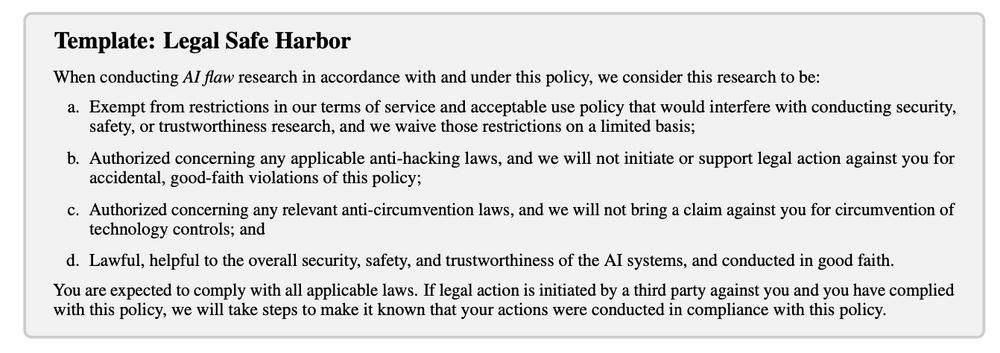
2️⃣ AI developers institute broadly-scoped AI flaw disclosure programs + safe harbors.
Security-only or invite-only bug bounties from OpenAI and Anthropic are a great start.
But eventually we need disclosure programs to cover the full range of AI issues, and protect independent researchers.
5/
Security-only or invite-only bug bounties from OpenAI and Anthropic are a great start.
But eventually we need disclosure programs to cover the full range of AI issues, and protect independent researchers.
5/
March 13, 2025 at 3:59 PM
2️⃣ AI developers institute broadly-scoped AI flaw disclosure programs + safe harbors.
Security-only or invite-only bug bounties from OpenAI and Anthropic are a great start.
But eventually we need disclosure programs to cover the full range of AI issues, and protect independent researchers.
5/
Security-only or invite-only bug bounties from OpenAI and Anthropic are a great start.
But eventually we need disclosure programs to cover the full range of AI issues, and protect independent researchers.
5/
To empower universal AI safety and security, we propose:
1️⃣ adoption of standardized AI flaw reports, to improve flaw reproducibility, triaging, coordination across stakeholders, and ultimately AI safety.
4/
1️⃣ adoption of standardized AI flaw reports, to improve flaw reproducibility, triaging, coordination across stakeholders, and ultimately AI safety.
4/


March 13, 2025 at 3:59 PM
To empower universal AI safety and security, we propose:
1️⃣ adoption of standardized AI flaw reports, to improve flaw reproducibility, triaging, coordination across stakeholders, and ultimately AI safety.
4/
1️⃣ adoption of standardized AI flaw reports, to improve flaw reproducibility, triaging, coordination across stakeholders, and ultimately AI safety.
4/
Motivation
Today, GPAI serves 300M+ users globally, w/ diverse & unforeseen uses across modalities and languages.
➡️ We need third-party evaluation for its broad expertise, participation and independence, including from real users, academic researchers, white-hat hackers, and journalists
2/
Today, GPAI serves 300M+ users globally, w/ diverse & unforeseen uses across modalities and languages.
➡️ We need third-party evaluation for its broad expertise, participation and independence, including from real users, academic researchers, white-hat hackers, and journalists
2/

March 13, 2025 at 3:59 PM
Motivation
Today, GPAI serves 300M+ users globally, w/ diverse & unforeseen uses across modalities and languages.
➡️ We need third-party evaluation for its broad expertise, participation and independence, including from real users, academic researchers, white-hat hackers, and journalists
2/
Today, GPAI serves 300M+ users globally, w/ diverse & unforeseen uses across modalities and languages.
➡️ We need third-party evaluation for its broad expertise, participation and independence, including from real users, academic researchers, white-hat hackers, and journalists
2/
What are 3 concrete steps that can improve AI safety in 2025? 🤖⚠️
Our new paper, “In House Evaluation is Not Enough” has 3 calls-to-actions to empower evaluators:
1️⃣ Standardized AI flaw reports
2️⃣ AI flaw disclosure programs + safe harbors.
3️⃣ A coordination center for transferable AI flaws.
1/🧵
Our new paper, “In House Evaluation is Not Enough” has 3 calls-to-actions to empower evaluators:
1️⃣ Standardized AI flaw reports
2️⃣ AI flaw disclosure programs + safe harbors.
3️⃣ A coordination center for transferable AI flaws.
1/🧵
March 13, 2025 at 3:59 PM
What are 3 concrete steps that can improve AI safety in 2025? 🤖⚠️
Our new paper, “In House Evaluation is Not Enough” has 3 calls-to-actions to empower evaluators:
1️⃣ Standardized AI flaw reports
2️⃣ AI flaw disclosure programs + safe harbors.
3️⃣ A coordination center for transferable AI flaws.
1/🧵
Our new paper, “In House Evaluation is Not Enough” has 3 calls-to-actions to empower evaluators:
1️⃣ Standardized AI flaw reports
2️⃣ AI flaw disclosure programs + safe harbors.
3️⃣ A coordination center for transferable AI flaws.
1/🧵
Thrilled to be at #AAAI2025 for our tutorial, “AI Data Transparency: The Past, Present, and Beyond.”
We’re presenting the state of transparency, tooling, and policy, from the Foundation Model Transparency Index, Factsheets, the the EU AI Act to new frameworks like @MLCommons’ Croissant.
1/
We’re presenting the state of transparency, tooling, and policy, from the Foundation Model Transparency Index, Factsheets, the the EU AI Act to new frameworks like @MLCommons’ Croissant.
1/

February 26, 2025 at 6:15 PM
Thrilled to be at #AAAI2025 for our tutorial, “AI Data Transparency: The Past, Present, and Beyond.”
We’re presenting the state of transparency, tooling, and policy, from the Foundation Model Transparency Index, Factsheets, the the EU AI Act to new frameworks like @MLCommons’ Croissant.
1/
We’re presenting the state of transparency, tooling, and policy, from the Foundation Model Transparency Index, Factsheets, the the EU AI Act to new frameworks like @MLCommons’ Croissant.
1/
I compiled a list of resources for understanding AI copyright challenges (US-centric). 📚
➡️ why is copyright an issue for AI?
➡️ what is fair use?
➡️ why are memorization and generation important?
➡️ how does it impact the AI data supply / web crawling?
🧵
➡️ why is copyright an issue for AI?
➡️ what is fair use?
➡️ why are memorization and generation important?
➡️ how does it impact the AI data supply / web crawling?
🧵

February 19, 2025 at 4:32 PM
I compiled a list of resources for understanding AI copyright challenges (US-centric). 📚
➡️ why is copyright an issue for AI?
➡️ what is fair use?
➡️ why are memorization and generation important?
➡️ how does it impact the AI data supply / web crawling?
🧵
➡️ why is copyright an issue for AI?
➡️ what is fair use?
➡️ why are memorization and generation important?
➡️ how does it impact the AI data supply / web crawling?
🧵
Publishers are understandably worried: news sites fear losing readers to AI chatbots; artists and designers fear AI image generators; coding forums fear AI-driven replacements.
Increasingly, they block or charge all non-human traffic, not just AI crawlers.
3/
Increasingly, they block or charge all non-human traffic, not just AI crawlers.
3/

February 12, 2025 at 4:47 PM
Publishers are understandably worried: news sites fear losing readers to AI chatbots; artists and designers fear AI image generators; coding forums fear AI-driven replacements.
Increasingly, they block or charge all non-human traffic, not just AI crawlers.
3/
Increasingly, they block or charge all non-human traffic, not just AI crawlers.
3/
3/ In the copyright section, this diagram shows how copyright concerns can intertwine consequences for artists, developer transparency, and even the structure of the web.

February 10, 2025 at 3:13 PM
3/ In the copyright section, this diagram shows how copyright concerns can intertwine consequences for artists, developer transparency, and even the structure of the web.