




Simon Fisher
@profsimonfisher.bsky.social
Director of Language & Genetics at Max Planck Institute, Nijmegen.
Tracing the complex connections between genes, brains, speech & language.
Website: https://www.mpi.nl/people/fisher-simon-e
ORCID: https://orcid.org/0000-0002-3132-1996
Tracing the complex connections between genes, brains, speech & language.
Website: https://www.mpi.nl/people/fisher-simon-e
ORCID: https://orcid.org/0000-0002-3132-1996
You've never truly lived until you've tried explaining to an uninterested colleague why “Buffalo buffalo Buffalo buffalo buffalo buffalo Buffalo buffalo“ is indeed a grammatically correct sentence.
November 30, 2025 at 10:27 AM
I've found that conflation of sequencing & genotyping is one of the most common misunderstandings when discussing interdisciplinary projects with non-genetics colleagues, so a good visual explainer could indeed be super helpful!
November 28, 2025 at 8:37 PM
I've found that conflation of sequencing & genotyping is one of the most common misunderstandings when discussing interdisciplinary projects with non-genetics colleagues, so a good visual explainer could indeed be super helpful!
I've said it before, I'll say it again, every journal should have a feline gracing its cover.

November 27, 2025 at 7:18 PM
I've said it before, I'll say it again, every journal should have a feline gracing its cover.
See also...
If someone you know buys into claims about "genetic optimization" of embryos using polygenic scores of cognition, just send them our 2024 paper on Beethoven & musicality. We wrote it to help communicate limits of individual-level genetic predictions & complexity of links between DNA & behaviour. 🧪👇
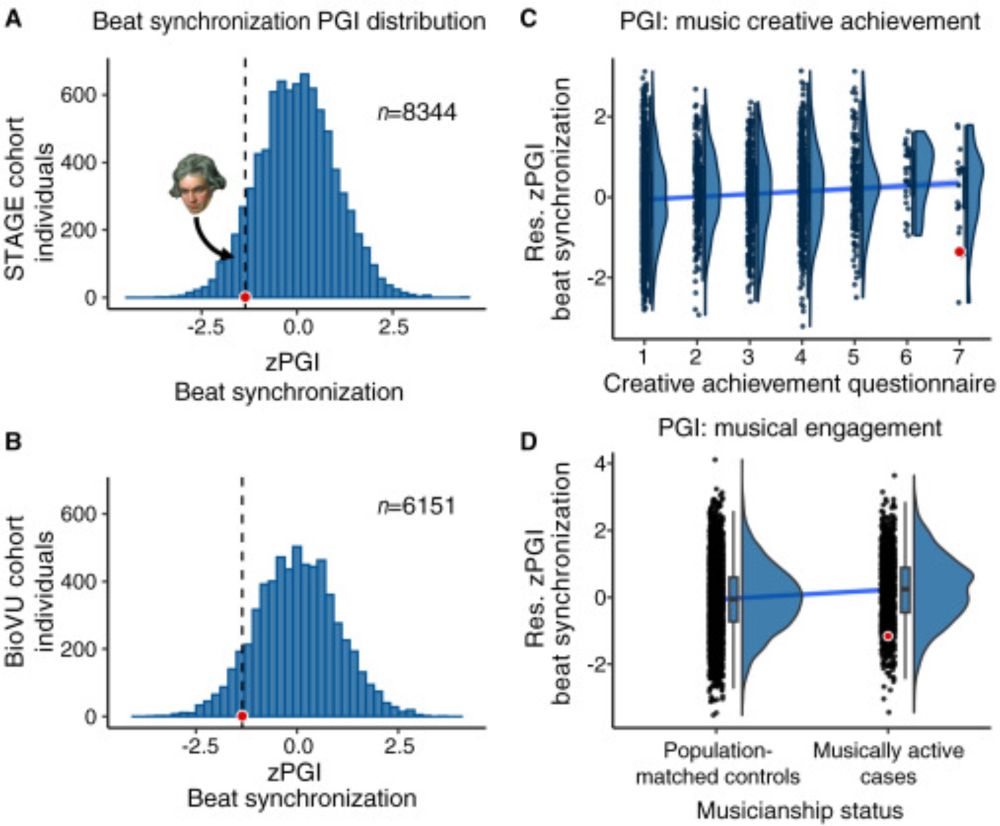
Notes from Beethoven’s genome
Wesseldijk et al. compare the genomic information collected from Ludwig van Beethoven
with population-based datasets used to quantify musical achievement.
www.cell.com
November 26, 2025 at 9:42 AM
See also...
Gutted to be missing this.
November 24, 2025 at 5:21 PM
Gutted to be missing this.
Reposted by Simon Fisher

This overview dovetails very nicely with the complementary, more historical and theoretical (albeit short) review of the study of language evolution in this entry in the Open Encyclopedia of Cognitive Science (open access for all): oecs.mit.edu/pub/18miikqb/

Language Evolution
oecs.mit.edu
November 23, 2025 at 11:07 PM
This overview dovetails very nicely with the complementary, more historical and theoretical (albeit short) review of the study of language evolution in this entry in the Open Encyclopedia of Cognitive Science (open access for all): oecs.mit.edu/pub/18miikqb/
If you're unable to download our newly published article on language evolution via the Science journal link at the top of my thread, please go to website below, from which anyone can immediately access the published paper fully free of charge. 🧪 15/15
What enables human language? A biocultural framework | Max Planck Institute
www.mpi.nl
November 23, 2025 at 5:22 PM
If you're unable to download our newly published article on language evolution via the Science journal link at the top of my thread, please go to website below, from which anyone can immediately access the published paper fully free of charge. 🧪 15/15
This was very much a team science effort. Huge thanks to amazing co-authors @inbalarnon.bsky.social, @lirancarmel.bsky.social, Nico Claidière, @tecumsehfitch.bsky.social, Susan Goldin-Meadow, @simonkirby.bsky.social, @kazuookanoya.bsky.social, @limorraviv.bsky.social, @luciewolters.bsky.social. 14/n
November 23, 2025 at 4:51 PM
This was very much a team science effort. Huge thanks to amazing co-authors @inbalarnon.bsky.social, @lirancarmel.bsky.social, Nico Claidière, @tecumsehfitch.bsky.social, Susan Goldin-Meadow, @simonkirby.bsky.social, @kazuookanoya.bsky.social, @limorraviv.bsky.social, @luciewolters.bsky.social. 14/n
Language evolution research is vibrant & dynamic. The literature is much broader than we could fully cover in limited space of this piece; facets & fields of focus were of course shaped by our own backgrounds/specializations. We hope it will motivate readers to dive further into this rich topic.13/n
November 23, 2025 at 4:16 PM
Language evolution research is vibrant & dynamic. The literature is much broader than we could fully cover in limited space of this piece; facets & fields of focus were of course shaped by our own backgrounds/specializations. We hope it will motivate readers to dive further into this rich topic.13/n
The case studies show value of biocultural framing, where biological preparedness & cultural evolution interact in language emergence. A recurring theme is the role of reward systems, including motivation to communicate & endogenous + exogenous rewards for successful imitation & communication...12/n
November 23, 2025 at 3:58 PM
The case studies show value of biocultural framing, where biological preparedness & cultural evolution interact in language emergence. A recurring theme is the role of reward systems, including motivation to communicate & endogenous + exogenous rewards for successful imitation & communication...12/n
We draw on empirical data across disciplines & methods: molecular studies of speech/language disorders, ancient DNA, gene manipulations in model systems, real-world cases of language emergence, recreating cultural evolution in the lab; comparative work in nonhuman animals (songbirds & primates).11/n

November 23, 2025 at 3:45 PM
We draw on empirical data across disciplines & methods: molecular studies of speech/language disorders, ancient DNA, gene manipulations in model systems, real-world cases of language emergence, recreating cultural evolution in the lab; comparative work in nonhuman animals (songbirds & primates).11/n
Our 3 facets: vocal production learning = ability to modify vocalizations based on experience; language structure = systematic ways in which linguistic elements relate to one another; & social underpinnings = behaviours/processes that facilitate social interaction & enable cultural transmission.10/n

November 23, 2025 at 12:05 PM
Our 3 facets: vocal production learning = ability to modify vocalizations based on experience; language structure = systematic ways in which linguistic elements relate to one another; & social underpinnings = behaviours/processes that facilitate social interaction & enable cultural transmission.10/n
As multifaceted & biocultural perspectives are increasingly appreciated, there’s a need to integrate them & give concrete case studies of how that advances understanding. Our paper does so for 3 facets. We don’t claim they’re the only ones relevant to language evolution but use them as exemplars.9/n
November 23, 2025 at 11:57 AM
As multifaceted & biocultural perspectives are increasingly appreciated, there’s a need to integrate them & give concrete case studies of how that advances understanding. Our paper does so for 3 facets. We don’t claim they’re the only ones relevant to language evolution but use them as exemplars.9/n
Interacting processes operating on vastly different timescales (from milliseconds to millennia) shape emergence & properties of human language(s). Roles of biology & culture, & the complex interplay between them, can be empirically investigated in humans, nonhuman animals & computational models. 8/n

November 23, 2025 at 11:54 AM
Interacting processes operating on vastly different timescales (from milliseconds to millennia) shape emergence & properties of human language(s). Roles of biology & culture, & the complex interplay between them, can be empirically investigated in humans, nonhuman animals & computational models. 8/n
Biological factors (incl learning mechanisms/biases) are key BUT no human infant develops fully structured language in isolation; it arises only after extended social & communicative interaction. Generations of learners progressively systematize language via communication & cultural transmission.7/n
November 23, 2025 at 11:54 AM
Biological factors (incl learning mechanisms/biases) are key BUT no human infant develops fully structured language in isolation; it arises only after extended social & communicative interaction. Generations of learners progressively systematize language via communication & cultural transmission.7/n
Common wisdom was that language first arose 50-150kya but latest data make deeper origins (hundreds of thousands of years) more plausible. Even if language system typical of modern humans emerged recently, some facets may involve longer timescales - no one evolutionary window has all the answers.6/n
November 23, 2025 at 11:54 AM
Common wisdom was that language first arose 50-150kya but latest data make deeper origins (hundreds of thousands of years) more plausible. Even if language system typical of modern humans emerged recently, some facets may involve longer timescales - no one evolutionary window has all the answers.6/n