


Kumano’s lab in Asamushi
@kuma3yo.bsky.social
A research lab in marine station in Tohoku, Japan, that studies adult pluripotent stem cells and evolution of germline segregation mechanisms in animal development using marine animals such as jellyfish and tunicates.
We went to the Harabetsu fishing port to buy morning type Halocynthia roretzi, a.k.a. White Hoya, from a local fisherman. These ascidians are farmed for several years in the sea, originating from young juveniles grown by a fisheries facility through artificial fertilization and larval attachment.


November 6, 2025 at 10:25 AM
We went to the Harabetsu fishing port to buy morning type Halocynthia roretzi, a.k.a. White Hoya, from a local fisherman. These ascidians are farmed for several years in the sea, originating from young juveniles grown by a fisheries facility through artificial fertilization and larval attachment.
We hosted a seminar in the station by Dr. Kei Jokura from National Institute for Basic Biology. He was talking to us about his research on the function of cilia in the comb plates and balance organs in ctenophore.

October 29, 2025 at 1:02 AM
We hosted a seminar in the station by Dr. Kei Jokura from National Institute for Basic Biology. He was talking to us about his research on the function of cilia in the comb plates and balance organs in ctenophore.
We went out on the boat off the Kominato fishing port to collect morning type ascidians Halocynthia roretzi. Two technicians dived into the sea about 25 m deep twice each and picked more than a hundred natural individuals in total. They will be used for our research in the upcoming spawning season.


October 23, 2025 at 9:04 AM
We went out on the boat off the Kominato fishing port to collect morning type ascidians Halocynthia roretzi. Two technicians dived into the sea about 25 m deep twice each and picked more than a hundred natural individuals in total. They will be used for our research in the upcoming spawning season.
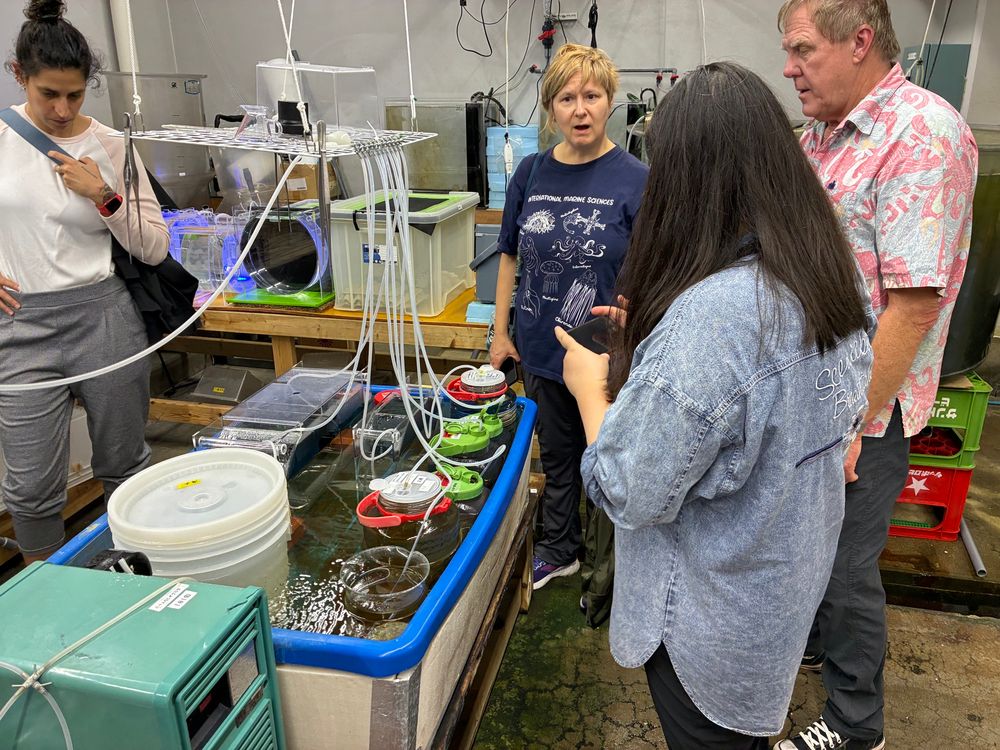
As a part of the jellyfish workshop, we got to see the backyard of the Asamushi Aquarium. We were all excited to see how they grow and maintain many kinds of jellyfish they are exhibiting there.


October 8, 2025 at 8:17 AM
As a part of the jellyfish workshop, we got to see the backyard of the Asamushi Aquarium. We were all excited to see how they grow and maintain many kinds of jellyfish they are exhibiting there.
We are hosting a jellyfish workshop here in Asamushi (Oct 5-9). People from Dr. Mark Martindale’s lab in Florida, Dr. Cheryl Ames’ lab in Sendai and Kumano’s lab are gathering all together, and experiencing and discussing jellyfish and other marine animals all day long.


October 6, 2025 at 9:34 PM
We are hosting a jellyfish workshop here in Asamushi (Oct 5-9). People from Dr. Mark Martindale’s lab in Florida, Dr. Cheryl Ames’ lab in Sendai and Kumano’s lab are gathering all together, and experiencing and discussing jellyfish and other marine animals all day long.
A new student Lu Wang has set up the culturing system for Clytia sp. IZ-D in the lab. She is the first one in the lab to use this species for research. It is a new species recently collected off the coast of Sanriku. It has just started producing medusae so hopefully we can get gametes in ten days.


October 2, 2025 at 6:51 AM
A new student Lu Wang has set up the culturing system for Clytia sp. IZ-D in the lab. She is the first one in the lab to use this species for research. It is a new species recently collected off the coast of Sanriku. It has just started producing medusae so hopefully we can get gametes in ten days.
A PhD student Yuma Miyazawa and Kumano are now in Tutzing, Germany, attending Hydra Meeting 2025. All the participants are staying within the grounds of Evangelische Akademie Tutzing, a historical education and conference center, and discussing biology of basal metazoans all day. Very good meeting.


September 25, 2025 at 2:49 AM
A PhD student Yuma Miyazawa and Kumano are now in Tutzing, Germany, attending Hydra Meeting 2025. All the participants are staying within the grounds of Evangelische Akademie Tutzing, a historical education and conference center, and discussing biology of basal metazoans all day. Very good meeting.
This is the other one developing. The movie was taken by a student.
September 18, 2025 at 2:14 AM
This is the other one developing. The movie was taken by a student.
We are hosting a marine biology course for Japanese and international students from Kyoto, Tsukuba and Sendai. On Day 3 they tried to collect eggs and sperm from three different animals, starfish, sand dollars and sea squirts on their own, and got two of them fertilized and they are now developing.
September 18, 2025 at 2:13 AM
We are hosting a marine biology course for Japanese and international students from Kyoto, Tsukuba and Sendai. On Day 3 they tried to collect eggs and sperm from three different animals, starfish, sand dollars and sea squirts on their own, and got two of them fertilized and they are now developing.
We finally got EDOKKO 1 into the sea about 15 and 35 m deep to monitor environmental conditions for the scallop farming in Mutsu bay for the next several months in collaboration with the local government and fishermen. The fishermen and the technicians of the station did great job together.


August 4, 2025 at 5:03 AM
We finally got EDOKKO 1 into the sea about 15 and 35 m deep to monitor environmental conditions for the scallop farming in Mutsu bay for the next several months in collaboration with the local government and fishermen. The fishermen and the technicians of the station did great job together.
Kumano visited the Dr. Deguchi’s lab in Miyagi University of Education to collect cleavage-stage embryos of the jellyfish Clytia IZ-D for us to do in situ hybridization analysis. They kindly had eggs and sperm spawned, fertilized them and grew them to the stage of our interest on the spot.


July 28, 2025 at 9:40 PM
Kumano visited the Dr. Deguchi’s lab in Miyagi University of Education to collect cleavage-stage embryos of the jellyfish Clytia IZ-D for us to do in situ hybridization analysis. They kindly had eggs and sperm spawned, fertilized them and grew them to the stage of our interest on the spot.
Assist. Prof. Shumpei Morita attended 19th International Congress of Comparative Endocrinology held in Sendai from July 8th to 12th and presented his research on germ cell regeneration mechanisms in the ascidian Ciona robusta.


July 25, 2025 at 9:14 PM
Assist. Prof. Shumpei Morita attended 19th International Congress of Comparative Endocrinology held in Sendai from July 8th to 12th and presented his research on germ cell regeneration mechanisms in the ascidian Ciona robusta.
Assistant Prof. Shumpei Morita was in Noto Marine Station, Kanazawa University, from June 26 to 28 to collect Peronella japonica for his research on germline development in sea urchins. Research with this species could give us an interesting insight into the evolution of germline development.


July 2, 2025 at 6:33 AM
Assistant Prof. Shumpei Morita was in Noto Marine Station, Kanazawa University, from June 26 to 28 to collect Peronella japonica for his research on germline development in sea urchins. Research with this species could give us an interesting insight into the evolution of germline development.
Technicians Hirabayashi-san and Koyama-san dived and collected for us young ascidian individuals of H. roretzi from the sea around the Hadaka-jima island by the station. The biggest individual in the image is about 5 cm in size (about 2 years old) and the smallest 1 cm (about 1 year old).


June 6, 2025 at 3:41 AM
Technicians Hirabayashi-san and Koyama-san dived and collected for us young ascidian individuals of H. roretzi from the sea around the Hadaka-jima island by the station. The biggest individual in the image is about 5 cm in size (about 2 years old) and the smallest 1 cm (about 1 year old).
Kumano is now in Suwa, attending the annual director meeting of Japan’s Marine and lake stations. They took us a tour to the Suwa Hydrobiological Station, Shinshu University, located by the Suwa lake. Very surprisingly, the station has its own hot spring, which is so amazing!


June 4, 2025 at 12:54 PM
Kumano is now in Suwa, attending the annual director meeting of Japan’s Marine and lake stations. They took us a tour to the Suwa Hydrobiological Station, Shinshu University, located by the Suwa lake. Very surprisingly, the station has its own hot spring, which is so amazing!
Asst. Prof. Shumpei Morita was in Tateyama Marine Station of Ochanomizu University for a week for his collaborative research with Prof. Kiyomoto there on germ cell regeneration in sea urchin embryos. Labeled green in the left image are primordial germ cells in a Hemicentrotus gastrula embryo.


May 28, 2025 at 12:53 AM
Asst. Prof. Shumpei Morita was in Tateyama Marine Station of Ochanomizu University for a week for his collaborative research with Prof. Kiyomoto there on germ cell regeneration in sea urchin embryos. Labeled green in the left image are primordial germ cells in a Hemicentrotus gastrula embryo.
We are now recruiting students for April 2026 admission to the Master degree program of our Graduate School. If you are interested in studying with us in Asamushi, please visit the website below and contact us for more information and a lab tour.
www.lifesci.tohoku.ac.jp/en/admission...
www.lifesci.tohoku.ac.jp/en/admission...
Examination Schedule and Application Guidelines|Graduate School of Life Sciences Tohoku University
www.lifesci.tohoku.ac.jp
May 20, 2025 at 8:24 AM
We are now recruiting students for April 2026 admission to the Master degree program of our Graduate School. If you are interested in studying with us in Asamushi, please visit the website below and contact us for more information and a lab tour.
www.lifesci.tohoku.ac.jp/en/admission...
www.lifesci.tohoku.ac.jp/en/admission...
We got some adults of the ascidian Ciona savignyi with full of eggs and sperm for our research from a fisheries facility of Aomori city. While they are a useful animal for us to study biology with, they are very disliked by local fishermen as being damaging to the scallop farming in the Mutsu bay.


May 20, 2025 at 8:00 AM
We got some adults of the ascidian Ciona savignyi with full of eggs and sperm for our research from a fisheries facility of Aomori city. While they are a useful animal for us to study biology with, they are very disliked by local fishermen as being damaging to the scallop farming in the Mutsu bay.
A PhD student Mako Takahashi found a fused medusa of C. pacificum in one of her culturing dishes. It has two manubria (and mouths) and twelve main tentacles. It was produced in fusion during its budding off the side of a polyp, unlike a recent report on fused comb jellies by Dr. Jokura in Curr Biol.


May 13, 2025 at 8:30 AM
A PhD student Mako Takahashi found a fused medusa of C. pacificum in one of her culturing dishes. It has two manubria (and mouths) and twelve main tentacles. It was produced in fusion during its budding off the side of a polyp, unlike a recent report on fused comb jellies by Dr. Jokura in Curr Biol.
The manuscript entitled “Diversification of cnidarian mechanosensory neurons across life cycle phases: evidence from Hydrozoa”, which describes research done by Prof. Nakanishi from U. of Arkansas during his sabbatical stay in the station, has been accepted in Integrative and Comparative Biology.
May 7, 2025 at 1:50 AM
The manuscript entitled “Diversification of cnidarian mechanosensory neurons across life cycle phases: evidence from Hydrozoa”, which describes research done by Prof. Nakanishi from U. of Arkansas during his sabbatical stay in the station, has been accepted in Integrative and Comparative Biology.
The ascidian Halocynthia roretzi fertilized in February in the lab has grown into a juvenile about 1 mm in its size in the station’s aquarium tank.

April 21, 2025 at 3:11 AM
The ascidian Halocynthia roretzi fertilized in February in the lab has grown into a juvenile about 1 mm in its size in the station’s aquarium tank.
A new technician here Hirabayashi-san found the jellyfish Aequorea coerulescens alive near the pier of the station. It was a perfect timing because we had just heard someone from the University of Tokyo wants one living in nature. Now it is swimming in our aquarium tank.

April 18, 2025 at 12:05 PM
A new technician here Hirabayashi-san found the jellyfish Aequorea coerulescens alive near the pier of the station. It was a perfect timing because we had just heard someone from the University of Tokyo wants one living in nature. Now it is swimming in our aquarium tank.
We hosted a research seminar by Dr. Nakayama from the University of Tokyo, who talked about the use of polarization during the courtship of the squid Doratosepion andreanum. He is visiting the station to do research in the Asamushi aquarium, only place where this particular species is kept alive.
April 15, 2025 at 5:38 AM
We hosted a research seminar by Dr. Nakayama from the University of Tokyo, who talked about the use of polarization during the courtship of the squid Doratosepion andreanum. He is visiting the station to do research in the Asamushi aquarium, only place where this particular species is kept alive.
Another day for further training on EDOKKO 1, where each of us tried to set up the system on our own.


March 28, 2025 at 6:23 AM
Another day for further training on EDOKKO 1, where each of us tried to set up the system on our own.
EDOKKO 1, a glass-made underwater monitoring system, arrived in the station. Technicians Washio-san and Abe-san, Prof. Fujii from Onagawa Field Center and Kumano got training all day long on how to operate it. It will be placed at the bottom of the Mutsu bay for monitoring for a WPI-AIMEC project.


March 27, 2025 at 10:27 AM
EDOKKO 1, a glass-made underwater monitoring system, arrived in the station. Technicians Washio-san and Abe-san, Prof. Fujii from Onagawa Field Center and Kumano got training all day long on how to operate it. It will be placed at the bottom of the Mutsu bay for monitoring for a WPI-AIMEC project.