



Kosta Boskovic
@kostaboskovic.bsky.social
Psychology PhD student at the University of California, San Diego | curious about how humans develop abstract thought and language!
https://kostaboskovic.github.io/
https://kostaboskovic.github.io/
Reposted by Kosta Boskovic
some parents, esp white parents, fail to answer their children's questions about race or provide colorblind messages ("race is not important"). but are these effective? 🗣️ we find they aren't! structural explanations seem to be more constructive (1/5) onlinelibrary.wiley.com/doi/10.1111/...

How Colorblind and Structural Messages Affect Children's Reasoning About Novel Group Disparities
Children experience a variety of messages about racial–ethnic socialization from their parents, teachers, and other sources, who might not answer children's questions about race, or might explicitly...
onlinelibrary.wiley.com
December 3, 2025 at 9:48 PM
some parents, esp white parents, fail to answer their children's questions about race or provide colorblind messages ("race is not important"). but are these effective? 🗣️ we find they aren't! structural explanations seem to be more constructive (1/5) onlinelibrary.wiley.com/doi/10.1111/...
New pre-print with @drbarner.bsky.social! We ask how children come to understand age. We find that young children use numerical age and facial morphology to identify who’s older, not just size, and point to acquiring a number system as key to developing an understanding of age.
osf.io/gvb46
osf.io/gvb46
OSF
osf.io
December 1, 2025 at 5:04 PM
New pre-print with @drbarner.bsky.social! We ask how children come to understand age. We find that young children use numerical age and facial morphology to identify who’s older, not just size, and point to acquiring a number system as key to developing an understanding of age.
osf.io/gvb46
osf.io/gvb46
Reposted by Kosta Boskovic

Just in: @drbarner.bsky.social & I find that blind adults and children who have symbols for large numbers, and use 1:1 correspondence to count, do not extend a similar 1:1 strategy to a set-matching task, which assesses their knowledge of Hume’s principle. A 🧵:
www.sciencedirect.com/science/arti...
www.sciencedirect.com/science/arti...

Exact numerical reasoning in blind children and adults
What is the origin of exact numerical reasoning in humans? Previous studies report that innumerate humans are unable to recognize that two sets placed…
www.sciencedirect.com
October 26, 2025 at 12:48 AM
Just in: @drbarner.bsky.social & I find that blind adults and children who have symbols for large numbers, and use 1:1 correspondence to count, do not extend a similar 1:1 strategy to a set-matching task, which assesses their knowledge of Hume’s principle. A 🧵:
www.sciencedirect.com/science/arti...
www.sciencedirect.com/science/arti...
Extremely disappointing decision from the NSF today to exclude second-year graduate students from eligibility for the GRFP. I and many other second-year grads purposely held off from applying in our first year to be able to do so now...
September 26, 2025 at 5:25 PM
Extremely disappointing decision from the NSF today to exclude second-year graduate students from eligibility for the GRFP. I and many other second-year grads purposely held off from applying in our first year to be able to do so now...
Reposted by Kosta Boskovic
Now out in Open Mind!
@drbarner.bsky.social and I find that when people hear a conditional statement like “If you mow the lawn, you’ll get $5,” they often interpret it as “only if you mow the lawn”, a pragmatic, perfected meaning.
doi.org/10.1162/opmi...
@drbarner.bsky.social and I find that when people hear a conditional statement like “If you mow the lawn, you’ll get $5,” they often interpret it as “only if you mow the lawn”, a pragmatic, perfected meaning.
doi.org/10.1162/opmi...

Already Perfect: Language Users Access the Pragmatic Meanings of Conditionals First
Abstract. Conditional statements often have two interpretations. For instance, the statement, “If you mow the lawn, you will receive $5”, might be understood to mean that mowing the lawn is just one p...
doi.org
September 12, 2025 at 8:00 PM
Now out in Open Mind!
@drbarner.bsky.social and I find that when people hear a conditional statement like “If you mow the lawn, you’ll get $5,” they often interpret it as “only if you mow the lawn”, a pragmatic, perfected meaning.
doi.org/10.1162/opmi...
@drbarner.bsky.social and I find that when people hear a conditional statement like “If you mow the lawn, you’ll get $5,” they often interpret it as “only if you mow the lawn”, a pragmatic, perfected meaning.
doi.org/10.1162/opmi...
Thrilled to have another CogSci in the books!
Curious about how children learn what age is? Check out my poster with @drbarner.bsky.social here: qr.codes/yjFi54
Curious about how children learn what age is? Check out my poster with @drbarner.bsky.social here: qr.codes/yjFi54

August 20, 2025 at 12:28 AM
Thrilled to have another CogSci in the books!
Curious about how children learn what age is? Check out my poster with @drbarner.bsky.social here: qr.codes/yjFi54
Curious about how children learn what age is? Check out my poster with @drbarner.bsky.social here: qr.codes/yjFi54
Reposted by Kosta Boskovic

Fun new paper led by Sebastian Holt, training adults on artificial number systems. Most work tests only base-10 learning; we trained adults on a range of base systems & manipulated whether numbers were learned as part of a counting system, or unordered words. onlinelibrary.wiley.com/doi/10.1111/...
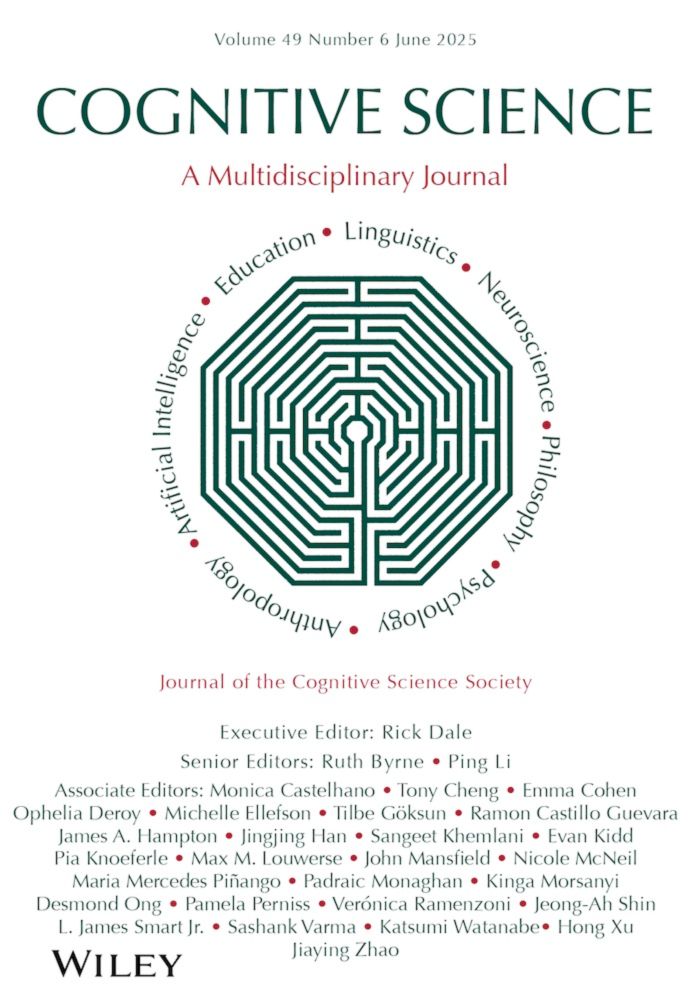
Learning a Novel Number System: The Role of Compositional Rules and Counting Procedures
Humans count to indefinitely large numbers by recycling words from a finite list, and combining them using rules—for example, combining sixty with unit labels to generate sixty-one, sixty-two, and so...
onlinelibrary.wiley.com
June 6, 2025 at 4:44 PM
Fun new paper led by Sebastian Holt, training adults on artificial number systems. Most work tests only base-10 learning; we trained adults on a range of base systems & manipulated whether numbers were learned as part of a counting system, or unordered words. onlinelibrary.wiley.com/doi/10.1111/...
Reposted by Kosta Boskovic
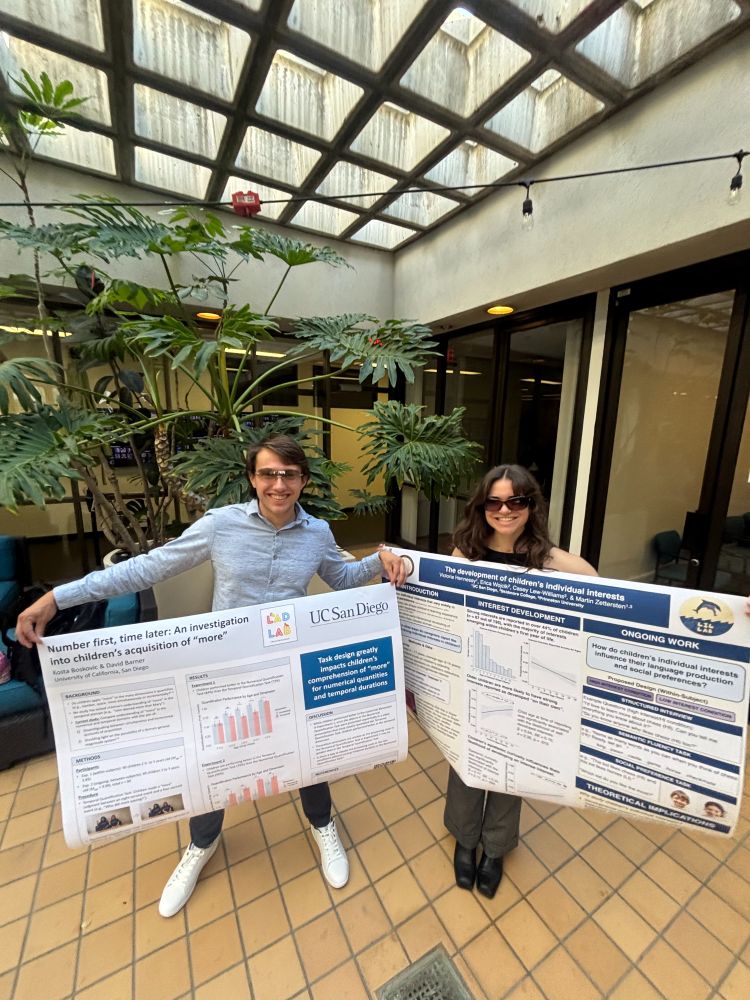
We were lucky to receive so much support from members of our Departments of Psychology and Cognitive Science, including @asmithflores.bsky.social who coined SoCal MInDS, Salih Özdemir who created our logo, and Tori Hennessy and @kostaboskovic.bsky.social who affirmed that our science is COOL! 😎
May 21, 2025 at 12:49 AM
We were lucky to receive so much support from members of our Departments of Psychology and Cognitive Science, including @asmithflores.bsky.social who coined SoCal MInDS, Salih Özdemir who created our logo, and Tori Hennessy and @kostaboskovic.bsky.social who affirmed that our science is COOL! 😎
Reposted by Kosta Boskovic
Out now! @drbarner.bsky.social & I find that Hindi kids learn yesterday & tomorrow earlier than English kids, despite having only word 'kal' to reference both the past and future. We argue that kids rely on tense info (over associations w/ events) to learn.
onlinelibrary.wiley.com/doi/10.1111/...
onlinelibrary.wiley.com/doi/10.1111/...

Twice Upon a Time: Children Use Syntax to Learn the Meanings of Yesterday and Tomorrow
Time words like “yesterday” and “tomorrow” are abstract, and are interpreted relative to the context in which they are produced: the word “tomorrow” refers to a different point in time now than in 24....
onlinelibrary.wiley.com
December 31, 2024 at 4:03 PM
Out now! @drbarner.bsky.social & I find that Hindi kids learn yesterday & tomorrow earlier than English kids, despite having only word 'kal' to reference both the past and future. We argue that kids rely on tense info (over associations w/ events) to learn.
onlinelibrary.wiley.com/doi/10.1111/...
onlinelibrary.wiley.com/doi/10.1111/...