



Kerrie Ann Gardner
@kerriedoodles.bsky.social
Artist, writer, naturalist, photographer and wonderer. Enchanted by the natural world but angered by our treatment of it. Always happier outside. Often found gazing at the sky.
Website: www.kerrieanngardner.co.uk
Website: www.kerrieanngardner.co.uk
Day eight of #ArtAdventCalendar.
Tonight’s offering is this coloured pencil drawing of a kestrel I drew for my mum.
Tonight’s offering is this coloured pencil drawing of a kestrel I drew for my mum.

December 8, 2025 at 6:17 PM
Day eight of #ArtAdventCalendar.
Tonight’s offering is this coloured pencil drawing of a kestrel I drew for my mum.
Tonight’s offering is this coloured pencil drawing of a kestrel I drew for my mum.
Day seven of #ArtAdventCalendar.
Already a week in! I briefly tried paper cutting a few years ago and really enjoyed it. Here’s one of the scenes I cut out.
Already a week in! I briefly tried paper cutting a few years ago and really enjoyed it. Here’s one of the scenes I cut out.

December 7, 2025 at 6:43 PM
Day seven of #ArtAdventCalendar.
Already a week in! I briefly tried paper cutting a few years ago and really enjoyed it. Here’s one of the scenes I cut out.
Already a week in! I briefly tried paper cutting a few years ago and really enjoyed it. Here’s one of the scenes I cut out.

December 6, 2025 at 6:24 PM

December 5, 2025 at 8:17 PM
Day four of #ArtAdventCalendar.
Here’s a pen and pencil drawing of a woodcock (one of my favourite birds) flying out to forage as the full moon rises behind a distant hill.
Here’s a pen and pencil drawing of a woodcock (one of my favourite birds) flying out to forage as the full moon rises behind a distant hill.

December 4, 2025 at 7:20 PM
Day four of #ArtAdventCalendar.
Here’s a pen and pencil drawing of a woodcock (one of my favourite birds) flying out to forage as the full moon rises behind a distant hill.
Here’s a pen and pencil drawing of a woodcock (one of my favourite birds) flying out to forage as the full moon rises behind a distant hill.
Day three of #ArtAdventCalendar.
Many moons ago, I used to paint stones. I’d sketch out an idea and then slowly transfer it onto a selected pebble. Here’s an example of one of my concept sketches and the finished stone.
Many moons ago, I used to paint stones. I’d sketch out an idea and then slowly transfer it onto a selected pebble. Here’s an example of one of my concept sketches and the finished stone.

December 3, 2025 at 6:01 AM
Day three of #ArtAdventCalendar.
Many moons ago, I used to paint stones. I’d sketch out an idea and then slowly transfer it onto a selected pebble. Here’s an example of one of my concept sketches and the finished stone.
Many moons ago, I used to paint stones. I’d sketch out an idea and then slowly transfer it onto a selected pebble. Here’s an example of one of my concept sketches and the finished stone.
Day two of #ArtAdventCalendar. Here’s a print I made just under a year ago of a crow carrying a crescent moon. 🌙

December 2, 2025 at 7:46 PM
Day two of #ArtAdventCalendar. Here’s a print I made just under a year ago of a crow carrying a crescent moon. 🌙
They were so beautiful!

December 1, 2025 at 8:27 PM
They were so beautiful!
Oooh, it’s time for #ArtAdventCalendar again! I haven’t made much art this year but I’ll see what I can find in the archives. 😉
Day One: A pencil drawing of a juvenile Tawny Owl, inspired by a pair of Tawny Owl fledglings which frequented our garden a few summers ago.
Day One: A pencil drawing of a juvenile Tawny Owl, inspired by a pair of Tawny Owl fledglings which frequented our garden a few summers ago.

December 1, 2025 at 6:44 PM
Oooh, it’s time for #ArtAdventCalendar again! I haven’t made much art this year but I’ll see what I can find in the archives. 😉
Day One: A pencil drawing of a juvenile Tawny Owl, inspired by a pair of Tawny Owl fledglings which frequented our garden a few summers ago.
Day One: A pencil drawing of a juvenile Tawny Owl, inspired by a pair of Tawny Owl fledglings which frequented our garden a few summers ago.
Watching a cumulus congestus transforming into a cumulonimbus endlessly fascinating. As soon as the upper regions reach the tropopause (the boundary between the troposphere and the stratosphere) they start to spread out, forming an incus, the well known anvil shape of a storm cloud.

November 10, 2025 at 9:02 PM
Watching a cumulus congestus transforming into a cumulonimbus endlessly fascinating. As soon as the upper regions reach the tropopause (the boundary between the troposphere and the stratosphere) they start to spread out, forming an incus, the well known anvil shape of a storm cloud.
I’m dreaming of doing this again. For the last few weeks the weather’s been too rough, but hopefully it’ll settle down soon. 🤞🏽
Soft pastel on Pastelmat.
Soft pastel on Pastelmat.

November 4, 2025 at 6:41 AM
I’m dreaming of doing this again. For the last few weeks the weather’s been too rough, but hopefully it’ll settle down soon. 🤞🏽
Soft pastel on Pastelmat.
Soft pastel on Pastelmat.
I haven’t created any art for a loooong time. My inner critic got too loud, causing me to abandon art entirely. But a few months ago I took up a new hobby - and whoosh! Inspiration flooded in, and I felt compelled to take up my soft pastels again. 🪂

September 27, 2025 at 2:58 PM
I haven’t created any art for a loooong time. My inner critic got too loud, causing me to abandon art entirely. But a few months ago I took up a new hobby - and whoosh! Inspiration flooded in, and I felt compelled to take up my soft pastels again. 🪂
Before the stormy weather passed through this morning there were some fantastic clouds around. An early show of Asperitas clouds gave way to a fiery sunrise. Worth standing in the rain for!


September 7, 2025 at 3:06 PM
Before the stormy weather passed through this morning there were some fantastic clouds around. An early show of Asperitas clouds gave way to a fiery sunrise. Worth standing in the rain for!
Gosh, I’ve been really rubbish at posting on Bluesky. Here’s a sketch of a Nightjar egg to say sorry.

May 28, 2025 at 5:31 AM
Gosh, I’ve been really rubbish at posting on Bluesky. Here’s a sketch of a Nightjar egg to say sorry.
LOOK WHO JUST FLEW OVER OUR HOUSE!

March 22, 2025 at 1:03 PM
LOOK WHO JUST FLEW OVER OUR HOUSE!
*Atmospheric Optics*
‘E’ is for Earth’s Shadow. Visible at twilight opposite the Sun, Earth’s Shadow is seen as a dark wedge on the horizon below the Belt of Venus. Its umbra extends 870,000 miles into space. It also gives us lunar eclipses. Total lunar eclipses turn the Moon bright red!
‘E’ is for Earth’s Shadow. Visible at twilight opposite the Sun, Earth’s Shadow is seen as a dark wedge on the horizon below the Belt of Venus. Its umbra extends 870,000 miles into space. It also gives us lunar eclipses. Total lunar eclipses turn the Moon bright red!

February 18, 2025 at 9:09 PM
*Atmospheric Optics*
‘E’ is for Earth’s Shadow. Visible at twilight opposite the Sun, Earth’s Shadow is seen as a dark wedge on the horizon below the Belt of Venus. Its umbra extends 870,000 miles into space. It also gives us lunar eclipses. Total lunar eclipses turn the Moon bright red!
‘E’ is for Earth’s Shadow. Visible at twilight opposite the Sun, Earth’s Shadow is seen as a dark wedge on the horizon below the Belt of Venus. Its umbra extends 870,000 miles into space. It also gives us lunar eclipses. Total lunar eclipses turn the Moon bright red!
*Atmospheric Optics*
‘C’ is for Crepuscular Rays. These are the sunbeams which shine out from gaps in clouds. Particles in the air scatter the light and make the beams visible. This phenomenon is also know as ‘God Rays’, as if a celestial being is casting them out as a symbol of hope.
‘C’ is for Crepuscular Rays. These are the sunbeams which shine out from gaps in clouds. Particles in the air scatter the light and make the beams visible. This phenomenon is also know as ‘God Rays’, as if a celestial being is casting them out as a symbol of hope.

February 17, 2025 at 5:34 PM
*Atmospheric Optics*
‘C’ is for Crepuscular Rays. These are the sunbeams which shine out from gaps in clouds. Particles in the air scatter the light and make the beams visible. This phenomenon is also know as ‘God Rays’, as if a celestial being is casting them out as a symbol of hope.
‘C’ is for Crepuscular Rays. These are the sunbeams which shine out from gaps in clouds. Particles in the air scatter the light and make the beams visible. This phenomenon is also know as ‘God Rays’, as if a celestial being is casting them out as a symbol of hope.
*Atmospheric Optics*
‘C’ is for cloud iridescence. This colourful optical phenomena appears on clouds close to the Sun or Moon. It’s caused by diffraction (small water droplets or ice crystals scatter the light) and is also called irisation, after the Greek goddess of rainbows, Iris.
‘C’ is for cloud iridescence. This colourful optical phenomena appears on clouds close to the Sun or Moon. It’s caused by diffraction (small water droplets or ice crystals scatter the light) and is also called irisation, after the Greek goddess of rainbows, Iris.

February 16, 2025 at 9:33 AM
*Atmospheric Optics*
‘C’ is for cloud iridescence. This colourful optical phenomena appears on clouds close to the Sun or Moon. It’s caused by diffraction (small water droplets or ice crystals scatter the light) and is also called irisation, after the Greek goddess of rainbows, Iris.
‘C’ is for cloud iridescence. This colourful optical phenomena appears on clouds close to the Sun or Moon. It’s caused by diffraction (small water droplets or ice crystals scatter the light) and is also called irisation, after the Greek goddess of rainbows, Iris.
*Atmospheric Optics*
Today we move on to the letter ‘C’ beginning with a Circumzenithal Arc (CZA). This phenomenon is caused by sunlight refracting through ice crystals in cirrus or cirrostratus clouds. It looks like an upside-down rainbow & is sometimes called a ‘smile in the sky’.
Today we move on to the letter ‘C’ beginning with a Circumzenithal Arc (CZA). This phenomenon is caused by sunlight refracting through ice crystals in cirrus or cirrostratus clouds. It looks like an upside-down rainbow & is sometimes called a ‘smile in the sky’.

February 11, 2025 at 12:51 PM
*Atmospheric Optics*
Today we move on to the letter ‘C’ beginning with a Circumzenithal Arc (CZA). This phenomenon is caused by sunlight refracting through ice crystals in cirrus or cirrostratus clouds. It looks like an upside-down rainbow & is sometimes called a ‘smile in the sky’.
Today we move on to the letter ‘C’ beginning with a Circumzenithal Arc (CZA). This phenomenon is caused by sunlight refracting through ice crystals in cirrus or cirrostratus clouds. It looks like an upside-down rainbow & is sometimes called a ‘smile in the sky’.
*Atmospheric Optics*
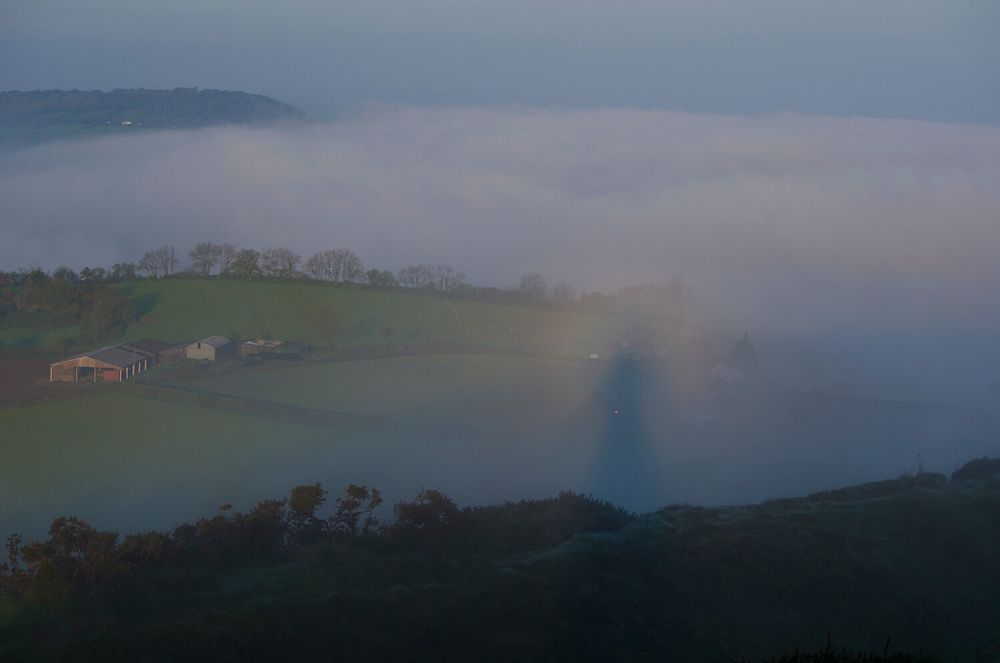
Still on the letter ‘B’, tonight I’m focusing on the Brocken spectre; the magnified shadow of an observer cast on a cloud opposite a light source. This shadow is surrounded by a halo known as a glory. It’s named after the Brocken, a mountain in Germany where it’s often seen.
Still on the letter ‘B’, tonight I’m focusing on the Brocken spectre; the magnified shadow of an observer cast on a cloud opposite a light source. This shadow is surrounded by a halo known as a glory. It’s named after the Brocken, a mountain in Germany where it’s often seen.
February 9, 2025 at 8:22 PM
*Atmospheric Optics*
Still on the letter ‘B’, tonight I’m focusing on the Brocken spectre; the magnified shadow of an observer cast on a cloud opposite a light source. This shadow is surrounded by a halo known as a glory. It’s named after the Brocken, a mountain in Germany where it’s often seen.
Still on the letter ‘B’, tonight I’m focusing on the Brocken spectre; the magnified shadow of an observer cast on a cloud opposite a light source. This shadow is surrounded by a halo known as a glory. It’s named after the Brocken, a mountain in Germany where it’s often seen.
*Atmospheric Optics*
Time for the letter 'B', starting with The Belt of Venus.
This atmospheric phenomenon is caused by backscattering. It's a band of pink seen close to the horizon during twilight. Look west before sunrise and east after sunset. The dark blue area below it is Earth's shadow.
Time for the letter 'B', starting with The Belt of Venus.
This atmospheric phenomenon is caused by backscattering. It's a band of pink seen close to the horizon during twilight. Look west before sunrise and east after sunset. The dark blue area below it is Earth's shadow.

February 8, 2025 at 6:12 PM
*Atmospheric Optics*
Time for the letter 'B', starting with The Belt of Venus.
This atmospheric phenomenon is caused by backscattering. It's a band of pink seen close to the horizon during twilight. Look west before sunrise and east after sunset. The dark blue area below it is Earth's shadow.
Time for the letter 'B', starting with The Belt of Venus.
This atmospheric phenomenon is caused by backscattering. It's a band of pink seen close to the horizon during twilight. Look west before sunrise and east after sunset. The dark blue area below it is Earth's shadow.
*Atmospheric Optics*
Time for aurora!
In a nutshell, aurorae are produced when charged particles from the Sun interact with the Earth’s magnetic field. The different colours are caused by various gases in Earth’s atmosphere.
It’s one of my favourite atmospheric optical phenomena - magical! ✨
Time for aurora!
In a nutshell, aurorae are produced when charged particles from the Sun interact with the Earth’s magnetic field. The different colours are caused by various gases in Earth’s atmosphere.
It’s one of my favourite atmospheric optical phenomena - magical! ✨

February 6, 2025 at 8:06 PM
*Atmospheric Optics*
Time for aurora!
In a nutshell, aurorae are produced when charged particles from the Sun interact with the Earth’s magnetic field. The different colours are caused by various gases in Earth’s atmosphere.
It’s one of my favourite atmospheric optical phenomena - magical! ✨
Time for aurora!
In a nutshell, aurorae are produced when charged particles from the Sun interact with the Earth’s magnetic field. The different colours are caused by various gases in Earth’s atmosphere.
It’s one of my favourite atmospheric optical phenomena - magical! ✨
*Atmospheric Optics*
Apologies about this photograph, as it doesn’t showcase this phenomenon particularly well, but here are some faint anti-crepuscular rays. These beams can be seen opposite the sun, converging toward the antisolar point. They are caused by cloud shadows and atmospheric haze.
Apologies about this photograph, as it doesn’t showcase this phenomenon particularly well, but here are some faint anti-crepuscular rays. These beams can be seen opposite the sun, converging toward the antisolar point. They are caused by cloud shadows and atmospheric haze.

February 5, 2025 at 8:03 PM
*Atmospheric Optics*
Apologies about this photograph, as it doesn’t showcase this phenomenon particularly well, but here are some faint anti-crepuscular rays. These beams can be seen opposite the sun, converging toward the antisolar point. They are caused by cloud shadows and atmospheric haze.
Apologies about this photograph, as it doesn’t showcase this phenomenon particularly well, but here are some faint anti-crepuscular rays. These beams can be seen opposite the sun, converging toward the antisolar point. They are caused by cloud shadows and atmospheric haze.
*Atmospheric Optics*
Still on the letter ‘A’, tonight it’s Alpenglow, from the German word Alpenglühen, which means ‘Alps glow’. Alpenglow refers to the reddish colour seen on mountain peaks at dawn and dusk.
Have you seen Alpenglow? Please share your pictures if you have, I’d love to see. ⛰️
Still on the letter ‘A’, tonight it’s Alpenglow, from the German word Alpenglühen, which means ‘Alps glow’. Alpenglow refers to the reddish colour seen on mountain peaks at dawn and dusk.
Have you seen Alpenglow? Please share your pictures if you have, I’d love to see. ⛰️

February 4, 2025 at 7:23 PM
*Atmospheric Optics*
Still on the letter ‘A’, tonight it’s Alpenglow, from the German word Alpenglühen, which means ‘Alps glow’. Alpenglow refers to the reddish colour seen on mountain peaks at dawn and dusk.
Have you seen Alpenglow? Please share your pictures if you have, I’d love to see. ⛰️
Still on the letter ‘A’, tonight it’s Alpenglow, from the German word Alpenglühen, which means ‘Alps glow’. Alpenglow refers to the reddish colour seen on mountain peaks at dawn and dusk.
Have you seen Alpenglow? Please share your pictures if you have, I’d love to see. ⛰️
*Atmospheric Optics*
Another ‘A’ today - Alexander’s Band.
If you look closely at a double rainbow, you’ll see a darker area between the primary & secondary bow. This is Alexander’s Band. It appears darker because light in this area is being scattered at angles which don’t reach the viewer’s eyes.
Another ‘A’ today - Alexander’s Band.
If you look closely at a double rainbow, you’ll see a darker area between the primary & secondary bow. This is Alexander’s Band. It appears darker because light in this area is being scattered at angles which don’t reach the viewer’s eyes.

February 3, 2025 at 8:41 PM
*Atmospheric Optics*
Another ‘A’ today - Alexander’s Band.
If you look closely at a double rainbow, you’ll see a darker area between the primary & secondary bow. This is Alexander’s Band. It appears darker because light in this area is being scattered at angles which don’t reach the viewer’s eyes.
Another ‘A’ today - Alexander’s Band.
If you look closely at a double rainbow, you’ll see a darker area between the primary & secondary bow. This is Alexander’s Band. It appears darker because light in this area is being scattered at angles which don’t reach the viewer’s eyes.