



Island bird Research
@islandbirdproject.bsky.social
We study the evolution of birds on islands and we are part of CIBIO, Portugal (Sociality group) and CEFE, Montpellier, France (E3CO group)
www.islandbirdproject.com
www.islandbirdproject.com
8/8
Work by our team: @raquelponti.bsky.social, @anavleitao.bsky.social, @claire-doutrelant.bsky.social, Rita Covas.
We thank Pepijn Kamminga @naturalis.bsky.social, Paul Sweet @amnh.org, & Robert Prys-Jones @nhm-london.bsky.social who kindly supported our visits to the museums.
TY! #BOUasm25
Work by our team: @raquelponti.bsky.social, @anavleitao.bsky.social, @claire-doutrelant.bsky.social, Rita Covas.
We thank Pepijn Kamminga @naturalis.bsky.social, Paul Sweet @amnh.org, & Robert Prys-Jones @nhm-london.bsky.social who kindly supported our visits to the museums.
TY! #BOUasm25

November 18, 2025 at 1:45 PM
8/8
Work by our team: @raquelponti.bsky.social, @anavleitao.bsky.social, @claire-doutrelant.bsky.social, Rita Covas.
We thank Pepijn Kamminga @naturalis.bsky.social, Paul Sweet @amnh.org, & Robert Prys-Jones @nhm-london.bsky.social who kindly supported our visits to the museums.
TY! #BOUasm25
Work by our team: @raquelponti.bsky.social, @anavleitao.bsky.social, @claire-doutrelant.bsky.social, Rita Covas.
We thank Pepijn Kamminga @naturalis.bsky.social, Paul Sweet @amnh.org, & Robert Prys-Jones @nhm-london.bsky.social who kindly supported our visits to the museums.
TY! #BOUasm25
7/8
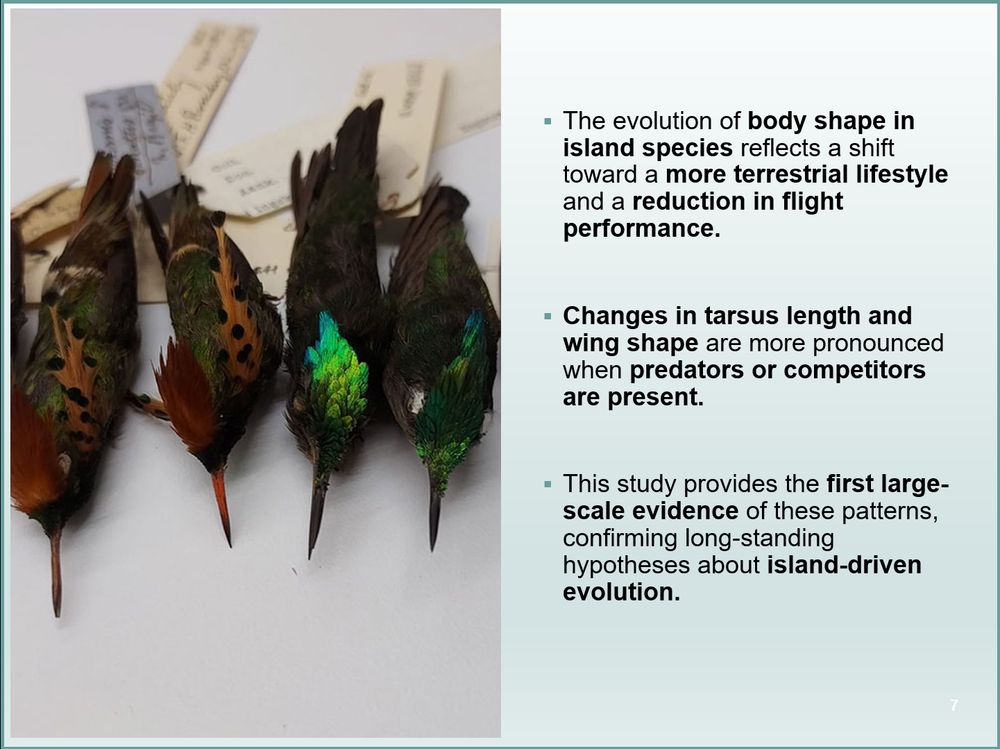
These results reveal a global pattern of morphological adaptation in island birds. Key ecological factors such as predation and competition play a central role in shaping these evolutionary changes.
These results reveal a global pattern of morphological adaptation in island birds. Key ecological factors such as predation and competition play a central role in shaping these evolutionary changes.
November 18, 2025 at 1:45 PM
7/8
These results reveal a global pattern of morphological adaptation in island birds. Key ecological factors such as predation and competition play a central role in shaping these evolutionary changes.
These results reveal a global pattern of morphological adaptation in island birds. Key ecological factors such as predation and competition play a central role in shaping these evolutionary changes.
6/8
We also found that island bird evolved longer tarsi than their mainland ancestors but shorter in presence of predators and competitors
We also found that island bird evolved longer tarsi than their mainland ancestors but shorter in presence of predators and competitors

November 18, 2025 at 1:45 PM
6/8
We also found that island bird evolved longer tarsi than their mainland ancestors but shorter in presence of predators and competitors
We also found that island bird evolved longer tarsi than their mainland ancestors but shorter in presence of predators and competitors
5/8
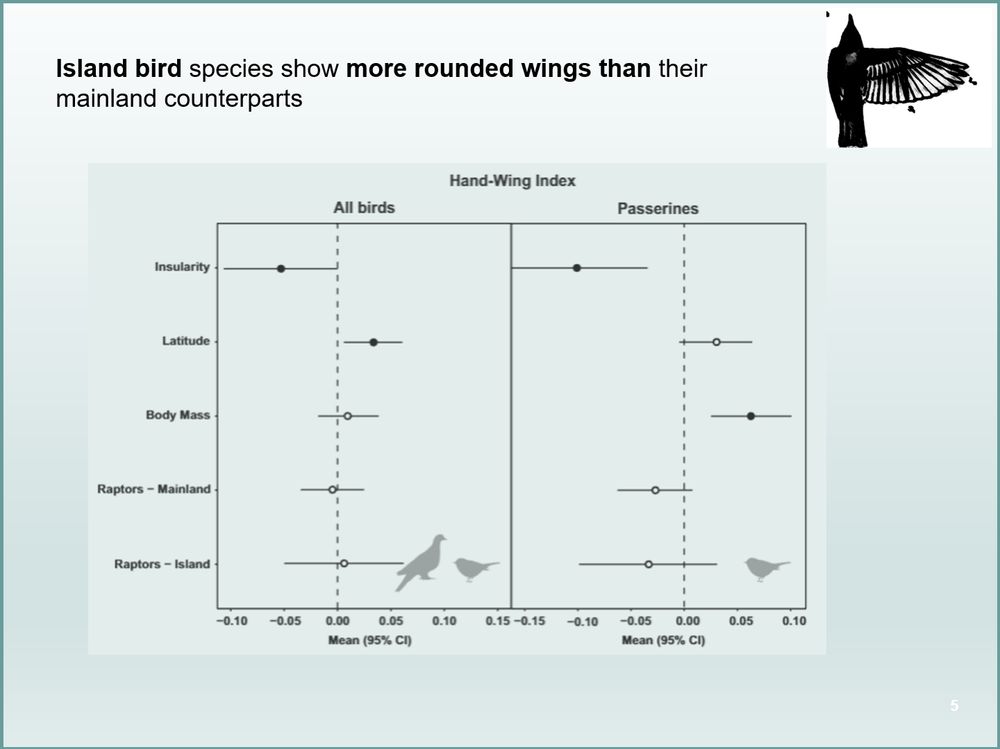
We found that island endemics evolved more rounded wings than their mainland counterparts.
We found that island endemics evolved more rounded wings than their mainland counterparts.
November 18, 2025 at 1:45 PM
5/8
We found that island endemics evolved more rounded wings than their mainland counterparts.
We found that island endemics evolved more rounded wings than their mainland counterparts.
4/8
We took measurements of wing and tarsus length from museum specimens 🏛️and from AVONET.
We used Birdlife species distribution maps to calculate the overlapping competitors and predators’ species per each focal one.
We implemented Bayesian Phylogenetic mixed models to test our hypothesis.
We took measurements of wing and tarsus length from museum specimens 🏛️and from AVONET.
We used Birdlife species distribution maps to calculate the overlapping competitors and predators’ species per each focal one.
We implemented Bayesian Phylogenetic mixed models to test our hypothesis.

November 18, 2025 at 1:45 PM
4/8
We took measurements of wing and tarsus length from museum specimens 🏛️and from AVONET.
We used Birdlife species distribution maps to calculate the overlapping competitors and predators’ species per each focal one.
We implemented Bayesian Phylogenetic mixed models to test our hypothesis.
We took measurements of wing and tarsus length from museum specimens 🏛️and from AVONET.
We used Birdlife species distribution maps to calculate the overlapping competitors and predators’ species per each focal one.
We implemented Bayesian Phylogenetic mixed models to test our hypothesis.
3/8
We analysed pairs of endemic island birds and their closest mainland relatives to ask: how does insularity affect locomotion-related traits and what role do predator and competitor diversity play in shaping these traits?
We analysed pairs of endemic island birds and their closest mainland relatives to ask: how does insularity affect locomotion-related traits and what role do predator and competitor diversity play in shaping these traits?

November 18, 2025 at 1:45 PM
3/8
We analysed pairs of endemic island birds and their closest mainland relatives to ask: how does insularity affect locomotion-related traits and what role do predator and competitor diversity play in shaping these traits?
We analysed pairs of endemic island birds and their closest mainland relatives to ask: how does insularity affect locomotion-related traits and what role do predator and competitor diversity play in shaping these traits?
2/8
Island biotas experience unique conditions, that foster unique evolutionary patterns, often markedly different from their continental ancestors.
Some of these patterns are particularly well-known, such as body size evolution “island rule”, while changes in body shape remain understudied.
Island biotas experience unique conditions, that foster unique evolutionary patterns, often markedly different from their continental ancestors.
Some of these patterns are particularly well-known, such as body size evolution “island rule”, while changes in body shape remain understudied.

November 18, 2025 at 1:45 PM
2/8
Island biotas experience unique conditions, that foster unique evolutionary patterns, often markedly different from their continental ancestors.
Some of these patterns are particularly well-known, such as body size evolution “island rule”, while changes in body shape remain understudied.
Island biotas experience unique conditions, that foster unique evolutionary patterns, often markedly different from their continental ancestors.
Some of these patterns are particularly well-known, such as body size evolution “island rule”, while changes in body shape remain understudied.
@claire-doutrelant.bsky.social and Rita Covas
November 6, 2025 at 3:05 PM
@claire-doutrelant.bsky.social and Rita Covas
More info on
www.islandbirdproject.com
www.islandbirdproject.com

Home - Birds on Islands Research
[cs_content _p='7'][cs_element_section _id=
www.islandbirdproject.com
February 11, 2025 at 4:10 PM
More info on
www.islandbirdproject.com
www.islandbirdproject.com
Raquel Ponti @raquelponti.bsky.social is a #MSCA postdoctoral research at BIOPOLIS, Portugal, studying general patterns of morphological evolution in endemic island birds, and the mechanisms involved. 🦜🏝️
5/5
5/5

February 11, 2025 at 4:10 PM
Raquel Ponti @raquelponti.bsky.social is a #MSCA postdoctoral research at BIOPOLIS, Portugal, studying general patterns of morphological evolution in endemic island birds, and the mechanisms involved. 🦜🏝️
5/5
5/5
Ana Leitão @anavleitao.bsky.social is a MSCA postdoctoral researcher at #BIOPOLIS. Her work has been focused in understanding the evolution of elaborate (or lack of) traits such as plumage colors and bird song, in both female and male birds. 🪶🐦
4/5
4/5

February 11, 2025 at 4:10 PM
Ana Leitão @anavleitao.bsky.social is a MSCA postdoctoral researcher at #BIOPOLIS. Her work has been focused in understanding the evolution of elaborate (or lack of) traits such as plumage colors and bird song, in both female and male birds. 🪶🐦
4/5
4/5
Claire Doutrelant is a senior researcher at CEFE, Montpellier, with especial interest in the impact of sexual and social evolution on islands signals (both male songs and male and female colors). 🎨🎶
3/5
3/5

February 11, 2025 at 4:10 PM
Claire Doutrelant is a senior researcher at CEFE, Montpellier, with especial interest in the impact of sexual and social evolution on islands signals (both male songs and male and female colors). 🎨🎶
3/5
3/5
Rita Covas, principal researcher at BIOPOLIS, Portugal investigates adaptation patterns to island environments, focusing on the evolution of reproductive life histories, #sociality, immunity, and morphology in island birds, among other interests. 🏝️🦤
2/5
2/5

February 11, 2025 at 4:10 PM
Rita Covas, principal researcher at BIOPOLIS, Portugal investigates adaptation patterns to island environments, focusing on the evolution of reproductive life histories, #sociality, immunity, and morphology in island birds, among other interests. 🏝️🦤
2/5
2/5