




GT Separations Science and Engineering Center
@gtssec.bsky.social
Solving the world's greatest separations challenges through innovative research and design home to engineers & scientists from Georgia Tech ChBE
Read more 👉 research.gatech.edu/georgia-tech...
Georgia Tech Researchers Named Finalists for Prestigious Blavatnik Science Awards | Research
Two Georgia Tech researchers in the College of Engineering have been named finalists for the 2025 Blavatnik National Awards for Young Scientists. Their discoveries, which could create cleaner industri...
research.gatech.edu
October 13, 2025 at 1:27 AM
Read more 👉 research.gatech.edu/georgia-tech...
This work combines machine learning with transport modeling to guide the selection of high-performing microporous polymers for OSRO. Grateful to the editors and reviewers for recognizing its impact!🎉
August 19, 2025 at 5:04 PM
This work combines machine learning with transport modeling to guide the selection of high-performing microporous polymers for OSRO. Grateful to the editors and reviewers for recognizing its impact!🎉
This approach cuts DAC energy demand to as low as 1.7-3.3 GJ/tCO₂ and slashes the levelized cost of capture by ~60%, opening a scalable, low-cost path for gigaton-scale carbon removal. Read more: pubs.rsc.org/en/content/a...
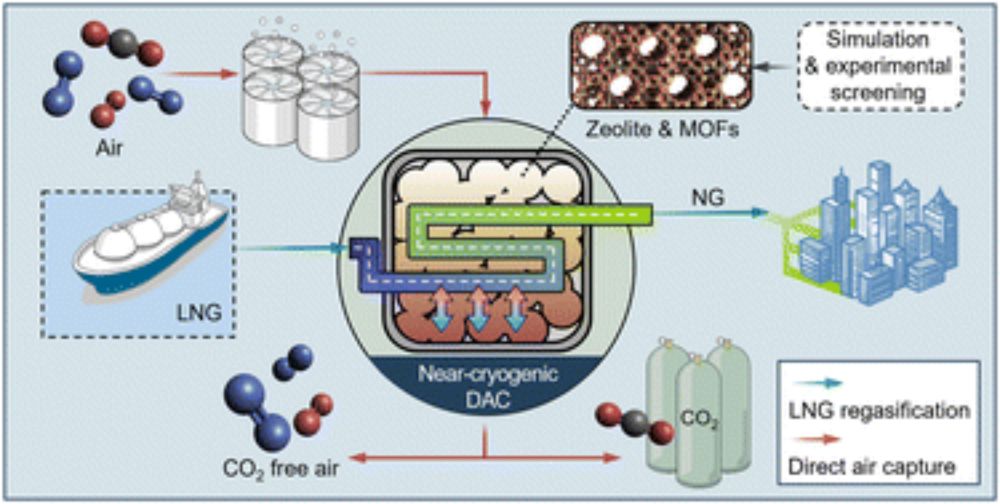
Near-cryogenic direct air capture using adsorbents
Direct air capture (DAC) of CO2 is a key component in the portfolio of negative emissions technologies for mitigating global warming. However, even with the most potent amine sorbents, large-scale DAC...
pubs.rsc.org
July 10, 2025 at 7:33 PM
This approach cuts DAC energy demand to as low as 1.7-3.3 GJ/tCO₂ and slashes the levelized cost of capture by ~60%, opening a scalable, low-cost path for gigaton-scale carbon removal. Read more: pubs.rsc.org/en/content/a...
Aminolysis between PEI and CA reduces CO₂ capacity, but pre-hydrolysis or switching to PES can preserve up to 97% capacity over 20 cycles. A critical step forward in designing robust DAC contactors! Read more👉 pubs.acs.org/doi/10.1021/...
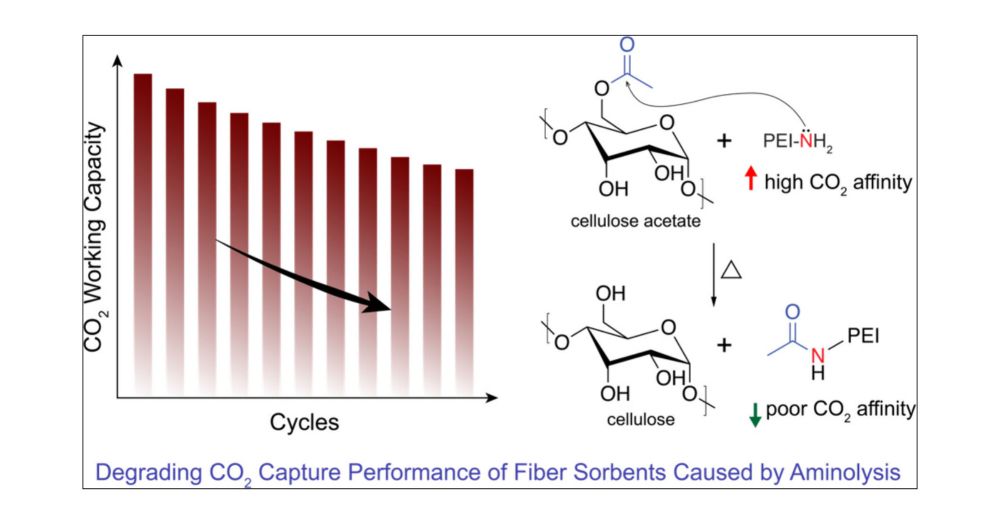
Performance Degradation of Amine-Infused Fiber Sorbents for Direct Air Capture: Mechanisms and Solutions
Sorbent stability poses significant impacts on long-term performance of direct air capture (DAC) of CO2 and levelized cost of capture (LCOC). We report the DAC performance degradation of amine-infused...
pubs.acs.org
June 18, 2025 at 4:38 AM
Aminolysis between PEI and CA reduces CO₂ capacity, but pre-hydrolysis or switching to PES can preserve up to 97% capacity over 20 cycles. A critical step forward in designing robust DAC contactors! Read more👉 pubs.acs.org/doi/10.1021/...
These self-supported sorbents achieve a 31% increase in CO₂ uptake under humid conditions, exhibit excellent mechanical stability, and reduce pressure drop for scalable DAC applications. Learn more: pubs.acs.org/doi/10.1021/...
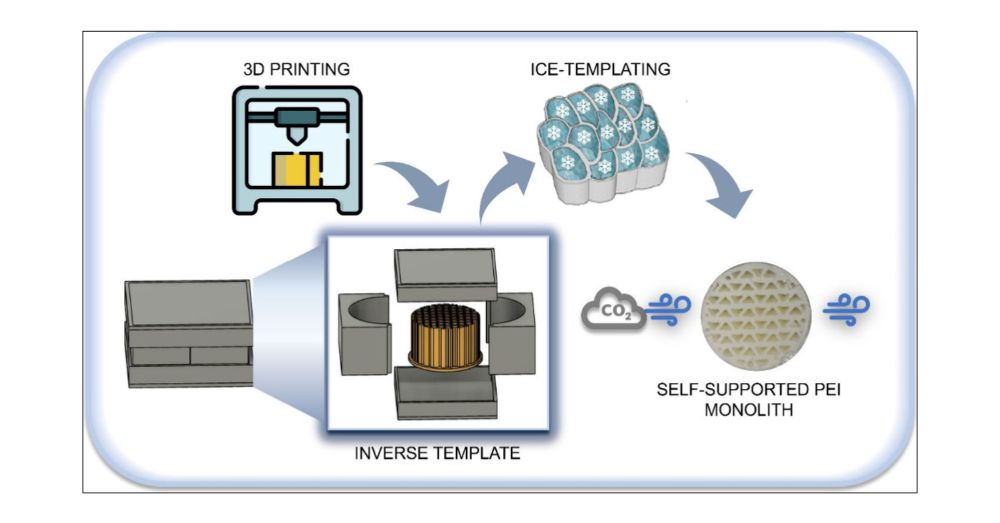
Self-Supported Branched Poly(ethylenimine) Monoliths from Inverse Template 3D Printing for Direct Air Capture
3D-printed inverse templates are combined with ice templating to develop self-supported branched poly(ethylenimine) monoliths with regular channels of varying channel density and ordered macropores. A maximum uptake of 0.96 mmol of CO2/g of monolith from ambient air containing 45.5% RH is achieved from dynamic breakthrough experiments, which is a 31% increase compared to the CO2 uptake from adsorption under dry conditions for the same duration. The breakthrough experiments show characteristics of internal mass-transfer limitations. The cyclic dynamic breakthrough experiments indicate stable operation without significant loss in CO2 uptake across eight cycles. Moreover, the self-supported monolith shows minimal loss in adsorption capacity (7.7%) upon exposure to air containing 21% oxygen at 110 °C, in comparison to a conventional sorbent consisting of poly(ethylenimine) impregnated on Al2O3 (18.9%). The monoliths exhibit good mechanical stability, contributed by elastic deformation, corresponding to up to 74% strain and lower pressure drop compared to many existing monoliths in the literature.
pubs.acs.org
February 11, 2025 at 5:30 PM
These self-supported sorbents achieve a 31% increase in CO₂ uptake under humid conditions, exhibit excellent mechanical stability, and reduce pressure drop for scalable DAC applications. Learn more: pubs.acs.org/doi/10.1021/...
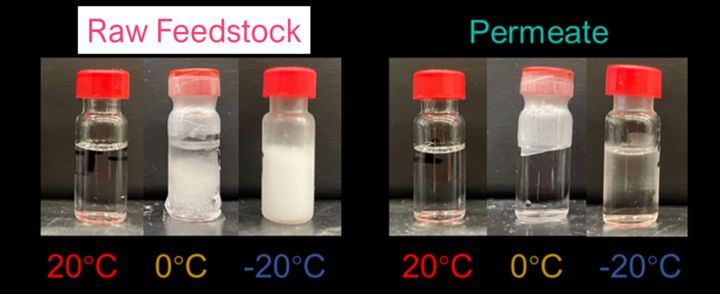
These innovative membranes demonstrate high selectivity for complex hydrocarbon mixtures, offering energy-efficient solutions for processes and reducing carbon emissions in chemical processing.
Read more: www.science.org/doi/10.1126/...
#MembraneScience #Sustainability #SeparationTechnology
Read more: www.science.org/doi/10.1126/...
#MembraneScience #Sustainability #SeparationTechnology
January 9, 2025 at 9:51 PM
These innovative membranes demonstrate high selectivity for complex hydrocarbon mixtures, offering energy-efficient solutions for processes and reducing carbon emissions in chemical processing.
Read more: www.science.org/doi/10.1126/...
#MembraneScience #Sustainability #SeparationTechnology
Read more: www.science.org/doi/10.1126/...
#MembraneScience #Sustainability #SeparationTechnology