




Jeffrey G. Snodgrass
@godfreysnorgyrs.bsky.social
Culture & mind; possible selves, affect regulation; ritual, role-playing games; pragmatic qual-quant methods, causality
The Avatar Faculty: Ecstatic Transformations in Religion & Video Games https://www.ucpress.edu/books/the-avatar-faculty/paper
The Avatar Faculty: Ecstatic Transformations in Religion & Video Games https://www.ucpress.edu/books/the-avatar-faculty/paper
Reposted by Jeffrey G. Snodgrass

7/ Survey experiments surge and now account for roughly 45% of all design-based studies. Lab experiments decline sharply after 2016, while field experiments and most quasi-experimental designs grow slowly from a very low base

December 2, 2025 at 11:46 PM
7/ Survey experiments surge and now account for roughly 45% of all design-based studies. Lab experiments decline sharply after 2016, while field experiments and most quasi-experimental designs grow slowly from a very low base
Reposted by Jeffrey G. Snodgrass
6/ The revolution is driven mainly by survey experiments and, to a much lesser extent, DID and unconfoundedness designs with matching & reweighting. Field experiments, IV, RDDs, natural experiments, and synthetic control all remain relatively rare in the discipline.

December 2, 2025 at 11:46 PM
6/ The revolution is driven mainly by survey experiments and, to a much lesser extent, DID and unconfoundedness designs with matching & reweighting. Field experiments, IV, RDDs, natural experiments, and synthetic control all remain relatively rare in the discipline.
Reposted by Jeffrey G. Snodgrass
4/ In our coding, design-based studies pin causality on a clear source of (quasi-)random variation and spell out identification assumptions, while model-based studies rely mainly on functional-form and statistical assumptions, often treating regression coefficients as causal

December 2, 2025 at 11:46 PM
4/ In our coding, design-based studies pin causality on a clear source of (quasi-)random variation and spell out identification assumptions, while model-based studies rely mainly on functional-form and statistical assumptions, often treating regression coefficients as causal
Reposted by Jeffrey G. Snodgrass
3/ About 40% of articles are empirical & quantitative. Of these, 81% are explanatory–using causal relationships to explain social phenomena–and just 29% of explanatory studies use explicit design-based methods. Most causal work still relies on model-based strategies or leaves the design implicit

December 2, 2025 at 11:46 PM
3/ About 40% of articles are empirical & quantitative. Of these, 81% are explanatory–using causal relationships to explain social phenomena–and just 29% of explanatory studies use explicit design-based methods. Most causal work still relies on model-based strategies or leaves the design implicit
Reposted by Jeffrey G. Snodgrass

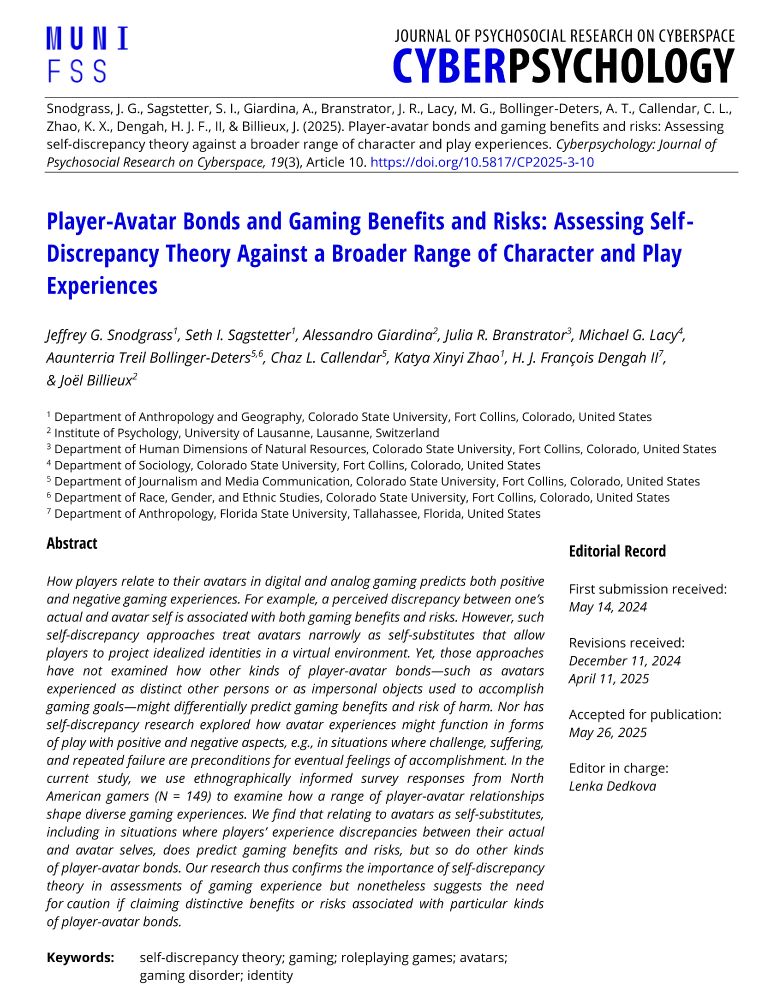
🔟 Player-avatar bonds and gaming benefits and risks: Assessing self-discrepancy theory against a broader range of character and play experiences
Snodgrass, Sagstetter, Branstrator, Giardina, Lacy, Bollinger-Deters, Callendar, Zhao, Dengah II, & Billieux
doi.org/10.5817/CP20...
Snodgrass, Sagstetter, Branstrator, Giardina, Lacy, Bollinger-Deters, Callendar, Zhao, Dengah II, & Billieux
doi.org/10.5817/CP20...
June 30, 2025 at 4:49 PM
🔟 Player-avatar bonds and gaming benefits and risks: Assessing self-discrepancy theory against a broader range of character and play experiences
Snodgrass, Sagstetter, Branstrator, Giardina, Lacy, Bollinger-Deters, Callendar, Zhao, Dengah II, & Billieux
doi.org/10.5817/CP20...
Snodgrass, Sagstetter, Branstrator, Giardina, Lacy, Bollinger-Deters, Callendar, Zhao, Dengah II, & Billieux
doi.org/10.5817/CP20...