




Jeremy Garb
@garbjeremy.bsky.social
PhD student at the Sorek lab.
Immune proteins.
Immune proteins.
It’s not just phages either.
We designed inhibitors for DdmDE, a system in Vibrio cholerae that usually clears plasmids from transformed cells.
Two of these binders conferred the plasmids with significant resistance against DdmDE-mediated plasmid clearance even in its native bacterial strain.
We designed inhibitors for DdmDE, a system in Vibrio cholerae that usually clears plasmids from transformed cells.
Two of these binders conferred the plasmids with significant resistance against DdmDE-mediated plasmid clearance even in its native bacterial strain.

September 2, 2025 at 7:36 AM
It’s not just phages either.
We designed inhibitors for DdmDE, a system in Vibrio cholerae that usually clears plasmids from transformed cells.
Two of these binders conferred the plasmids with significant resistance against DdmDE-mediated plasmid clearance even in its native bacterial strain.
We designed inhibitors for DdmDE, a system in Vibrio cholerae that usually clears plasmids from transformed cells.
Two of these binders conferred the plasmids with significant resistance against DdmDE-mediated plasmid clearance even in its native bacterial strain.
Now that we had binders against two defense systems, we engineered a single phage to carry two inhibitors.
➡️ This phage could overcome two defenses in the same bacterium.
This shows we can build “multi-resistant” phages for therapy.
➡️ This phage could overcome two defenses in the same bacterium.
This shows we can build “multi-resistant” phages for therapy.

September 2, 2025 at 7:36 AM
Now that we had binders against two defense systems, we engineered a single phage to carry two inhibitors.
➡️ This phage could overcome two defenses in the same bacterium.
This shows we can build “multi-resistant” phages for therapy.
➡️ This phage could overcome two defenses in the same bacterium.
This shows we can build “multi-resistant” phages for therapy.
We also built inhibitors against Avs1, a bacterial ancestor of human immune NLRs.
Synthetic binders blocked Avs1 activity—again, letting phages replicate in bacteria that co-express our binders with Avs1.
Synthetic binders blocked Avs1 activity—again, letting phages replicate in bacteria that co-express our binders with Avs1.

September 2, 2025 at 7:36 AM
We also built inhibitors against Avs1, a bacterial ancestor of human immune NLRs.
Synthetic binders blocked Avs1 activity—again, letting phages replicate in bacteria that co-express our binders with Avs1.
Synthetic binders blocked Avs1 activity—again, letting phages replicate in bacteria that co-express our binders with Avs1.
Using this workflow, we successfully identified multiple binders that inhibit Thoeris when co-expressed during infection ✅

September 2, 2025 at 7:36 AM
Using this workflow, we successfully identified multiple binders that inhibit Thoeris when co-expressed during infection ✅
To test candidate binders, and check if they successfully inhibit anti-phage defense systems, we built a 96-well transformation and phage-infection workflow (otherwise – far too many transformations!). This let us screen ~200 candidates at a time against a given system.

September 2, 2025 at 7:36 AM
To test candidate binders, and check if they successfully inhibit anti-phage defense systems, we built a 96-well transformation and phage-infection workflow (otherwise – far too many transformations!). This let us screen ~200 candidates at a time against a given system.
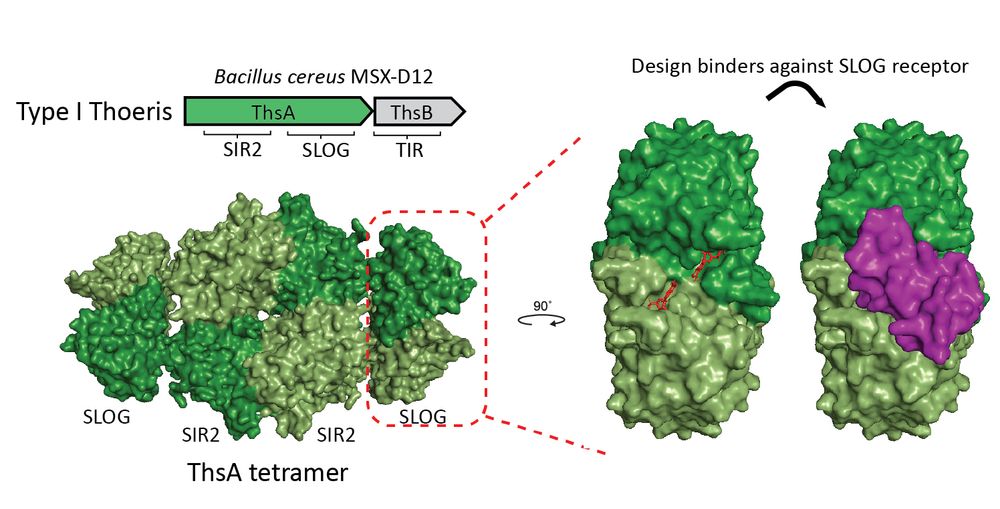
We started with the Thoeris system, where ThsB makes a signal (3′cADPR) that activates ThsA by binding its SLOG receptor domain.
We hypothesized that designing small proteins that bind the molecule-sensing site in the SLOG domain would disrupt its ability to perceive the signaling molecules.
We hypothesized that designing small proteins that bind the molecule-sensing site in the SLOG domain would disrupt its ability to perceive the signaling molecules.
September 2, 2025 at 7:36 AM
We started with the Thoeris system, where ThsB makes a signal (3′cADPR) that activates ThsA by binding its SLOG receptor domain.
We hypothesized that designing small proteins that bind the molecule-sensing site in the SLOG domain would disrupt its ability to perceive the signaling molecules.
We hypothesized that designing small proteins that bind the molecule-sensing site in the SLOG domain would disrupt its ability to perceive the signaling molecules.