



Héctor Gil Marín
@cosmonautico.bsky.social
RyC fellow at the Institute de Ciències del Cosmos at UniBarcelona studying the large scale structure of the Universe 🌌. BOSS, eBOSS and now in DESI 🏜🔭. Sometimes I ride my bike(s)🚵♂️.
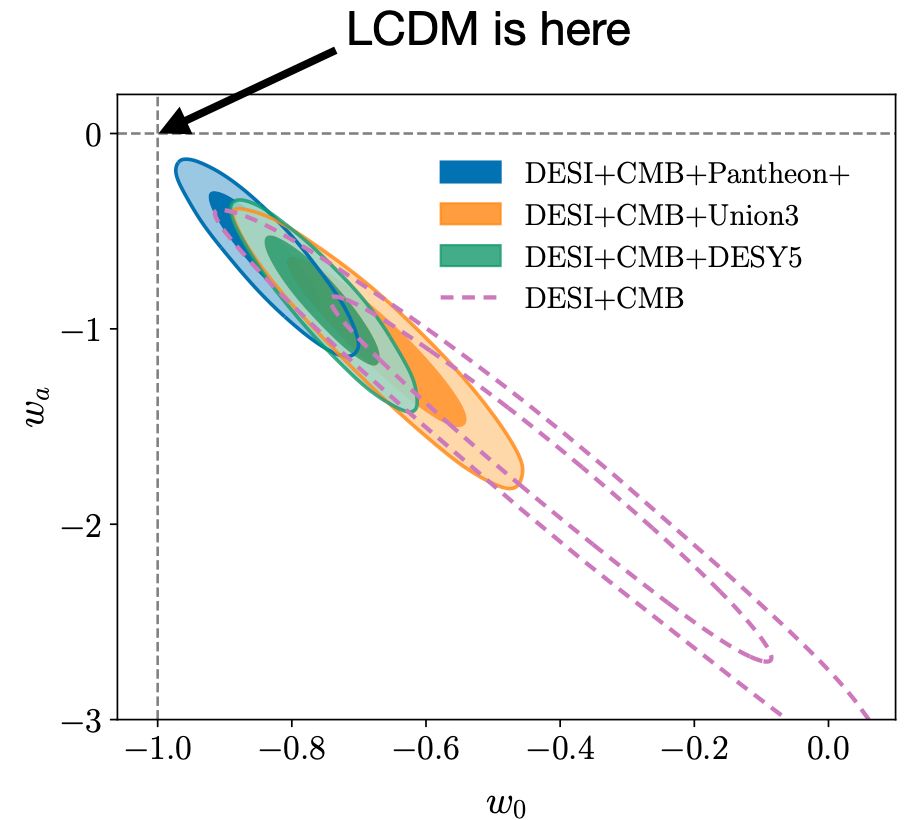
LCDM doesn't seem that robust anymore.
Is it a problem with the model? Is it a problem with the data?
Why does LCDM seem to break in this funny degeneration precisely crossing LCDM?
Interesting times ahead!! Looking forward to new @desisurvey.bsky.social releases.
Credit: @clairelamman.bsky.social
Is it a problem with the model? Is it a problem with the data?
Why does LCDM seem to break in this funny degeneration precisely crossing LCDM?
Interesting times ahead!! Looking forward to new @desisurvey.bsky.social releases.
Credit: @clairelamman.bsky.social

March 20, 2025 at 1:31 AM
LCDM doesn't seem that robust anymore.
Is it a problem with the model? Is it a problem with the data?
Why does LCDM seem to break in this funny degeneration precisely crossing LCDM?
Interesting times ahead!! Looking forward to new @desisurvey.bsky.social releases.
Credit: @clairelamman.bsky.social
Is it a problem with the model? Is it a problem with the data?
Why does LCDM seem to break in this funny degeneration precisely crossing LCDM?
Interesting times ahead!! Looking forward to new @desisurvey.bsky.social releases.
Credit: @clairelamman.bsky.social
7. And finally, neutrinos. Within LCDM the neutrino bound at 95% is on <0.064 eV, but without a peak expected on the negative neutrino masses. Within wowaCDM the 95% bound is on <0.163 eV, but the peak is on the positive side.

March 20, 2025 at 1:24 AM
7. And finally, neutrinos. Within LCDM the neutrino bound at 95% is on <0.064 eV, but without a peak expected on the negative neutrino masses. Within wowaCDM the 95% bound is on <0.163 eV, but the peak is on the positive side.
6. When adding the SNe, the tension rises to 2.8σ if we consider Pantheon+, 3.8σ for Union3, and 4.2σ for DES. However, this tension can be relaxed if z<0.1 SNe (the less homogeneous ones for the DES case) are removed.

March 20, 2025 at 1:22 AM
6. When adding the SNe, the tension rises to 2.8σ if we consider Pantheon+, 3.8σ for Union3, and 4.2σ for DES. However, this tension can be relaxed if z<0.1 SNe (the less homogeneous ones for the DES case) are removed.
5. DESI with the full CMB (w lensing) is in tension with LCDM at 3.1σ when we allow w0-wa to vary. This can be reduced to 2.4σ if lensing and other late-time effects are excluded.

March 20, 2025 at 1:19 AM
5. DESI with the full CMB (w lensing) is in tension with LCDM at 3.1σ when we allow w0-wa to vary. This can be reduced to 2.4σ if lensing and other late-time effects are excluded.
3. As expected, the same H0 tension between direct measurements and inverse-distance ladder (via sound horizon scale) calibration. But....
4. We also find mild-to-strong discrepancy on the Ωm between DESI-BAO and the uncalibrated SNe (depending on the SNe sample)
4. We also find mild-to-strong discrepancy on the Ωm between DESI-BAO and the uncalibrated SNe (depending on the SNe sample)


March 20, 2025 at 1:16 AM
3. As expected, the same H0 tension between direct measurements and inverse-distance ladder (via sound horizon scale) calibration. But....
4. We also find mild-to-strong discrepancy on the Ωm between DESI-BAO and the uncalibrated SNe (depending on the SNe sample)
4. We also find mild-to-strong discrepancy on the Ωm between DESI-BAO and the uncalibrated SNe (depending on the SNe sample)
In this contour, DESY5 means the SNe from DES, not the 3x2pt DES (that would be Y3, as there are no Y5 yet, as far as I know). The tension with LCDM in this plot is 4.2 sigma. Excluding any SNe, but keeping the full CMB signal (with lensing included), makes the tension 3.1 sigma.
March 20, 2025 at 1:04 AM
In this contour, DESY5 means the SNe from DES, not the 3x2pt DES (that would be Y3, as there are no Y5 yet, as far as I know). The tension with LCDM in this plot is 4.2 sigma. Excluding any SNe, but keeping the full CMB signal (with lensing included), makes the tension 3.1 sigma.
Bueno, de DESI es más bien mañana si vives en este lado del planeta 🔭
March 19, 2025 at 7:42 AM
Bueno, de DESI es más bien mañana si vives en este lado del planeta 🔭
You can read more about it in arxiv.org/abs/2503.09714, and stay tuned for fa ollow-up paper on the cosmological interpretation of these results in the light of different cosmology models, and in combination with other datasets!

Full-Shape analysis of the power spectrum and bispectrum of DESI DR1 LRG and QSO samples
We present the first joint analysis of the power spectrum and bispectrum using the Data Release 1 (DR1) of the Dark Energy Spectroscopic Instrument (DESI), focusing on Luminous Red Galaxies (LRGs) and...
arxiv.org
March 14, 2025 at 8:43 AM
You can read more about it in arxiv.org/abs/2503.09714, and stay tuned for fa ollow-up paper on the cosmological interpretation of these results in the light of different cosmology models, and in combination with other datasets!
A lot of effort has been spent into determining potential systematics. This has only been possible thanks to the invaluable help of the DESI team. Not only for the production of this excellent dataset, but also the many resources in the type of realistic mocks and pipelines.

March 14, 2025 at 8:41 AM
A lot of effort has been spent into determining potential systematics. This has only been possible thanks to the invaluable help of the DESI team. Not only for the production of this excellent dataset, but also the many resources in the type of realistic mocks and pipelines.
Thanks to this extra information brought by the bispectrum signal, we can constrain the isotropic dilation scale, the Alcock-Paczynski parameter, the growth of structure and the shape of the power spectrum with better precision than with the recent power spectrum only analysis. 📐

March 14, 2025 at 8:38 AM
Thanks to this extra information brought by the bispectrum signal, we can constrain the isotropic dilation scale, the Alcock-Paczynski parameter, the growth of structure and the shape of the power spectrum with better precision than with the recent power spectrum only analysis. 📐
Maybe I am missing something, but a few months before (arxiv.org/pdf/1707.06547) this paper already combined BAO+BBN to obtain H0=67.81±1.25 km/s/Mpc. Once galaxy and Lya BAO are included there is no longer a strong degeneracy on H0-Om plane, and WL data doesn't add much, as the DES col acknowledges
December 5, 2024 at 8:22 AM
Maybe I am missing something, but a few months before (arxiv.org/pdf/1707.06547) this paper already combined BAO+BBN to obtain H0=67.81±1.25 km/s/Mpc. Once galaxy and Lya BAO are included there is no longer a strong degeneracy on H0-Om plane, and WL data doesn't add much, as the DES col acknowledges