



Héctor Gil Marín
@cosmonautico.bsky.social
RyC fellow at the Institute de Ciències del Cosmos at UniBarcelona studying the large scale structure of the Universe 🌌. BOSS, eBOSS and now in DESI 🏜🔭. Sometimes I ride my bike(s)🚵♂️.
En dues setmanes participaré al event Pint of Science 2025 🍺🪐, será dimecres 21 al centre cívic Sarrià (Kasa Hanaka Sarrià) i parlaré sobre el costat fosc de l'univers (aka Dark Energy i Dark Matter) a partir de les 19h.

May 11, 2025 at 8:08 PM
En dues setmanes participaré al event Pint of Science 2025 🍺🪐, será dimecres 21 al centre cívic Sarrià (Kasa Hanaka Sarrià) i parlaré sobre el costat fosc de l'univers (aka Dark Energy i Dark Matter) a partir de les 19h.
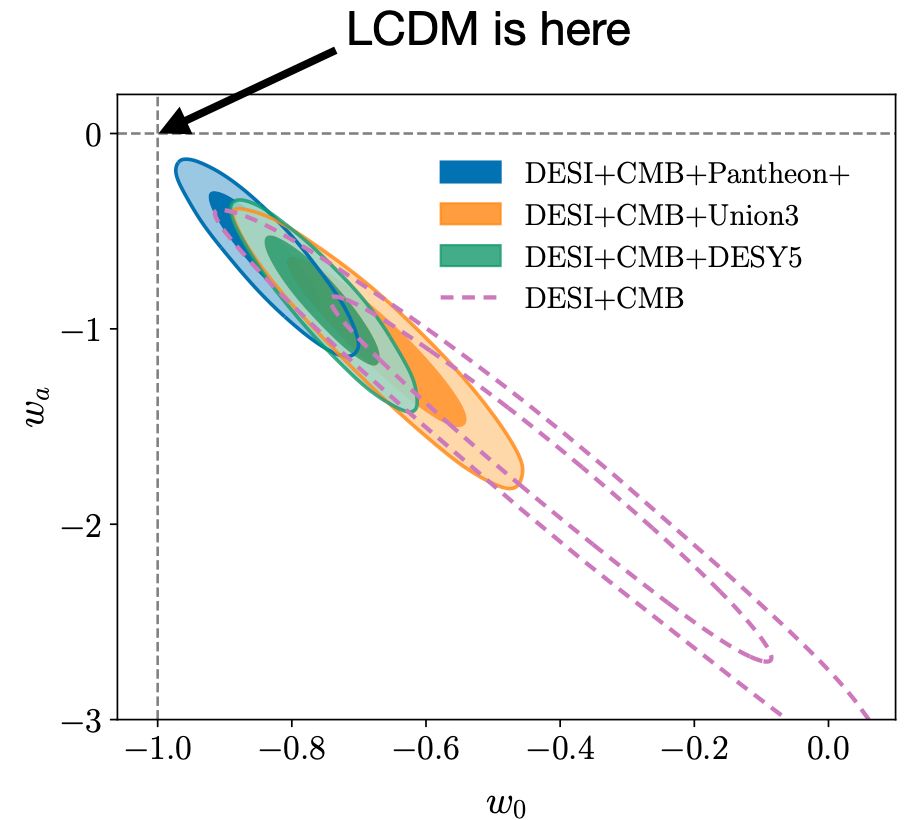
LCDM doesn't seem that robust anymore.
Is it a problem with the model? Is it a problem with the data?
Why does LCDM seem to break in this funny degeneration precisely crossing LCDM?
Interesting times ahead!! Looking forward to new @desisurvey.bsky.social releases.
Credit: @clairelamman.bsky.social
Is it a problem with the model? Is it a problem with the data?
Why does LCDM seem to break in this funny degeneration precisely crossing LCDM?
Interesting times ahead!! Looking forward to new @desisurvey.bsky.social releases.
Credit: @clairelamman.bsky.social

March 20, 2025 at 1:31 AM
LCDM doesn't seem that robust anymore.
Is it a problem with the model? Is it a problem with the data?
Why does LCDM seem to break in this funny degeneration precisely crossing LCDM?
Interesting times ahead!! Looking forward to new @desisurvey.bsky.social releases.
Credit: @clairelamman.bsky.social
Is it a problem with the model? Is it a problem with the data?
Why does LCDM seem to break in this funny degeneration precisely crossing LCDM?
Interesting times ahead!! Looking forward to new @desisurvey.bsky.social releases.
Credit: @clairelamman.bsky.social
7. And finally, neutrinos. Within LCDM the neutrino bound at 95% is on <0.064 eV, but without a peak expected on the negative neutrino masses. Within wowaCDM the 95% bound is on <0.163 eV, but the peak is on the positive side.

March 20, 2025 at 1:24 AM
7. And finally, neutrinos. Within LCDM the neutrino bound at 95% is on <0.064 eV, but without a peak expected on the negative neutrino masses. Within wowaCDM the 95% bound is on <0.163 eV, but the peak is on the positive side.
6. When adding the SNe, the tension rises to 2.8σ if we consider Pantheon+, 3.8σ for Union3, and 4.2σ for DES. However, this tension can be relaxed if z<0.1 SNe (the less homogeneous ones for the DES case) are removed.

March 20, 2025 at 1:22 AM
6. When adding the SNe, the tension rises to 2.8σ if we consider Pantheon+, 3.8σ for Union3, and 4.2σ for DES. However, this tension can be relaxed if z<0.1 SNe (the less homogeneous ones for the DES case) are removed.
5. DESI with the full CMB (w lensing) is in tension with LCDM at 3.1σ when we allow w0-wa to vary. This can be reduced to 2.4σ if lensing and other late-time effects are excluded.

March 20, 2025 at 1:19 AM
5. DESI with the full CMB (w lensing) is in tension with LCDM at 3.1σ when we allow w0-wa to vary. This can be reduced to 2.4σ if lensing and other late-time effects are excluded.
3. As expected, the same H0 tension between direct measurements and inverse-distance ladder (via sound horizon scale) calibration. But....
4. We also find mild-to-strong discrepancy on the Ωm between DESI-BAO and the uncalibrated SNe (depending on the SNe sample)
4. We also find mild-to-strong discrepancy on the Ωm between DESI-BAO and the uncalibrated SNe (depending on the SNe sample)


March 20, 2025 at 1:16 AM
3. As expected, the same H0 tension between direct measurements and inverse-distance ladder (via sound horizon scale) calibration. But....
4. We also find mild-to-strong discrepancy on the Ωm between DESI-BAO and the uncalibrated SNe (depending on the SNe sample)
4. We also find mild-to-strong discrepancy on the Ωm between DESI-BAO and the uncalibrated SNe (depending on the SNe sample)
🔊 New BAO analysis from the 3-year observations (DR2). Long story short, as follows.
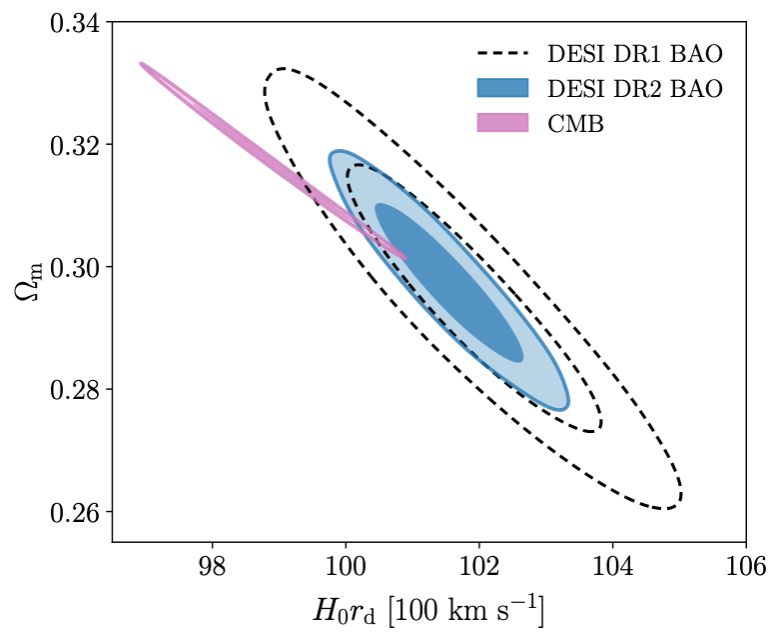
1. DESI alone is consistent with LCDM. 👉 Boring
2. DESI and Planck have a 2.3 discrepancy in Ωm-H0rd plane. 👉Interesting.
1. DESI alone is consistent with LCDM. 👉 Boring
2. DESI and Planck have a 2.3 discrepancy in Ωm-H0rd plane. 👉Interesting.
March 20, 2025 at 1:12 AM
🔊 New BAO analysis from the 3-year observations (DR2). Long story short, as follows.
1. DESI alone is consistent with LCDM. 👉 Boring
2. DESI and Planck have a 2.3 discrepancy in Ωm-H0rd plane. 👉Interesting.
1. DESI alone is consistent with LCDM. 👉 Boring
2. DESI and Planck have a 2.3 discrepancy in Ωm-H0rd plane. 👉Interesting.
A lot of effort has been spent into determining potential systematics. This has only been possible thanks to the invaluable help of the DESI team. Not only for the production of this excellent dataset, but also the many resources in the type of realistic mocks and pipelines.

March 14, 2025 at 8:41 AM
A lot of effort has been spent into determining potential systematics. This has only been possible thanks to the invaluable help of the DESI team. Not only for the production of this excellent dataset, but also the many resources in the type of realistic mocks and pipelines.
Thanks to this extra information brought by the bispectrum signal, we can constrain the isotropic dilation scale, the Alcock-Paczynski parameter, the growth of structure and the shape of the power spectrum with better precision than with the recent power spectrum only analysis. 📐

March 14, 2025 at 8:38 AM
Thanks to this extra information brought by the bispectrum signal, we can constrain the isotropic dilation scale, the Alcock-Paczynski parameter, the growth of structure and the shape of the power spectrum with better precision than with the recent power spectrum only analysis. 📐
🥁Paper Day! Here goes the first bispectrum analysis of the @desisurvey.bsky.social DR1 LRG and QSO data, led by my PhD student Sergi Novell at @icc-ub.bsky.social. In combination with the power spectrum multipoles we measure 150 triangle configurations corresponding to a total volume of 13.1 Gpc3

March 14, 2025 at 8:32 AM
🥁Paper Day! Here goes the first bispectrum analysis of the @desisurvey.bsky.social DR1 LRG and QSO data, led by my PhD student Sergi Novell at @icc-ub.bsky.social. In combination with the power spectrum multipoles we measure 150 triangle configurations corresponding to a total volume of 13.1 Gpc3
Dimecres 26 de Febrer a les 19h parlaré sobre la matèria i l'energia fosca i el paper dels cartografiats de galàxies en la cosmologia actual.
📍Agrupació Astronómica de sabadell.
🕖 19h. Entrada lliure fins a completar l'aforament.
🗣 Idioma castellà.
📍Agrupació Astronómica de sabadell.
🕖 19h. Entrada lliure fins a completar l'aforament.
🗣 Idioma castellà.

February 23, 2025 at 6:52 PM
Dimecres 26 de Febrer a les 19h parlaré sobre la matèria i l'energia fosca i el paper dels cartografiats de galàxies en la cosmologia actual.
📍Agrupació Astronómica de sabadell.
🕖 19h. Entrada lliure fins a completar l'aforament.
🗣 Idioma castellà.
📍Agrupació Astronómica de sabadell.
🕖 19h. Entrada lliure fins a completar l'aforament.
🗣 Idioma castellà.
... and this is just the beginning of @desisurvey ! Stay tuned for new results on the constraints of primordial non-Gaussianties and the year-3 analysis of the BAO signal very soon!

November 21, 2024 at 1:04 PM
... and this is just the beginning of @desisurvey ! Stay tuned for new results on the constraints of primordial non-Gaussianties and the year-3 analysis of the BAO signal very soon!
Last but not least, we improve by 15% the upper bound on the sum of the neutrino masses (within ΛCDM) setting the upper bound to be 0.071 eV at 95% c.l.

November 21, 2024 at 1:03 PM
Last but not least, we improve by 15% the upper bound on the sum of the neutrino masses (within ΛCDM) setting the upper bound to be 0.071 eV at 95% c.l.
There is not much change in terms of dynamical Dark Energy with respect to what was found in BAO. There is still a moderate preference for dynamical DE when DESI is combined with CMB and SNe. This degeneracy slightly pulls Ωm to be higher and σ8 lower with respect to ΛCDM.

November 21, 2024 at 1:03 PM
There is not much change in terms of dynamical Dark Energy with respect to what was found in BAO. There is still a moderate preference for dynamical DE when DESI is combined with CMB and SNe. This degeneracy slightly pulls Ωm to be higher and σ8 lower with respect to ΛCDM.
Another important result is the agreement between the amplitude of dark matter fluctuations, σ8 between DESI results and CMB and DES-Y3 6 x 2 pt. Combining all of them we measure Ωm=0.3009±0.0034, σ8 = 0.8028±0.0047 and h=0.6840±0.0027 in ΛCDM.

November 21, 2024 at 1:02 PM
Another important result is the agreement between the amplitude of dark matter fluctuations, σ8 between DESI results and CMB and DES-Y3 6 x 2 pt. Combining all of them we measure Ωm=0.3009±0.0034, σ8 = 0.8028±0.0047 and h=0.6840±0.0027 in ΛCDM.
With these new results, we can test the prediction of GR on scales that otherwise would not be able to access. We find excellent agreement with the predictions on GR! So again, Einstein is right even on scales of order of magnitude larger than the solar system distances!

November 21, 2024 at 1:02 PM
With these new results, we can test the prediction of GR on scales that otherwise would not be able to access. We find excellent agreement with the predictions on GR! So again, Einstein is right even on scales of order of magnitude larger than the solar system distances!
What is new concerning the previous BAO DR1 results? This time, we get information not only on the expansion history of the universe but also from the growth of cosmic structures throughout the last ten billion years!

November 21, 2024 at 1:01 PM
What is new concerning the previous BAO DR1 results? This time, we get information not only on the expansion history of the universe but also from the growth of cosmic structures throughout the last ten billion years!