



Chelsea E. R. Edwards
@cer-edwards.bsky.social
NRC Postdoctoral Fellow @ NIST Neutron-Condensed Matter Science Group
First NIST paper published! From SAXS or SANS data, we show how to obtain a more accurate Rg as well as a new interaction length scale, Ri. In dilute solution, Ri is directly the MSD of the interparticle potential! And it's model-free: no closure approximation required.
pubs.acs.org/doi/full/10....
pubs.acs.org/doi/full/10....

Low-Q Asymptotic Behavior of the Effective Structure Factor Yields Model-Independent Radius of Interparticle Interaction (Ri)
Guinier analysis has been extensively used in academic and industrial research settings to obtain the model-independent size of a polymer, protein, or colloid in solution from small-angle scattering d...
pubs.acs.org
November 14, 2025 at 1:35 AM
First NIST paper published! From SAXS or SANS data, we show how to obtain a more accurate Rg as well as a new interaction length scale, Ri. In dilute solution, Ri is directly the MSD of the interparticle potential! And it's model-free: no closure approximation required.
pubs.acs.org/doi/full/10....
pubs.acs.org/doi/full/10....
Anyone going to ACS Colloids/IACIS in Canada next week?
I'm giving two talks on Tuesday:
1. Spontaneous core-shell coacervate droplets @ 11:20 in NRE 1-001
2. New(!) on getting interaction information from low-Q scattering, i.e. an extension (correction?) to Guinier analysis @ 14:20 in ECERF W2-010
I'm giving two talks on Tuesday:
1. Spontaneous core-shell coacervate droplets @ 11:20 in NRE 1-001
2. New(!) on getting interaction information from low-Q scattering, i.e. an extension (correction?) to Guinier analysis @ 14:20 in ECERF W2-010
June 19, 2025 at 5:13 PM
Anyone going to ACS Colloids/IACIS in Canada next week?
I'm giving two talks on Tuesday:
1. Spontaneous core-shell coacervate droplets @ 11:20 in NRE 1-001
2. New(!) on getting interaction information from low-Q scattering, i.e. an extension (correction?) to Guinier analysis @ 14:20 in ECERF W2-010
I'm giving two talks on Tuesday:
1. Spontaneous core-shell coacervate droplets @ 11:20 in NRE 1-001
2. New(!) on getting interaction information from low-Q scattering, i.e. an extension (correction?) to Guinier analysis @ 14:20 in ECERF W2-010
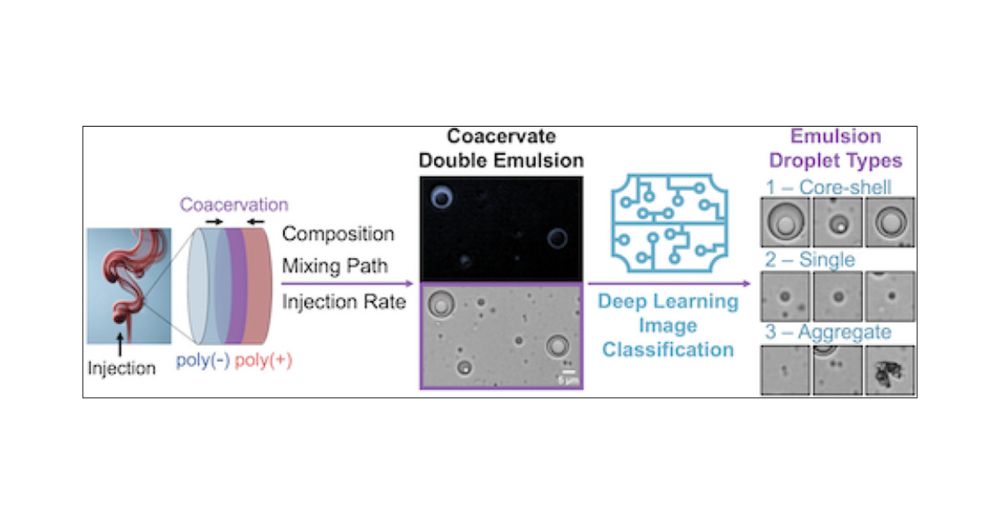
New paper from my PhD with @professor-meh.bsky.social! We show a simple route to all-water multiple emulsions, via coacervation with a single(!) dense phase. Amid size/shape variance, we use ML to quantify trends in droplet structure with mixing condition, which diverge from classical W/O/W systems.
Spontaneous Formation of Core–Shell Microdroplets during Conventional Coacervate Phase Separation
We report the single-step formation and stability of protocell-like, core-shell coacervate droplets comprising a polyelectrolyte-rich shell and a solvent-rich vacuole core from the poly(allylamine hydrochloride) (PAH) and poly(acrylic acid) (PAA) system. These double emulsion (DE) coacervate droplets coexist with single emulsion (SE) droplets, suggesting a kinetic mechanism of formation. We use high-throughput microscopy and machine learning to classify droplet morphologies across various final compositions (polyelectrolyte ratios and salt concentrations) and processing routes (mixing rate and thermodynamic path). We find that DE droplets form preferentially over SE droplets at a wide range of compositions using a slow injection mixing rate. DE droplet formation is enhanced at lower salt (NaCl) levels and near 1:1 charge stoichiometry, showing a preference for polycation excess. DE droplets are stable to the micron scale and retain their core-shell structure even after coalescence. Nevertheless, they are metastable; direct observations of various coarsening phenomena suggest that they are primarily stabilized by the viscoelasticity and high viscosity of the polymer-rich shell. Overall, the scalable, simple mixing process used herein offers a novel mechanism to produce multiphase coacervate droplets that is orthogonal to existing routes, which require either dropwise synthesis or thermodynamic tuning.
pubs.acs.org
March 25, 2025 at 7:21 PM
New paper from my PhD with @professor-meh.bsky.social! We show a simple route to all-water multiple emulsions, via coacervation with a single(!) dense phase. Amid size/shape variance, we use ML to quantify trends in droplet structure with mixing condition, which diverge from classical W/O/W systems.