



Ricardo J Pereira
@biodiversitysmns.bsky.social
Head of Biodiversity Monitoring | SMNS & Univ. of Hohenheim 🌿🪲🔬🧬
Passionate about species formation & persistence in a changing world. 🏃🏻♂️🌍
Committed to mentoring future scientists & engaged citizens. 🎓💡
https://biodiversitysmns.wixsite.com/rpereiralab
Passionate about species formation & persistence in a changing world. 🏃🏻♂️🌍
Committed to mentoring future scientists & engaged citizens. 🎓💡
https://biodiversitysmns.wixsite.com/rpereiralab
Pinned
Hello, BlueSky! 🦋 Excited to reconnect, exchange ideas, and build a collaborative space driven by curiosity and innovation.
We’re launching the Dept. of Biodiversity Monitoring at SMNS!🚀 Using museum & monitoring collections, we study genomic diversity 🧬 and species persistence in a changing world.
We’re launching the Dept. of Biodiversity Monitoring at SMNS!🚀 Using museum & monitoring collections, we study genomic diversity 🧬 and species persistence in a changing world.
Reposted by Ricardo J Pereira

So excited to share our new work out in @evolletters.bsky.social today!
doi.org/10.1093/evle...
Sexual signals and preferences for them often differ across groups, contributing to reproductive isolation. But how do new signals evolve if females already have preferences for existing ones? (1/4)
doi.org/10.1093/evle...
Sexual signals and preferences for them often differ across groups, contributing to reproductive isolation. But how do new signals evolve if females already have preferences for existing ones? (1/4)

How relaxed preferences facilitate the evolution of novel animal signals
Abstract. The evolution of novel animal signals is critical to the generation of biodiversity. Here, we explore how new sexual signals become established.
doi.org
December 8, 2025 at 6:33 PM
So excited to share our new work out in @evolletters.bsky.social today!
doi.org/10.1093/evle...
Sexual signals and preferences for them often differ across groups, contributing to reproductive isolation. But how do new signals evolve if females already have preferences for existing ones? (1/4)
doi.org/10.1093/evle...
Sexual signals and preferences for them often differ across groups, contributing to reproductive isolation. But how do new signals evolve if females already have preferences for existing ones? (1/4)
Reposted by Ricardo J Pereira

Accurate Runs of Homozygosity Estimation From Low Coverage Genome Sequences in Non-Model Species
#popgen #consgen
doi.org/10.1111/1755...
#popgen #consgen
doi.org/10.1111/1755...

Accurate Runs of Homozygosity Estimation From Low Coverage Genome Sequences in Non‐Model Species
Runs of homozygosity (ROH) are increasingly being analysed using whole genome sequences in non-model species as a measure of inbreeding and to assess demographic history, thus providing useful inform...
doi.org
December 7, 2025 at 7:32 AM
Accurate Runs of Homozygosity Estimation From Low Coverage Genome Sequences in Non-Model Species
#popgen #consgen
doi.org/10.1111/1755...
#popgen #consgen
doi.org/10.1111/1755...
Reposted by Ricardo J Pereira

When colonizing a new habitat, organisms adapt to maximize their reproductive success via #LifeHistory #evolution. @ecoevodevolab.bsky.social @cbank.bsky.social show that life history evolution facilitates niche diversification across a range of theoretical models @plosbiology.org 🧪 plos.io/4p7YT0a

November 13, 2025 at 1:55 PM
When colonizing a new habitat, organisms adapt to maximize their reproductive success via #LifeHistory #evolution. @ecoevodevolab.bsky.social @cbank.bsky.social show that life history evolution facilitates niche diversification across a range of theoretical models @plosbiology.org 🧪 plos.io/4p7YT0a
Reposted by Ricardo J Pereira

Excited to share our latest preprint!
@mheuertz.bsky.social & I just completed a review covering methods and empirical studies on adaptive introgression in a climate context.
We likely missed a few refs & ideas, so your feedback is highly welcome (ideally by email)!
Preprint➡️ doi.org/10.32942/X2B...
@mheuertz.bsky.social & I just completed a review covering methods and empirical studies on adaptive introgression in a climate context.
We likely missed a few refs & ideas, so your feedback is highly welcome (ideally by email)!
Preprint➡️ doi.org/10.32942/X2B...

November 28, 2025 at 5:14 AM
Excited to share our latest preprint!
@mheuertz.bsky.social & I just completed a review covering methods and empirical studies on adaptive introgression in a climate context.
We likely missed a few refs & ideas, so your feedback is highly welcome (ideally by email)!
Preprint➡️ doi.org/10.32942/X2B...
@mheuertz.bsky.social & I just completed a review covering methods and empirical studies on adaptive introgression in a climate context.
We likely missed a few refs & ideas, so your feedback is highly welcome (ideally by email)!
Preprint➡️ doi.org/10.32942/X2B...
Reposted by Ricardo J Pereira

(1/5)Thrilled to announce our paper on #ProjectPsyche is out! 🦋We describe how we’ve generated 1000+ high-quality genomes for European Lepidoptera, providing an unprecedented resource for biodiversity, conservation, and evolutionary research.
#Genomics #Biodiversity
www.cell.com/trends/ecolo...
#Genomics #Biodiversity
www.cell.com/trends/ecolo...

Project Psyche: reference genomes for all Lepidoptera in Europe
Project Psyche is a transnational initiative to generate and study chromosome-level
reference genomes of all ~11 000 species of Lepidoptera (butterflies and moths) found
in Europe. Here, we describe t...
www.cell.com
November 27, 2025 at 1:22 PM
(1/5)Thrilled to announce our paper on #ProjectPsyche is out! 🦋We describe how we’ve generated 1000+ high-quality genomes for European Lepidoptera, providing an unprecedented resource for biodiversity, conservation, and evolutionary research.
#Genomics #Biodiversity
www.cell.com/trends/ecolo...
#Genomics #Biodiversity
www.cell.com/trends/ecolo...
Join today our online colloquium to learn about the evolution of feather like structures 250 millions ago, before dinosaurs were around! @kombiota.bsky.social

#SaveTheDate: Research Colloquium: The wonder reptile Mirasaura and the Reptile Revolution of the Triassic
by Dr Stephan Spiekman
Tuesday | 25.11.2025 | 16:00
Join the talk in person at the Museum am Löwentor or online: https://t1p.de/sq0m6
by Dr Stephan Spiekman
Tuesday | 25.11.2025 | 16:00
Join the talk in person at the Museum am Löwentor or online: https://t1p.de/sq0m6

November 25, 2025 at 7:26 AM
Join today our online colloquium to learn about the evolution of feather like structures 250 millions ago, before dinosaurs were around! @kombiota.bsky.social
Reposted by Ricardo J Pereira

Latest work out today in @currentbiology.bsky.social
We find the fly development gene bicoid is much older than previously thought (~20 million yrs older!) 🪰🧬
To pinpoint its origins we tackled the Diptera phylogeny, providing some resolution (many open questions remain).
🔗 tinyurl.com/2vyuevpy
We find the fly development gene bicoid is much older than previously thought (~20 million yrs older!) 🪰🧬
To pinpoint its origins we tackled the Diptera phylogeny, providing some resolution (many open questions remain).
🔗 tinyurl.com/2vyuevpy
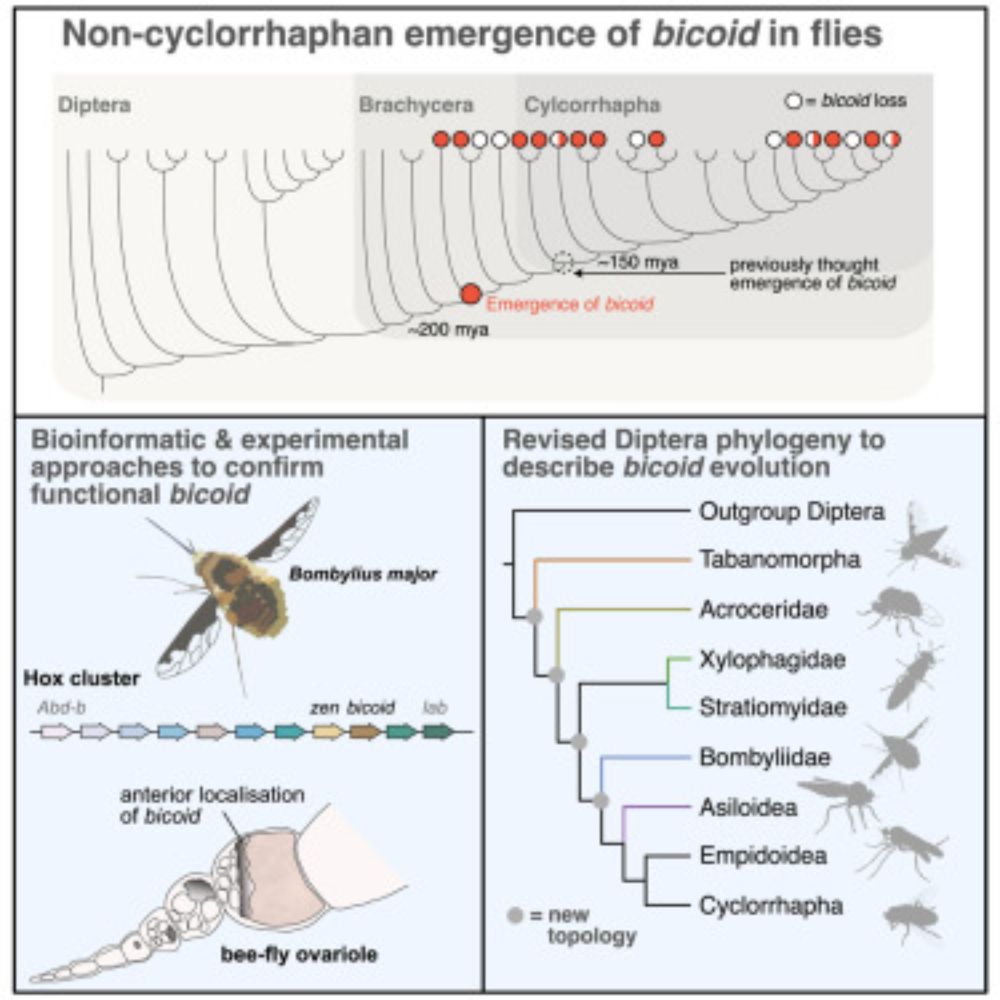
Revised evolutionary relationships within Brachycera and the early origin of bicoid in flies
Mulhair et al. uncover a functional bicoid in non-cyclorrhaphan flies, pushing the
gene's origin back by ∼20 million years. Reassessing the Diptera phylogeny using the
largest dataset to date permits ...
www.cell.com
October 17, 2025 at 3:14 PM
Latest work out today in @currentbiology.bsky.social
We find the fly development gene bicoid is much older than previously thought (~20 million yrs older!) 🪰🧬
To pinpoint its origins we tackled the Diptera phylogeny, providing some resolution (many open questions remain).
🔗 tinyurl.com/2vyuevpy
We find the fly development gene bicoid is much older than previously thought (~20 million yrs older!) 🪰🧬
To pinpoint its origins we tackled the Diptera phylogeny, providing some resolution (many open questions remain).
🔗 tinyurl.com/2vyuevpy
Reposted by Ricardo J Pereira

Every year #ESEB distinguishes a young evolutionary biologist with the John Maynard Smith Prize! Nominations for the 2026 prize are due by January 15th!
Find out more here: eseb.org/prizes-fundi...
Find out more here: eseb.org/prizes-fundi...

November 11, 2025 at 10:50 AM
Every year #ESEB distinguishes a young evolutionary biologist with the John Maynard Smith Prize! Nominations for the 2026 prize are due by January 15th!
Find out more here: eseb.org/prizes-fundi...
Find out more here: eseb.org/prizes-fundi...
Reposted by Ricardo J Pereira

Interested in the evolution of human language? Check out our new paper in @science.org where we synthesize latest findings and outline a multifaceted, bio-cultural approach for studying how language evolved. Super proud of this work, and hoping it leads to exciting new research! tinyurl.com/ykacvanp
November 21, 2025 at 9:47 AM
Interested in the evolution of human language? Check out our new paper in @science.org where we synthesize latest findings and outline a multifaceted, bio-cultural approach for studying how language evolved. Super proud of this work, and hoping it leads to exciting new research! tinyurl.com/ykacvanp
Reposted by Ricardo J Pereira

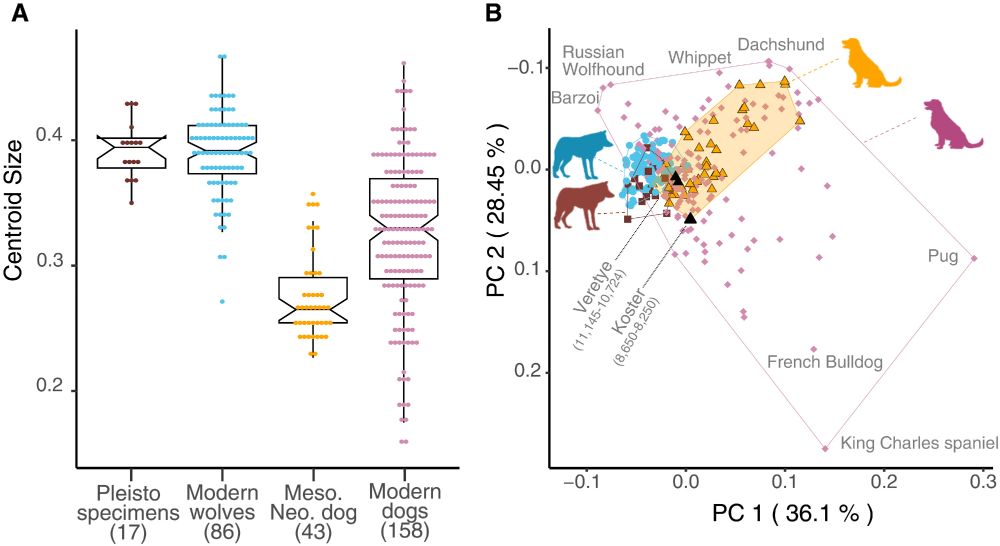
The emergence and diversification of dog morphology 🏺🧪
www.science.org/doi/10.1126/...
This study looked at more than 640 canid crania over the past 50,000 years (see the Perspective by Fillios) and found that by the beginning of the Holocene, dogs already displayed extensive variation.
www.science.org/doi/10.1126/...
This study looked at more than 640 canid crania over the past 50,000 years (see the Perspective by Fillios) and found that by the beginning of the Holocene, dogs already displayed extensive variation.
November 21, 2025 at 5:30 PM
The emergence and diversification of dog morphology 🏺🧪
www.science.org/doi/10.1126/...
This study looked at more than 640 canid crania over the past 50,000 years (see the Perspective by Fillios) and found that by the beginning of the Holocene, dogs already displayed extensive variation.
www.science.org/doi/10.1126/...
This study looked at more than 640 canid crania over the past 50,000 years (see the Perspective by Fillios) and found that by the beginning of the Holocene, dogs already displayed extensive variation.
Reposted by Ricardo J Pereira

We have a proper picture! Thanks @stephanspiekman.bsky.social and the rest that doesn’t have a BlueSky handle

November 14, 2025 at 9:56 PM
We have a proper picture! Thanks @stephanspiekman.bsky.social and the rest that doesn’t have a BlueSky handle
Reposted by Ricardo J Pereira

As human groups migrated and settled across Holocene Eurasia, dogs often traveled with them and were sometimes traded among populations, researchers report in Science. The results reveal the integral role these animals played in culture and exchange. https://scim.ag/4peI4kl

Genomic evidence for the Holocene codispersal of dogs and humans across Eastern Eurasia
As the first domestic species, dogs likely dispersed with different cultural groups during the Late Pleistocene and Holocene. To test this hypothesis, we analyzed 73 ancient dog genomes, including 17 ...
scim.ag
November 13, 2025 at 9:58 PM
As human groups migrated and settled across Holocene Eurasia, dogs often traveled with them and were sometimes traded among populations, researchers report in Science. The results reveal the integral role these animals played in culture and exchange. https://scim.ag/4peI4kl
Reposted by Ricardo J Pereira

Interesting paper by Andra Meneganzin and Chris
Stringer about whether you and I are different species (n.b. I am a neanderthal). doi.org/10.1093/evol...
Stringer about whether you and I are different species (n.b. I am a neanderthal). doi.org/10.1093/evol...

November 14, 2025 at 12:08 AM
Interesting paper by Andra Meneganzin and Chris
Stringer about whether you and I are different species (n.b. I am a neanderthal). doi.org/10.1093/evol...
Stringer about whether you and I are different species (n.b. I am a neanderthal). doi.org/10.1093/evol...
Reposted by Ricardo J Pereira
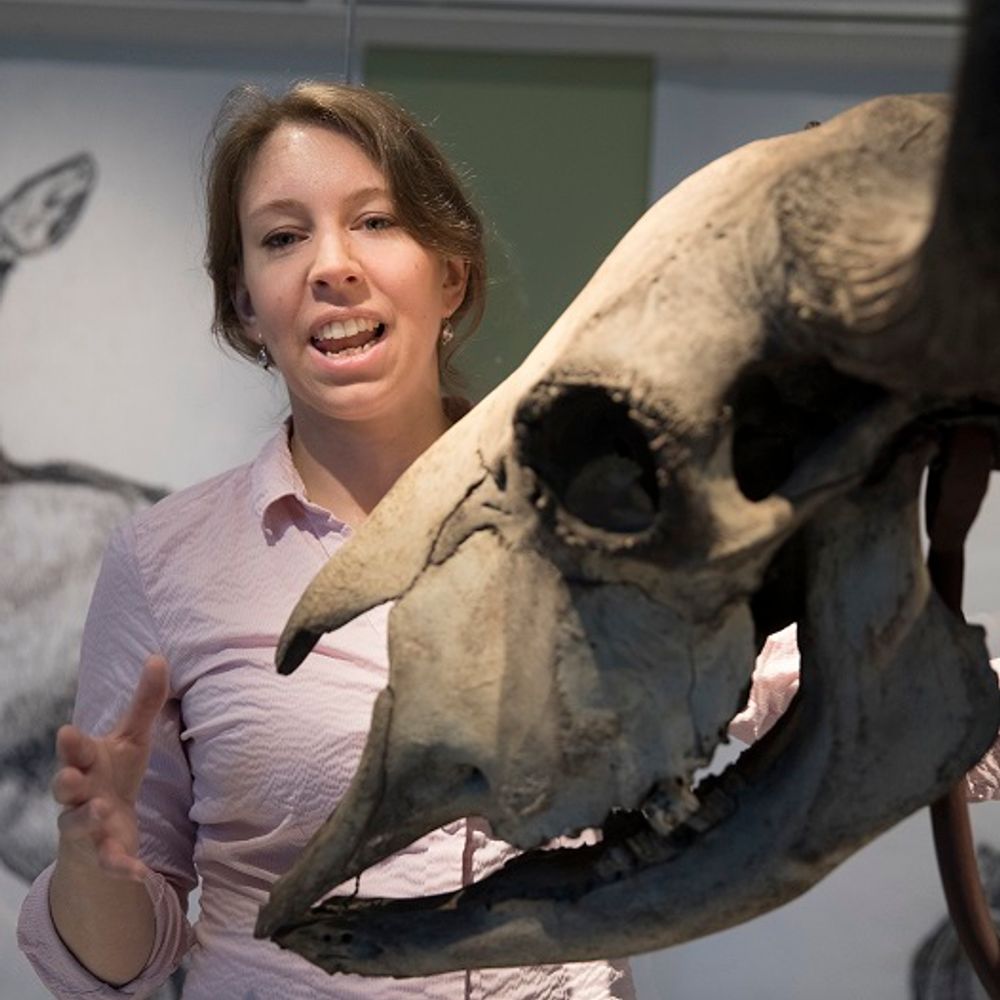
They are now published: the results of a study I contributed to when I was recently employed as an antiquarian at Lund University’s Historical Museum!
The emergence and diversification of #dog #morphology | Science www.science.org/doi/10.1126/...
The emergence and diversification of #dog #morphology | Science www.science.org/doi/10.1126/...

The emergence and diversification of dog morphology
Dogs exhibit an exceptional range of morphological diversity as a result of their long-term association with humans. Attempts to identify when dog morphological variation began to expand have been con...
www.science.org
November 14, 2025 at 5:46 AM
They are now published: the results of a study I contributed to when I was recently employed as an antiquarian at Lund University’s Historical Museum!
The emergence and diversification of #dog #morphology | Science www.science.org/doi/10.1126/...
The emergence and diversification of #dog #morphology | Science www.science.org/doi/10.1126/...
Reposted by Ricardo J Pereira

My department at UT Austin is looking to hire an Assistant Professor in Evolutionary Biology, broadly defined. Feel free to reach out to me with any questions you may have.
apply.interfolio.com/177547
apply.interfolio.com/177547
Apply - Interfolio
{{$ctrl.$state.data.pageTitle}} - Apply - Interfolio
apply.interfolio.com
November 13, 2025 at 3:23 PM
My department at UT Austin is looking to hire an Assistant Professor in Evolutionary Biology, broadly defined. Feel free to reach out to me with any questions you may have.
apply.interfolio.com/177547
apply.interfolio.com/177547
Reposted by Ricardo J Pereira

Congratulations to Joe Felsenstein on being awarded the 2026 Mendel Medal!

November 14, 2025 at 12:41 PM
Congratulations to Joe Felsenstein on being awarded the 2026 Mendel Medal!
Reposted by Ricardo J Pereira

Three German universities offering post-docs for researchers "who cannot conduct or continue their work in the USA appropriately because of actual political pressure. "
www.uni-konstanz.de/zukunftskoll...
www.uni-konstanz.de/zukunftskoll...
Early Career Rescue Fellowship
www.uni-konstanz.de
November 11, 2025 at 7:10 PM
Three German universities offering post-docs for researchers "who cannot conduct or continue their work in the USA appropriately because of actual political pressure. "
www.uni-konstanz.de/zukunftskoll...
www.uni-konstanz.de/zukunftskoll...
Reposted by Ricardo J Pereira

PhD position available in evolutionary genomics/bioinformatics (hoehnalab.github.io/job_adverts/...). Topic: analyzing gene expression evolution across several firefly species and linking expression changes to genomic architecture. The position is jointly supervised with @anaevolcatalan.bsky.social
hoehnalab.github.io
November 11, 2025 at 9:00 AM
PhD position available in evolutionary genomics/bioinformatics (hoehnalab.github.io/job_adverts/...). Topic: analyzing gene expression evolution across several firefly species and linking expression changes to genomic architecture. The position is jointly supervised with @anaevolcatalan.bsky.social
Reposted by Ricardo J Pereira
Please drop me a line is you are interested to work in my lab and are eligible for the CSC funding!
We are looking for candidates interested in (and eligible for) CSC-funded PhD positions, for the project " AI-powered system to monitor biodiversity and study behaviour of key wild pollinators"
www.findaphd.com/phds/project...
Please contact Lena by email for informal enquiries.
www.findaphd.com/phds/project...
Please contact Lena by email for informal enquiries.
November 11, 2025 at 9:03 PM
Please drop me a line is you are interested to work in my lab and are eligible for the CSC funding!
Reposted by Ricardo J Pereira

Common and Oriental cuckoos sneak their eggs into other birds’ nests.
Common cuckoos parasitize over 100 host species, fueling an evolutionary arms race: hosts are under pressure to detect foreign eggs, while cuckoos refine their mimicry to escape detection. 2/6
Common cuckoos parasitize over 100 host species, fueling an evolutionary arms race: hosts are under pressure to detect foreign eggs, while cuckoos refine their mimicry to escape detection. 2/6

October 30, 2025 at 7:15 PM
Common and Oriental cuckoos sneak their eggs into other birds’ nests.
Common cuckoos parasitize over 100 host species, fueling an evolutionary arms race: hosts are under pressure to detect foreign eggs, while cuckoos refine their mimicry to escape detection. 2/6
Common cuckoos parasitize over 100 host species, fueling an evolutionary arms race: hosts are under pressure to detect foreign eggs, while cuckoos refine their mimicry to escape detection. 2/6
Reposted by Ricardo J Pereira

What do you think has been on Earth longer - sharks or trees?
You might think trees have been around for a long time, but sharks have been here even longer!
See how sharks have survived and thrived through all five of Earth’s mass extinction events in this week’s Surprising Science.
You might think trees have been around for a long time, but sharks have been here even longer!
See how sharks have survived and thrived through all five of Earth’s mass extinction events in this week’s Surprising Science.
November 9, 2025 at 10:39 AM
What do you think has been on Earth longer - sharks or trees?
You might think trees have been around for a long time, but sharks have been here even longer!
See how sharks have survived and thrived through all five of Earth’s mass extinction events in this week’s Surprising Science.
You might think trees have been around for a long time, but sharks have been here even longer!
See how sharks have survived and thrived through all five of Earth’s mass extinction events in this week’s Surprising Science.
Reposted by Ricardo J Pereira

How time, climate, and storage shape DNA survival in herbarium specimens - and why plants from the tropics face tougher odds 🌿🧬
#AncientDNA
www.biorxiv.org/content/10.1...
#AncientDNA
www.biorxiv.org/content/10.1...

November 4, 2025 at 8:32 PM
How time, climate, and storage shape DNA survival in herbarium specimens - and why plants from the tropics face tougher odds 🌿🧬
#AncientDNA
www.biorxiv.org/content/10.1...
#AncientDNA
www.biorxiv.org/content/10.1...
Reposted by Ricardo J Pereira

Radar technology has been around for decades, used to track & predict weather. Now scientists have made a breakthrough using it to monitor insects - paving the way for cost effective biodiversity tracking across huge areas @katatrepsis.bsky.social @ncas-uk.bsky.social www.leeds.ac.uk/news/article...

Trillions of insects fly above us - weather radar reveals alarming declines
Scientists have made a breakthrough in monitoring insect populations across the UK using an unexpected tool: weather radar.
www.leeds.ac.uk
November 3, 2025 at 12:54 PM
Radar technology has been around for decades, used to track & predict weather. Now scientists have made a breakthrough using it to monitor insects - paving the way for cost effective biodiversity tracking across huge areas @katatrepsis.bsky.social @ncas-uk.bsky.social www.leeds.ac.uk/news/article...
Reposted by Ricardo J Pereira

My awesome grad student Shashank and I wrote this paper trying to look at broader patterns of HT in TEs. HT is happening everywhere! DNA transposons jump further than other classes! www.biorxiv.org/content/10.1...

Recent horizontal transfer of transposable elements in Drosophila
Transposable elements (TEs) are genetic elements also known as "jumping genes" that increase their copy numbers within a host through various mechanisms of transposition. TEs can also move between spe...
www.biorxiv.org
October 31, 2025 at 3:58 PM
My awesome grad student Shashank and I wrote this paper trying to look at broader patterns of HT in TEs. HT is happening everywhere! DNA transposons jump further than other classes! www.biorxiv.org/content/10.1...
Reposted by Ricardo J Pereira

Gelechioidea, that superdiverse superfamily of Lepidoptera that has been a super mess taxonomically, finally gets some structure at the family level with phylogenomics! Read all about it in our article led by PhD student @etkayapar.bsky.social !
resjournals.onlinelibrary.wiley.com/doi/10.1111/...
resjournals.onlinelibrary.wiley.com/doi/10.1111/...

Integrating Sanger and next‐generation sequencing data sheds light on phylogenetic relationships among gelechioid moths (Lepidoptera: Gelechioidea)
The maximum-likelihood analysis of a phylogenomic dataset of 1767 protein-coding genes from 57 ingroup taxa yields a robust family-level topology for Gelechioidea, revealing novel among-family relat...
resjournals.onlinelibrary.wiley.com
October 30, 2025 at 12:44 PM
Gelechioidea, that superdiverse superfamily of Lepidoptera that has been a super mess taxonomically, finally gets some structure at the family level with phylogenomics! Read all about it in our article led by PhD student @etkayapar.bsky.social !
resjournals.onlinelibrary.wiley.com/doi/10.1111/...
resjournals.onlinelibrary.wiley.com/doi/10.1111/...