



Luca Barlassina
@barlassina.bsky.social
Philosopher of mind/cognition.
Senior Lecturer; University of Sheffield.
lucabarlassina.org
Senior Lecturer; University of Sheffield.
lucabarlassina.org
Reposted by Luca Barlassina

This is a big one! A 4-year writing project over many timezones, arguing for a reimagining of the influential "core knowledge" thesis.
Led by @daweibai.bsky.social, we argue that much of our innate knowledge of the world is not "conceptual" in nature, but rather wired into perceptual processing. 👇
Led by @daweibai.bsky.social, we argue that much of our innate knowledge of the world is not "conceptual" in nature, but rather wired into perceptual processing. 👇

October 9, 2025 at 4:31 PM
This is a big one! A 4-year writing project over many timezones, arguing for a reimagining of the influential "core knowledge" thesis.
Led by @daweibai.bsky.social, we argue that much of our innate knowledge of the world is not "conceptual" in nature, but rather wired into perceptual processing. 👇
Led by @daweibai.bsky.social, we argue that much of our innate knowledge of the world is not "conceptual" in nature, but rather wired into perceptual processing. 👇
Reposted by Luca Barlassina
On the left is a rabbit. On the right is an elephant. But guess what: They’re the *same image*, rotated 90°!
In @currentbiology.bsky.social, @chazfirestone.bsky.social & I show how these images—known as “visual anagrams”—can help solve a longstanding problem in cognitive science. bit.ly/45BVnCZ
In @currentbiology.bsky.social, @chazfirestone.bsky.social & I show how these images—known as “visual anagrams”—can help solve a longstanding problem in cognitive science. bit.ly/45BVnCZ
August 19, 2025 at 4:32 PM
On the left is a rabbit. On the right is an elephant. But guess what: They’re the *same image*, rotated 90°!
In @currentbiology.bsky.social, @chazfirestone.bsky.social & I show how these images—known as “visual anagrams”—can help solve a longstanding problem in cognitive science. bit.ly/45BVnCZ
In @currentbiology.bsky.social, @chazfirestone.bsky.social & I show how these images—known as “visual anagrams”—can help solve a longstanding problem in cognitive science. bit.ly/45BVnCZ
Reposted by Luca Barlassina

My paper with @stellalourenco.bsky.social is now out in Science Advances!
We found that children have robust object recognition abilities that surpass many ANNs. Models only outperformed kids when their training far exceeded what a child could experience in their lifetime
doi.org/10.1126/scia...
We found that children have robust object recognition abilities that surpass many ANNs. Models only outperformed kids when their training far exceeded what a child could experience in their lifetime
doi.org/10.1126/scia...
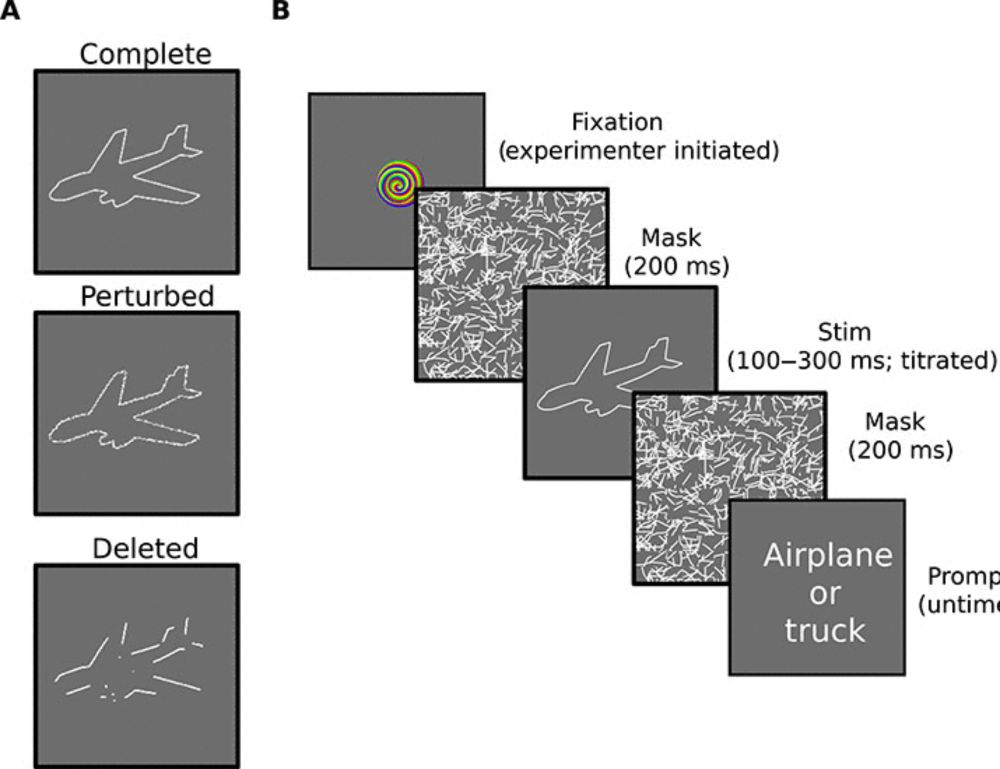
Fast and robust visual object recognition in young children
The visual recognition abilities of preschool children rival those of state-of-the-art artificial intelligence models.
doi.org
July 2, 2025 at 7:38 PM
My paper with @stellalourenco.bsky.social is now out in Science Advances!
We found that children have robust object recognition abilities that surpass many ANNs. Models only outperformed kids when their training far exceeded what a child could experience in their lifetime
doi.org/10.1126/scia...
We found that children have robust object recognition abilities that surpass many ANNs. Models only outperformed kids when their training far exceeded what a child could experience in their lifetime
doi.org/10.1126/scia...
Reposted by Luca Barlassina
How is valence computed in the brain? Check out our new preprint about a single cell that integrates excitatory and inhibitory input across modalities according to valence and impacts behavioral decisions. An exciting collaboration across many labs. Enjoy reading!
www.biorxiv.org/content/10.1...
www.biorxiv.org/content/10.1...

A multisensory, bidirectional, valence encoder guides behavioral decisions
A key function of the brain is to categorize sensory cues as repulsive or attractive and respond accordingly. While we have some understanding of how sensory information is processed in the sensory pe...
www.biorxiv.org
September 27, 2025 at 5:46 AM
How is valence computed in the brain? Check out our new preprint about a single cell that integrates excitatory and inhibitory input across modalities according to valence and impacts behavioral decisions. An exciting collaboration across many labs. Enjoy reading!
www.biorxiv.org/content/10.1...
www.biorxiv.org/content/10.1...
Reposted by Luca Barlassina
🌟From Nicolò Cesana-Arlotti, Sofia Jáuregui, Peter Mazalik, Shaun Nichols & Justin Halberda:
Logical concepts of (im)possibility guide young children's decision-making
Logical concepts of (im)possibility guide young children's decision-making

Logical Concepts of (Im)possibility Guide Young Children's Decision‐Making
The human capacity for rational decisions hinges on modal judgment: the discernment of what could, has to, or cannot happen. This ability was proposed to be a late outcome of human cognitive develop.....
doi.org
September 9, 2025 at 1:38 PM
🌟From Nicolò Cesana-Arlotti, Sofia Jáuregui, Peter Mazalik, Shaun Nichols & Justin Halberda:
Logical concepts of (im)possibility guide young children's decision-making
Logical concepts of (im)possibility guide young children's decision-making
Reposted by Luca Barlassina

Wild orangutans feast on fruit to prepare metabolically for famine, according to a new field-based study in #ScienceAdvances. https://scim.ag/3UQdXm0
August 29, 2025 at 6:31 PM
Wild orangutans feast on fruit to prepare metabolically for famine, according to a new field-based study in #ScienceAdvances. https://scim.ag/3UQdXm0
Reposted by Luca Barlassina
How much does the environment we’re raised in change how we see the world? Wonderful piece in @sciam.bsky.social by @norabradford.bsky.social, ft. an interview with @dorsaamir.bsky.social about our work on the 'cultural byproduct hypothesis'.
www.scientificamerican.com/article/does...
www.scientificamerican.com/article/does...

Why a Classic Psychology Theory about Vision Has Fallen Apart
The downfall of a long-standing theory in psychology raises a question: How much does the environment we’re raised in change how we literally see the world?
www.scientificamerican.com
August 22, 2025 at 5:06 PM
How much does the environment we’re raised in change how we see the world? Wonderful piece in @sciam.bsky.social by @norabradford.bsky.social, ft. an interview with @dorsaamir.bsky.social about our work on the 'cultural byproduct hypothesis'.
www.scientificamerican.com/article/does...
www.scientificamerican.com/article/does...
Reposted by Luca Barlassina

When an animals' groupmates go out of sight, do they also go out of mind?
In a new paper in Proc B @royalsocietypublishing.org, Luz Carvajal and I show that a bonobo (Kanzi) can keep mental tabs on the whereabouts of multiple hidden social partners
royalsocietypublishing.org/eprint/4GI7G...
In a new paper in Proc B @royalsocietypublishing.org, Luz Carvajal and I show that a bonobo (Kanzi) can keep mental tabs on the whereabouts of multiple hidden social partners
royalsocietypublishing.org/eprint/4GI7G...

Mental representation of the locations and identities of multiple hidden agents or objects by a bonobo | Proceedings of the Royal Society B: Biological Sciences
Humans are adept at navigating the social world in part because we flexibly map the
locations and identities of agents around us. While field studies suggest primates
can track individual conspecifics...
royalsocietypublishing.org
August 20, 2025 at 7:25 PM
When an animals' groupmates go out of sight, do they also go out of mind?
In a new paper in Proc B @royalsocietypublishing.org, Luz Carvajal and I show that a bonobo (Kanzi) can keep mental tabs on the whereabouts of multiple hidden social partners
royalsocietypublishing.org/eprint/4GI7G...
In a new paper in Proc B @royalsocietypublishing.org, Luz Carvajal and I show that a bonobo (Kanzi) can keep mental tabs on the whereabouts of multiple hidden social partners
royalsocietypublishing.org/eprint/4GI7G...
Reposted by Luca Barlassina

The fact that the thing we're calling artificial intelligence *can't do math* and yet we're jamming it into programs that successfully *have done math* for decades, then warning people against using the AI to do math, seems like an excellent summary of where we are.

Good thing no one uses Microsoft Excel for anything related to legal, regulatory or compliance business functions
www.theverge.com/news/761338/...
www.theverge.com/news/761338/...

August 19, 2025 at 6:09 PM
The fact that the thing we're calling artificial intelligence *can't do math* and yet we're jamming it into programs that successfully *have done math* for decades, then warning people against using the AI to do math, seems like an excellent summary of where we are.
Reposted by Luca Barlassina

my review 'core systems of music perception' is on the cover of TICS this month (algorithmic art by @kennyvaden.bsky.social)
www.cell.com/trends/cogni...
www.cell.com/trends/cogni...

August 5, 2025 at 5:44 PM
my review 'core systems of music perception' is on the cover of TICS this month (algorithmic art by @kennyvaden.bsky.social)
www.cell.com/trends/cogni...
www.cell.com/trends/cogni...
Evidence of mood states in reptiles | Animal Cognition
share.google/fi900djWYTjX...
share.google/fi900djWYTjX...

Evidence of mood states in reptiles - Animal Cognition
There is increasing evidence that non-human animals experience ‘free-floating’ mood states, but such evidence is lacking in reptiles, hindering the debate as to their affective capacity and with subse...
share.google
July 9, 2025 at 6:51 PM
Evidence of mood states in reptiles | Animal Cognition
share.google/fi900djWYTjX...
share.google/fi900djWYTjX...
Reposted by Luca Barlassina

A key takeaway from 20+ years of computational RL is: model-free=automatic, model-based=deliberate. My new paper w/ @benedek.bsky.social challenges this view, suggesting that MB algos are more ubiquitous, & automatic processing more sophisticated, than currently thought: www.pnas.org/doi/10.1073/...
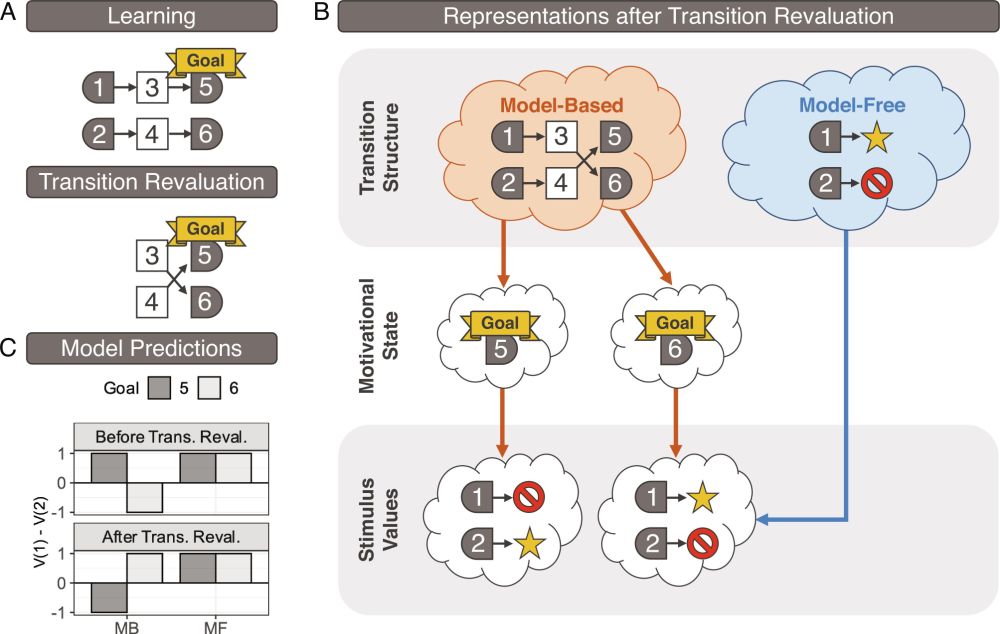
Model-based algorithms shape automatic evaluative processing | PNAS
Computational theories of reinforcement learning suggest that two families of algorithm—model-based
and model-free—tightly map onto the classic dis...
www.pnas.org
June 21, 2025 at 1:41 AM
A key takeaway from 20+ years of computational RL is: model-free=automatic, model-based=deliberate. My new paper w/ @benedek.bsky.social challenges this view, suggesting that MB algos are more ubiquitous, & automatic processing more sophisticated, than currently thought: www.pnas.org/doi/10.1073/...
Reposted by Luca Barlassina
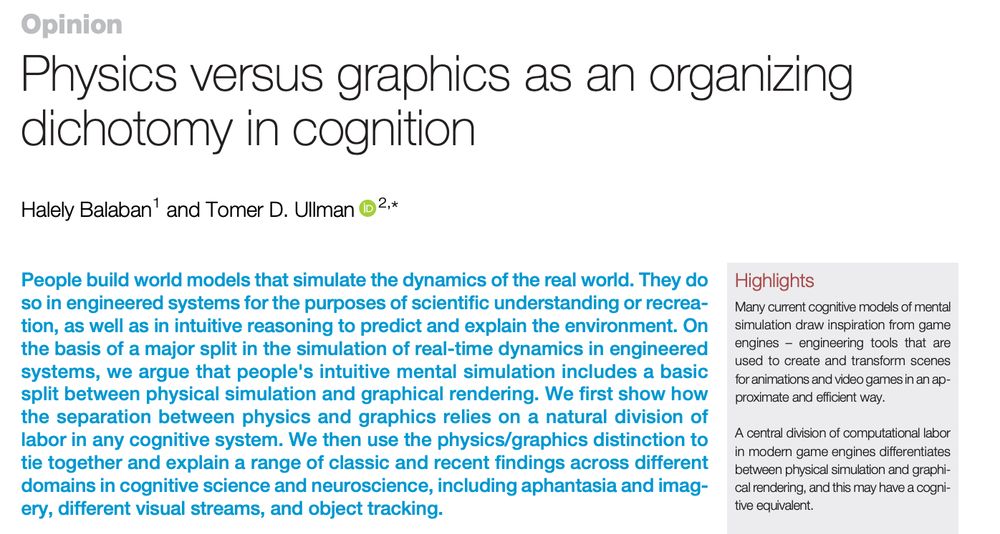
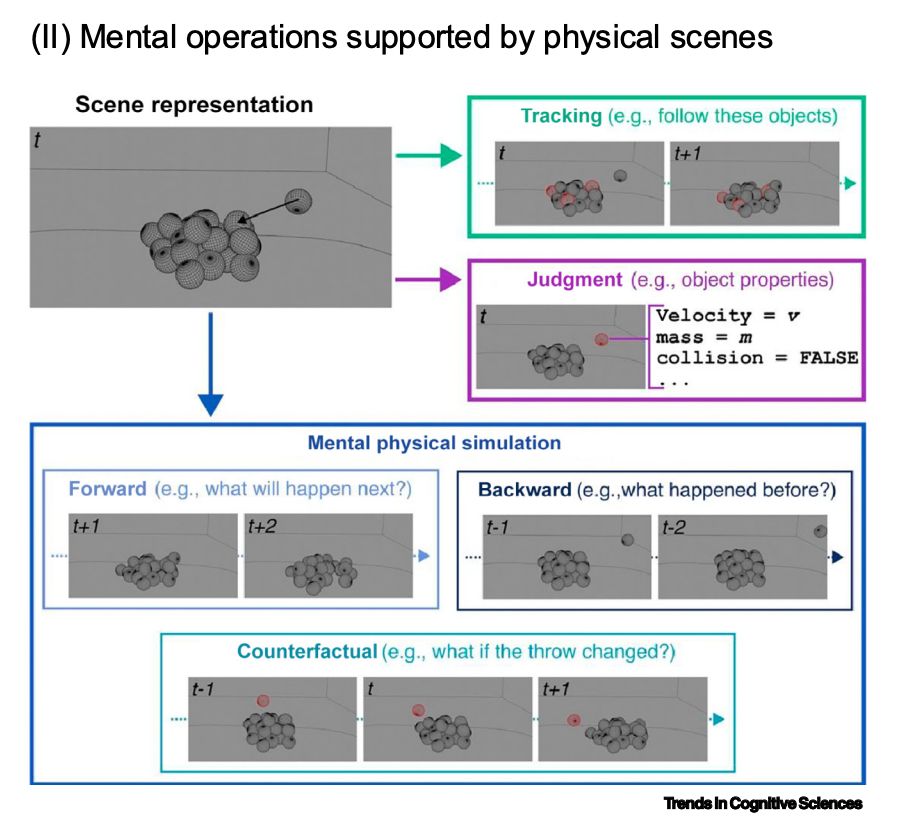
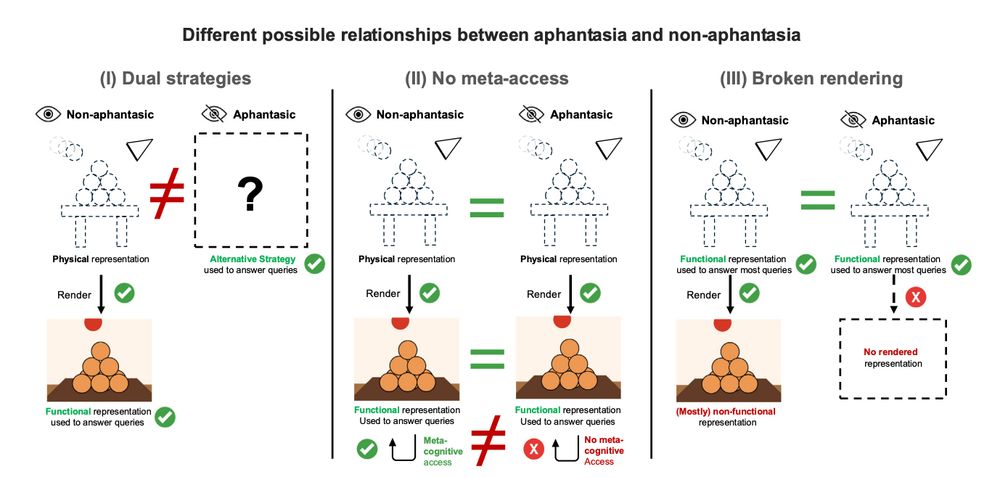
Out now in TiCS, something i've been thinking about a lot:
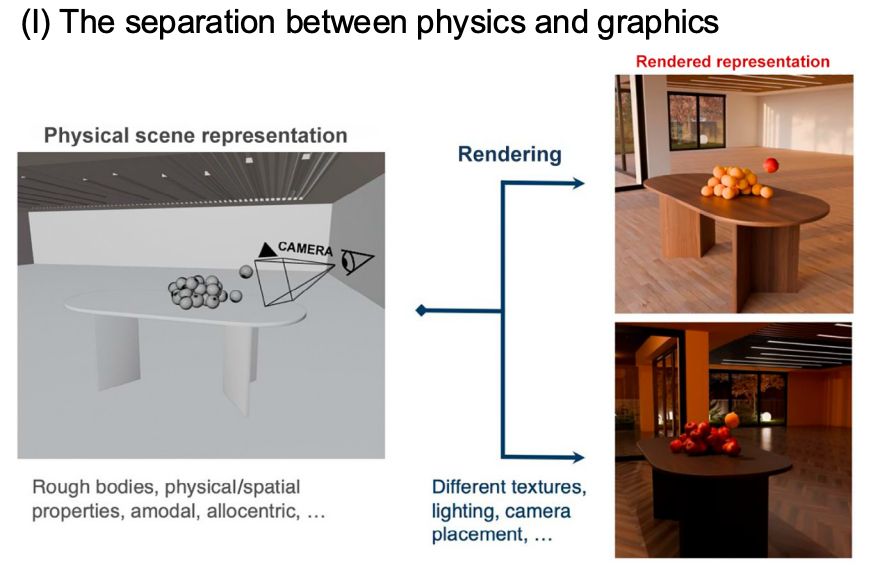
"Physics vs. graphics as an organizing dichotomy in cognition"
(by Balaban & me)
relevant for many people, related to imagination, intuitive physics, mental simulation, aphantasia, and more
authors.elsevier.com/a/1lBaC4sIRv...
"Physics vs. graphics as an organizing dichotomy in cognition"
(by Balaban & me)
relevant for many people, related to imagination, intuitive physics, mental simulation, aphantasia, and more
authors.elsevier.com/a/1lBaC4sIRv...
June 2, 2025 at 12:51 PM
Out now in TiCS, something i've been thinking about a lot:
"Physics vs. graphics as an organizing dichotomy in cognition"
(by Balaban & me)
relevant for many people, related to imagination, intuitive physics, mental simulation, aphantasia, and more
authors.elsevier.com/a/1lBaC4sIRv...
"Physics vs. graphics as an organizing dichotomy in cognition"
(by Balaban & me)
relevant for many people, related to imagination, intuitive physics, mental simulation, aphantasia, and more
authors.elsevier.com/a/1lBaC4sIRv...
Reposted by Luca Barlassina

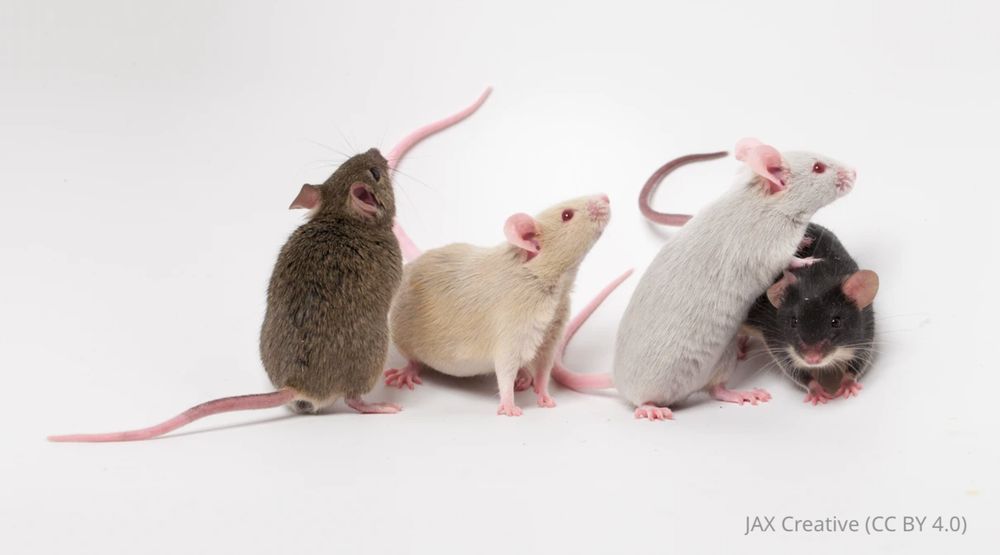
Turns out, two of pain’s most famous messengers — Substance P and CGRPα — might not be so essential after all. Mice missing both still felt pain just fine, challenging decades of assumptions about how pain signals travel.
buff.ly/ypISrtx
buff.ly/ypISrtx
June 1, 2025 at 8:21 AM
Turns out, two of pain’s most famous messengers — Substance P and CGRPα — might not be so essential after all. Mice missing both still felt pain just fine, challenging decades of assumptions about how pain signals travel.
buff.ly/ypISrtx
buff.ly/ypISrtx

Reposted by Luca Barlassina

5 years since our first pilot, and 25,000 participants later, I'm super happy this work with Makaela Nartker, @chazfirestone.bsky.social and Howard Egeth on inattentional blindness is now out in eLife! A little 🧵 of what we found... 1/12 elifesciences.org/articles/100...

Sensitivity to visual features in inattentional blindness
As a group, inattentionally blind participants can successfully report the location, color, and shape of stimuli they deny noticing, and exhibit a systematic bias to report not noticing.
elifesciences.org
May 20, 2025 at 1:16 PM
5 years since our first pilot, and 25,000 participants later, I'm super happy this work with Makaela Nartker, @chazfirestone.bsky.social and Howard Egeth on inattentional blindness is now out in eLife! A little 🧵 of what we found... 1/12 elifesciences.org/articles/100...
Reposted by Luca Barlassina
Researchers have known for decades that chimpanzees drum, but two new studies show that the animals drum to a distinct beat—which varies across their societies.
Learn more: scim.ag/3YJ7R9r
Learn more: scim.ag/3YJ7R9r
May 14, 2025 at 7:11 PM
Researchers have known for decades that chimpanzees drum, but two new studies show that the animals drum to a distinct beat—which varies across their societies.
Learn more: scim.ag/3YJ7R9r
Learn more: scim.ag/3YJ7R9r
Reposted by Luca Barlassina

The essay by @awaisaftab.bsky.social does a fine job of describing how cliff-edge fitness functions may explain vulnerability to some diseases. For an accessible Psychology Today article on the topic, see the link below. www.researchgate.net/publication/...
May 11, 2025 at 11:11 AM
The essay by @awaisaftab.bsky.social does a fine job of describing how cliff-edge fitness functions may explain vulnerability to some diseases. For an accessible Psychology Today article on the topic, see the link below. www.researchgate.net/publication/...
Laurenz Casser on whether objective pain measurement is possible. He says, "No, it is not" #philsky #psysky #pain

Objective pain score? Here’s the problem with that
The problem of pain measurement is not technological, but philosophical. Biomarkers won’t solve it.
theconversation.com
May 8, 2025 at 5:35 PM
Reposted by Luca Barlassina
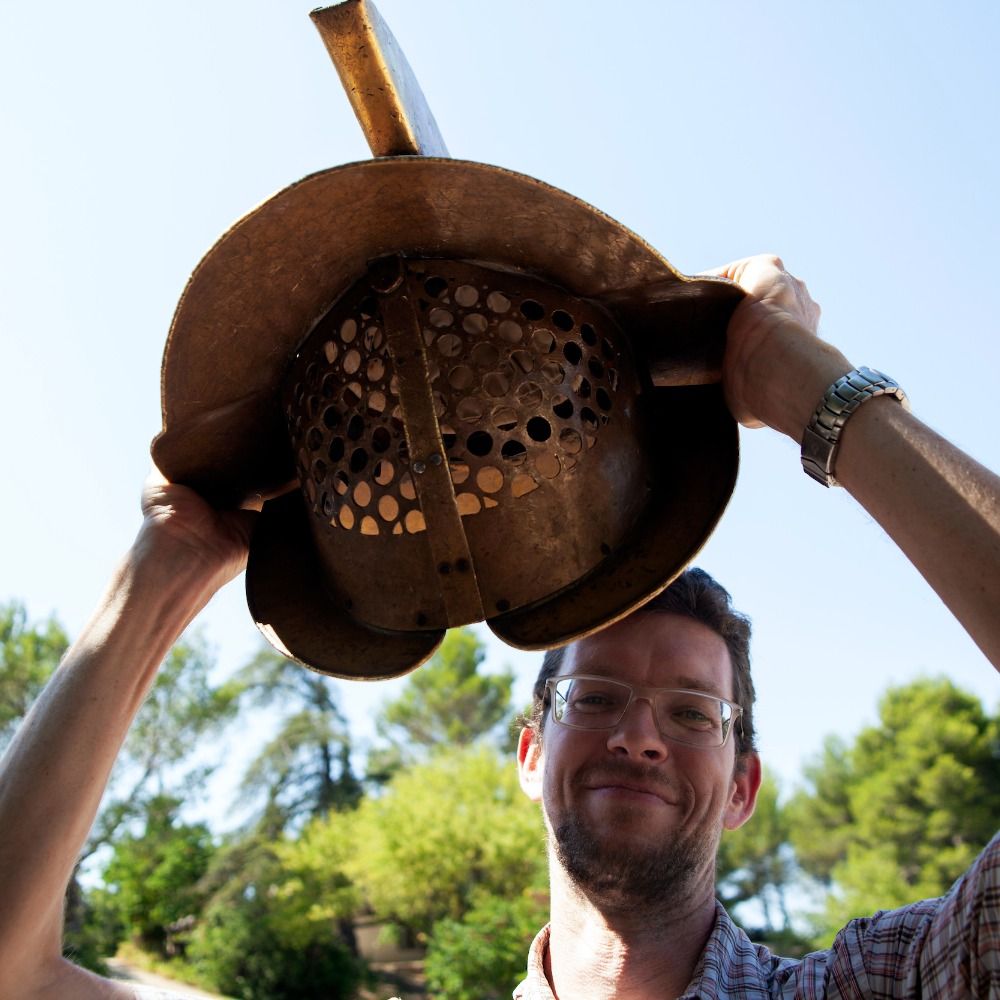
Between 1637 and 1697, people who died at Milan's biggest hospital were dropped into underground vaults. Now their remains (including nearly 3 million bones & preserved brains) are helping archaeologists reconstruct the lives, diet and drug habits of people historians often overlook. @science.org

Thousands buried in 17th century Italian crypt reveal lives of working poor
Remains recovered from beneath a Milan hospital shed light on health, diet, and drug habits during the 1600s
www.science.org
May 2, 2025 at 2:01 PM
Between 1637 and 1697, people who died at Milan's biggest hospital were dropped into underground vaults. Now their remains (including nearly 3 million bones & preserved brains) are helping archaeologists reconstruct the lives, diet and drug habits of people historians often overlook. @science.org
Reposted by Luca Barlassina

Are we “strangers to ourselves”? Classic theories say people have limited insight into how they decide. Our new paper at @natcomms.nature.com challenges this view. With @rcarl.bsky.social sky.social, @hedykober.bsky.social y.social, and @mjcrockett.bsky.social
www.nature.com/articles/s41...
🧵
www.nature.com/articles/s41...
🧵
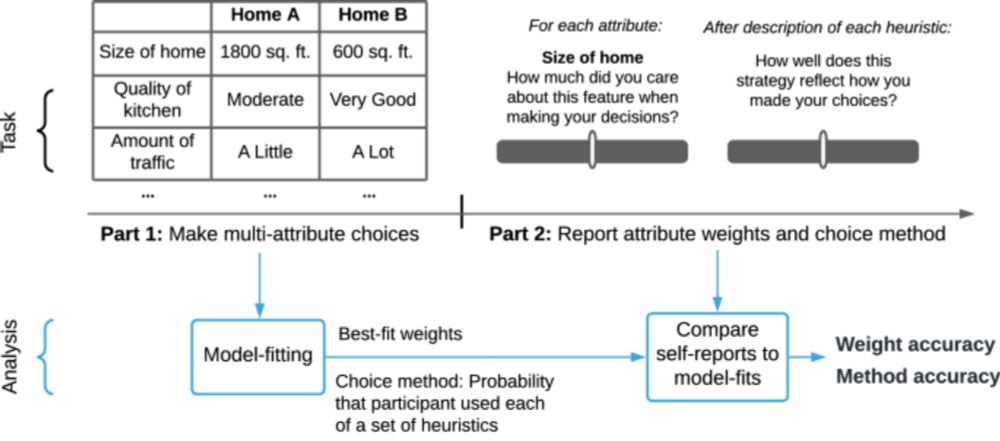
Introspective access to value-based multi-attribute choice processes - Nature Communications
People routinely choose between multi-attribute options, such as which movie to watch. Here, the authors show people often have accurate insight into their choices, challenging the notion that people ...
www.nature.com
April 30, 2025 at 2:16 PM
Are we “strangers to ourselves”? Classic theories say people have limited insight into how they decide. Our new paper at @natcomms.nature.com challenges this view. With @rcarl.bsky.social sky.social, @hedykober.bsky.social y.social, and @mjcrockett.bsky.social
www.nature.com/articles/s41...
🧵
www.nature.com/articles/s41...
🧵