



Alejandro Fernández-Roldán
@aleferna.bsky.social
Postdoctoral Researcher at Universitat Autònoma de Barcelona | Political behaviour, public opinion and philosophy of social sciences.
Personal news! 📣
I'm very happy to share that today I've joined @dec-gr.bsky.social as a postdoc to work on the @tact-forsed.bsky.social project, studying conspiracy beliefs and democratic backsliding across Europe.
Grateful to @galais.bsky.social and @mguinjoan.bsky.social for the opportunity!
I'm very happy to share that today I've joined @dec-gr.bsky.social as a postdoc to work on the @tact-forsed.bsky.social project, studying conspiracy beliefs and democratic backsliding across Europe.
Grateful to @galais.bsky.social and @mguinjoan.bsky.social for the opportunity!

December 1, 2025 at 10:18 AM
Personal news! 📣
I'm very happy to share that today I've joined @dec-gr.bsky.social as a postdoc to work on the @tact-forsed.bsky.social project, studying conspiracy beliefs and democratic backsliding across Europe.
Grateful to @galais.bsky.social and @mguinjoan.bsky.social for the opportunity!
I'm very happy to share that today I've joined @dec-gr.bsky.social as a postdoc to work on the @tact-forsed.bsky.social project, studying conspiracy beliefs and democratic backsliding across Europe.
Grateful to @galais.bsky.social and @mguinjoan.bsky.social for the opportunity!
A hidden gem for PolSci in an Econ journal: mainstream right-wing parties seem to capture only a fraction (!) of the far-right vote when the latter don't run in an election. Crucially, left parties seem to gain votes! A key finding for understanding potential coalitions doi.org/10.1016/j.jp...

November 28, 2025 at 11:22 AM
A hidden gem for PolSci in an Econ journal: mainstream right-wing parties seem to capture only a fraction (!) of the far-right vote when the latter don't run in an election. Crucially, left parties seem to gain votes! A key finding for understanding potential coalitions doi.org/10.1016/j.jp...
My monthly reminder ☝️

October 13, 2025 at 12:16 PM
My monthly reminder ☝️
Note: While NCReport has its own house effects and there are differences in sampling and non-sampling procedures between the two houses, in an upcoming paper @klaramueller.bsky.social and I show that CIS' deviation from all the other national polls is both weighty and consistent. E.g., see below 🙃


September 11, 2025 at 11:40 AM
Note: While NCReport has its own house effects and there are differences in sampling and non-sampling procedures between the two houses, in an upcoming paper @klaramueller.bsky.social and I show that CIS' deviation from all the other national polls is both weighty and consistent. E.g., see below 🙃
Ever struggle to explain why your research is relevant? Sometimes the data just does it for you! 👇
Has anyone seen a more dramatic poll discrepancy than this one from Spain nationwide polling? CIS has PSOE +9.0pp, while NCReport has PP +9.4pp *over the exact same fieldwork*! 🤯😅
Has anyone seen a more dramatic poll discrepancy than this one from Spain nationwide polling? CIS has PSOE +9.0pp, while NCReport has PP +9.4pp *over the exact same fieldwork*! 🤯😅

September 11, 2025 at 11:40 AM
Ever struggle to explain why your research is relevant? Sometimes the data just does it for you! 👇
Has anyone seen a more dramatic poll discrepancy than this one from Spain nationwide polling? CIS has PSOE +9.0pp, while NCReport has PP +9.4pp *over the exact same fieldwork*! 🤯😅
Has anyone seen a more dramatic poll discrepancy than this one from Spain nationwide polling? CIS has PSOE +9.0pp, while NCReport has PP +9.4pp *over the exact same fieldwork*! 🤯😅
Back in Exeter for the first time since my first PhD visiting stay! I'm thrilled to be presenting joint research on election polling with @klaramueller.bsky.social at the @psaepop.bsky.social Conference tomorrow. So looking forward to this panel full of great scholars

September 4, 2025 at 11:51 AM
Back in Exeter for the first time since my first PhD visiting stay! I'm thrilled to be presenting joint research on election polling with @klaramueller.bsky.social at the @psaepop.bsky.social Conference tomorrow. So looking forward to this panel full of great scholars
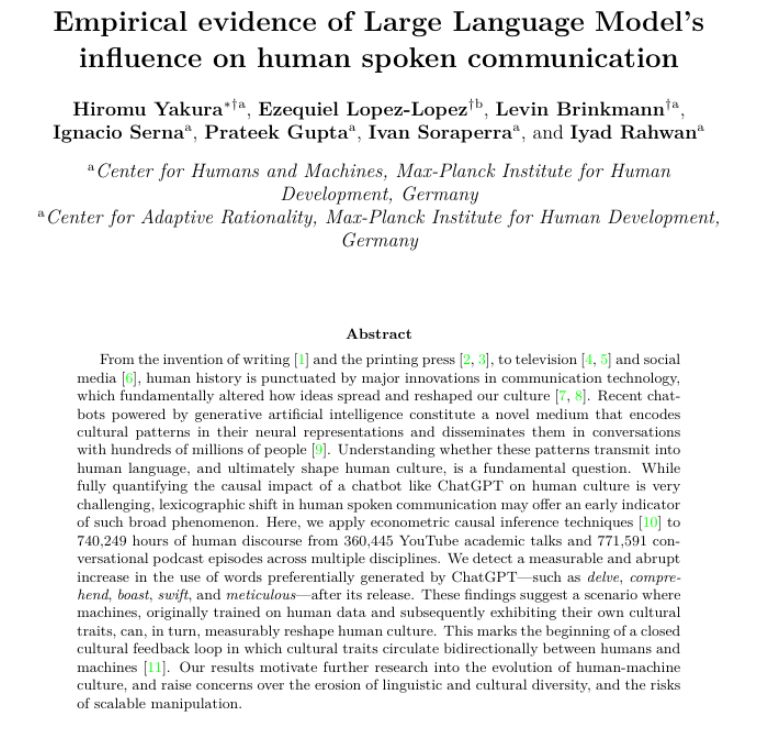
Just discovered that ChatGPT writes as I did during my masters (maybe even early PhD): trying to use grandiloquent words to compensate for a lack of depth in my writing(s)
August 1, 2025 at 2:10 PM
Just discovered that ChatGPT writes as I did during my masters (maybe even early PhD): trying to use grandiloquent words to compensate for a lack of depth in my writing(s)
(3)
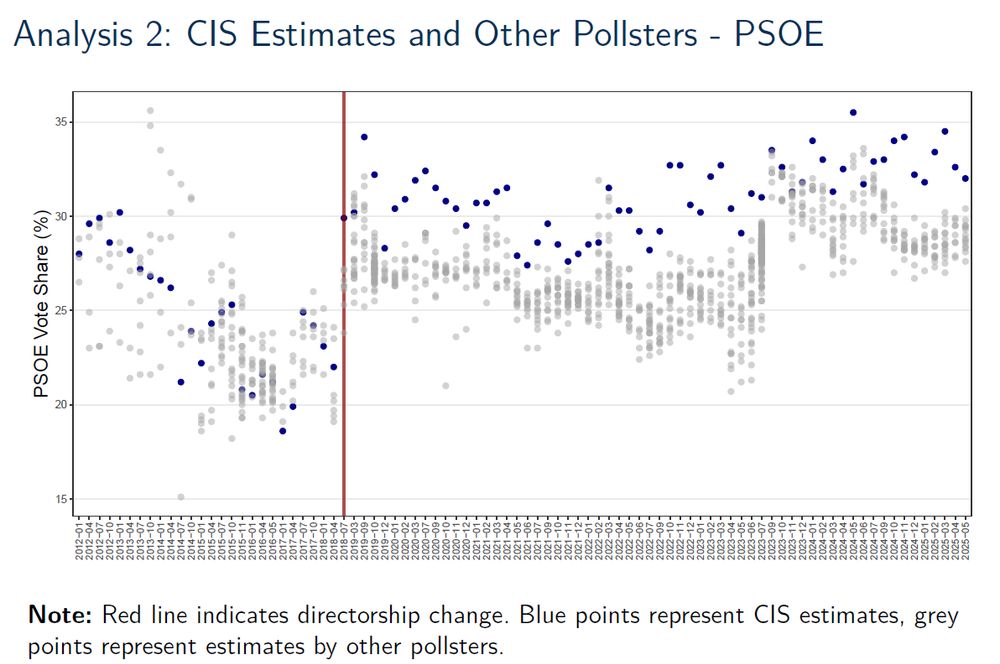
Certainly not to the surprise of those familiar Spanish politics, we find that since 2018 CIS systematically errs in *just* one direction: favouring government parties and allies
PS: This plot is merely to pique your interest (the cool ones to be revealed during the presentation! 🙃)
Certainly not to the surprise of those familiar Spanish politics, we find that since 2018 CIS systematically errs in *just* one direction: favouring government parties and allies
PS: This plot is merely to pique your interest (the cool ones to be revealed during the presentation! 🙃)
June 25, 2025 at 9:59 AM
(3)
Certainly not to the surprise of those familiar Spanish politics, we find that since 2018 CIS systematically errs in *just* one direction: favouring government parties and allies
PS: This plot is merely to pique your interest (the cool ones to be revealed during the presentation! 🙃)
Certainly not to the surprise of those familiar Spanish politics, we find that since 2018 CIS systematically errs in *just* one direction: favouring government parties and allies
PS: This plot is merely to pique your interest (the cool ones to be revealed during the presentation! 🙃)
(3)
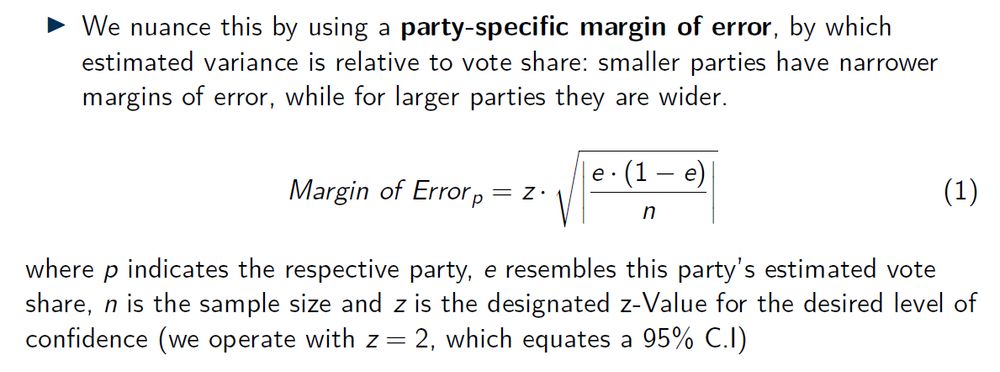
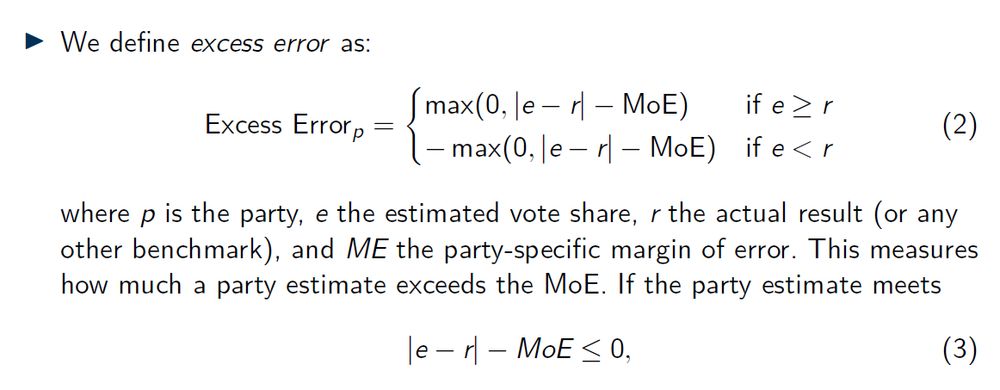
Crucially, beyond Simple Absolute Error estimation, we provide estimates that take into account Party-Specific Margin of Error", which are not frequently used (wrong!) in the literature.
This allows us then to obtain very nuanced results through another novel lens: Excess Error (!)
Crucially, beyond Simple Absolute Error estimation, we provide estimates that take into account Party-Specific Margin of Error", which are not frequently used (wrong!) in the literature.
This allows us then to obtain very nuanced results through another novel lens: Excess Error (!)
June 25, 2025 at 9:59 AM
(3)
Crucially, beyond Simple Absolute Error estimation, we provide estimates that take into account Party-Specific Margin of Error", which are not frequently used (wrong!) in the literature.
This allows us then to obtain very nuanced results through another novel lens: Excess Error (!)
Crucially, beyond Simple Absolute Error estimation, we provide estimates that take into account Party-Specific Margin of Error", which are not frequently used (wrong!) in the literature.
This allows us then to obtain very nuanced results through another novel lens: Excess Error (!)
(2)
The second is joint work with @prossertj.bsky.social and @jaclarner.bsky.social
Much research has investigated whether voter motivations are self-interested or sympathetic to certain groups. But few studies have addressed self-interest and sociotropy and social policy motivations. We do!
The second is joint work with @prossertj.bsky.social and @jaclarner.bsky.social
Much research has investigated whether voter motivations are self-interested or sympathetic to certain groups. But few studies have addressed self-interest and sociotropy and social policy motivations. We do!

June 25, 2025 at 9:59 AM
(2)
The second is joint work with @prossertj.bsky.social and @jaclarner.bsky.social
Much research has investigated whether voter motivations are self-interested or sympathetic to certain groups. But few studies have addressed self-interest and sociotropy and social policy motivations. We do!
The second is joint work with @prossertj.bsky.social and @jaclarner.bsky.social
Much research has investigated whether voter motivations are self-interested or sympathetic to certain groups. But few studies have addressed self-interest and sociotropy and social policy motivations. We do!
(1)
We find that these calls led to a remarkable reduction (!) in vote intention uncertainty across cases (2025 German Federal Election and 2024 UK General Election), though we observe *important* singularities in each context. Come see the presentation to find them out 🙃
#EPSA2025
We find that these calls led to a remarkable reduction (!) in vote intention uncertainty across cases (2025 German Federal Election and 2024 UK General Election), though we observe *important* singularities in each context. Come see the presentation to find them out 🙃
#EPSA2025

June 25, 2025 at 9:59 AM
(1)
We find that these calls led to a remarkable reduction (!) in vote intention uncertainty across cases (2025 German Federal Election and 2024 UK General Election), though we observe *important* singularities in each context. Come see the presentation to find them out 🙃
#EPSA2025
We find that these calls led to a remarkable reduction (!) in vote intention uncertainty across cases (2025 German Federal Election and 2024 UK General Election), though we observe *important* singularities in each context. Come see the presentation to find them out 🙃
#EPSA2025
(1)
The first one is joint work with @klaramueller.bsky.social.
In it, we examine how snap election *calls* affect vote intention uncertainty, estimated through “Don’t Know” responses in large public opinion surveys.
The first one is joint work with @klaramueller.bsky.social.
In it, we examine how snap election *calls* affect vote intention uncertainty, estimated through “Don’t Know” responses in large public opinion surveys.


June 25, 2025 at 9:59 AM
(1)
The first one is joint work with @klaramueller.bsky.social.
In it, we examine how snap election *calls* affect vote intention uncertainty, estimated through “Don’t Know” responses in large public opinion surveys.
The first one is joint work with @klaramueller.bsky.social.
In it, we examine how snap election *calls* affect vote intention uncertainty, estimated through “Don’t Know” responses in large public opinion surveys.
Unfortunately, I won't be able to participate in #EPSA2025 😔 - But as I'm coauthor of 3 pieces that will be presented, I feel compelled to share the details in case you're interested in any! - A thread follows 🧵
@epsanet.bsky.social
PS: Sadly, 2 of the presentations clash in date and time
@epsanet.bsky.social
PS: Sadly, 2 of the presentations clash in date and time


June 25, 2025 at 9:59 AM
Unfortunately, I won't be able to participate in #EPSA2025 😔 - But as I'm coauthor of 3 pieces that will be presented, I feel compelled to share the details in case you're interested in any! - A thread follows 🧵
@epsanet.bsky.social
PS: Sadly, 2 of the presentations clash in date and time
@epsanet.bsky.social
PS: Sadly, 2 of the presentations clash in date and time
Last week, I successfully defended my doctoral thesis at UC3M, and am thrilled to announce that I'm [finally] a doctor (!) cum laude🎓🥳 - Immense thanks to my three examiners (@mcuanti.bsky.social, Homero Gil de Zúñiga & Alberto Ardèvol-Abreu) for their insightful feedback and engaging discussion!


September 23, 2024 at 4:52 PM
Last week, I successfully defended my doctoral thesis at UC3M, and am thrilled to announce that I'm [finally] a doctor (!) cum laude🎓🥳 - Immense thanks to my three examiners (@mcuanti.bsky.social, Homero Gil de Zúñiga & Alberto Ardèvol-Abreu) for their insightful feedback and engaging discussion!
Popping in only to say that #ecprgc24 is my final conference as a PhD candidate, and I’m absolutely enjoying it @ecpr.bsky.social - Grateful for the opportunity to present my research here!


August 14, 2024 at 11:33 AM
Popping in only to say that #ecprgc24 is my final conference as a PhD candidate, and I’m absolutely enjoying it @ecpr.bsky.social - Grateful for the opportunity to present my research here!